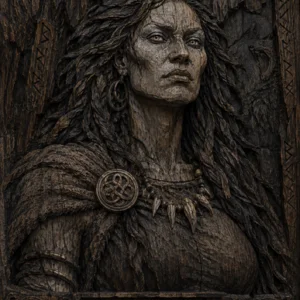

A legendary figure from Ethiopian oral tradition, Hagere is portrayed as a founding queen whose name means "land" or "homeland" in Ge'ez and Amharic. Associated with the mythic origins of the Solomonic dynasty, she embodies in Ethiopian oral narratives the idea of the mother-land and sacred sovereignty.
Hagere
Hagere
8 min read
Frequently asked questions
Key Facts
- Her name "Hagere" means "land" or "homeland" in Ge'ez and Amharic, making her a living allegory of the Ethiopian nation according to oral tradition.
- Oral narratives connect her to the Solomonic lineage, whose restoration is dated to around 1270 with Yekuno Amlak, though her figure predates this period in collective memory.
- Unlike historical figures attested by written sources, Hagere belongs exclusively to the oral tradition passed down by Ethiopian bards and storytellers known as azmaris.
- Her myth is part of a broader set of founding narratives linked to the Queen of Sheba (Makeda) and King Solomon — cornerstones of Ethiopian national identity.
- Information about this figure comes solely from oral traditions; no medieval written source directly attests to her under this name.
Works & Achievements
According to oral accounts, Hagere is said to have established the first pacts between humans and the Ethiopian land, defining agrarian rites and the obligations of rulers toward their people.
Azmaris dedicated sung poems accompanied by the masinko (a single-stringed fiddle) to the figure of Hagere, preserving her memory across generations of itinerant poet-musicians.
A ritual practice attributed to Hagere's teachings, consisting of pouring tej or mead onto the ground before sowing in order to win the favor of the earth-mother.
A founding narrative in which Hagere, standing atop a sacred peak, embodies the resistance of the Ethiopian people and the indestructibility of the homeland in the face of invasion — passed down during communal evening gatherings.
Anecdotes
In the oral traditions of the Ethiopian highlands, Hagere is not simply a character: she is the land itself made woman. Storytellers say that when she set foot on the ground, springs would burst forth and seeds would sprout. Her name, meaning 'country' in Ge'ez, reminds us that a people's identity can be embodied in a founding female figure.
According to some accounts passed down by azmaris (Ethiopian poet-musicians), Hagere refused to flee when invaders threatened her lands. She is said to have remained at the summit of a mountain, dressed in white, until her warriors returned victorious. This act of faithfulness to the land is still invoked in wedding songs as a symbol of rootedness.
Oral traditions linked to the Solomonic restoration (around 1270) sometimes cast Hagere as a mystical ancestor of the Ethiopian kings, predating even the Queen of Sheba. She is said to have forged an alliance with the mountain spirits — the zar — to ensure the kingdom's fertility, thus uniting celestial and earthly powers in the person of the sovereign.
In some villages of Tigray and Amhara, agrarian ceremonies still refer to an unnamed 'mother-homeland' that ethnologists have sometimes linked to the figure of Hagere. Libations of tej (honey wine) are offered to the earth before sowing, perpetuating a gesture that tradition attributes to this legendary founding queen.
Primary Sources
A foundational text of the Ethiopian tradition written in Ge'ez, recounting the origins of the Solomonic dynasty through the story of the Queen of Sheba and Solomon. It provides the mythical framework within which founding female figures such as Hagere are situated.
A corpus of songs and epic poems transmitted orally by the azmaris, itinerant poet-musicians of Ethiopia. Some evoke a primordial earth-queen whose name varies by region, sometimes identified with Hagere.
A collection of royal chronicles written in Ge'ez documenting the history of the Ethiopian dynasties. They mention tutelary female figures associated with the origins of royal power, providing a backdrop to the oral traditions surrounding Hagere.
The Ethiopian Jewish communities preserve parallel accounts of queen-founders linked to the land and sacred sovereignty, enriching our understanding of mythical figures such as Hagere within the context of pre-Christian beliefs on the Ethiopian highlands.
Key Places
A high-altitude territory where Ethiopia's great oral traditions developed. It is in these landscapes of mountains and valleys that the stories of Hagere take root, connected to the fertility of the red volcanic soil.
A sacred city in northern Ethiopia and former capital of the Aksumite Kingdom. It preserves towering stone stelae and, according to Ethiopian tradition, the Ark of the Covenant — forming the mythical backdrop against which Hagere's story unfolds.
Home to eleven rock-hewn churches carved from solid stone in the 12th and 13th centuries, Lalibela is a major center of medieval Ethiopian spirituality. The ceremonies held there sustain a symbolic bond between land, sovereignty, and the sacred.
The source of the Blue Nile and home to numerous island monasteries. Oral traditions place protective feminine figures here — guardians of water and earth — closely mirroring the image of Hagere as a nurturing mother.
A royal city built in the 17th century yet heir to the traditions of the medieval highlands. The azmari musicians of Gondar are among the chief keepers of the epic narratives that invoke Hagere.
Liens externes & ressources
Références
Œuvres
Fondation mythique du royaume-terre
tradition orale, époque médiévale
Corpus de chants épiques (masinko)
transmis oralement depuis le Moyen Âge éthiopien
Rites de libation à la terre (sem)
tradition continue
Mythe de la reine-montagne
tradition orale médiévale