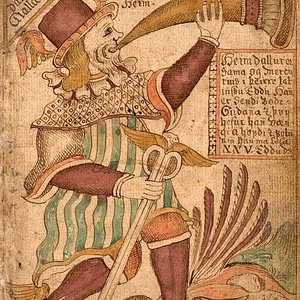

Heimdall is the guardian god of the Aesir in Norse mythology. Sentinel of the gods, he watches over the Bifröst bridge connecting the realms and will sound the Gjallarhorn to herald Ragnarök. He is associated with dawn, light, and vigilance.
Heimdall
Heimdall
8 min read
Frequently asked questions
Key Facts
- Heimdall is described in the Prose Edda (c. 1220) by Snorri Sturluson as the watchman of the Aesir gods
- He possesses extraordinary sensory abilities: he can hear grass growing and see in complete darkness
- He guards the Bifröst bridge, the boundary between Asgard (the realm of the gods) and the other worlds
- His most iconic attribute is the Gjallarhorn, a horn whose blast will ring out at Ragnarök to summon the gods to the final battle
- He is the sworn enemy of Loki; the two gods are fated to kill each other during Ragnarök
Works & Achievements
Heimdall's fundamental cosmic mission: to watch over the bridge between worlds and prevent the giants of Jötunheim from invading Asgard. This eternal vigilance is his most important role in Norse cosmology.
Traveling among humans under the name Ríg, Heimdall fathers the ancestors of the three orders of Norse society: thralls, free farmers, and noble warriors, thereby shaping the structure of human civilization.
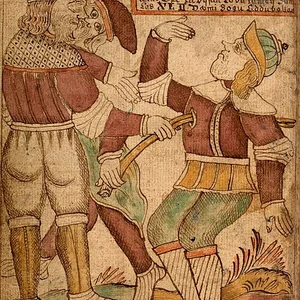
A heroic battle against Loki in the form of seals to recover the magical necklace of the goddess Freyja. This victory illustrates his role as protector of sacred treasures and divine beings.
The ultimate act foretold by the Völuspá: Heimdall will sound his great horn to summon the gods and the Einherjar warriors before the final battle, heralding the end of the Norse world.
A fate sealed in advance: Heimdall and Loki, eternal enemies, will slay each other at Ragnarök. This duel symbolizes the triumph of order over chaos, even at the cost of both combatants' lives.
Anecdotes
Heimdall possesses extraordinary sensory abilities: he can see as far as a hundred leagues both day and night, hear grass growing in the meadows and wool growing on sheep. He sleeps so little that he is described as barely sleeping at all — absolute vigilance in the service of the gods.
According to the poem Rígsþula from the Poetic Edda, Heimdall travels through Midgard under the name Ríg and visits three human households in turn. From his unions with three women are born the ancestors of the three classes of Norse society: the thralls (slaves), the karls (free farmers), and the jarls (noble warriors).
In a mythic confrontation, Heimdall and Loki both transformed into seals to fight on a rock at the edge of the sea. What was at stake was the Brísingamen necklace of the goddess Freyja, which Loki had stolen. Heimdall won the struggle and returned the jewel to Freyja.
Heimdall's Gjallarhorn is one of the most feared weapons in the Norse cosmos: when it sounds at full power, its echo will travel across the Nine Worlds and awaken all the gods for the battle of Ragnarök. It is said that the horn is sometimes hidden beneath the roots of the cosmic tree Yggdrasil.
Heimdall was born of nine mothers, all described as wave-giantesses or daughters of the sea. This mysterious detail ties him to the primordial ocean and to the boundary between the world of the gods and that of nature's primal forces.
Primary Sources
Hljóðs bið ek allar helgar kindir [...] Heimdallr, þess er hvítastr ása — I ask for silence from all sacred races [...] Heimdall, the whitest of the Æsir.
Gengr þar líðandi löndum á miðjum líknsamr ásinn er Rígr heitir — Striding thus, through the middle of the lands, walked the benevolent god who is called Ríg.
There is a god named Heimdall. He is called the White. He is great and holy. He rides a horse called Gulltoppr. He dwells in a place called Himinbjörg, near the Bifröst bridge. He is the watchman of the gods.
Þegi þú, Heimdallr! Þér var í árdaga örmlig líf um lagið; aurgo baki skalt þú æ vera ok vaka vörðr goða — Be silent, Heimdall! Since ancient times, a wretched life has been laid upon you: forever mud-backed, you must keep watch as guardian of the gods.
A skaldic fragment describing Heimdall and Loki fighting in the form of seals over possession of Freyja's Brísingamen, quoted in Snorri Sturluson's Skáldskaparmál.
Key Places
Heimdall's dwelling, located at the peak of the sky at the edge of the Bifröst bridge. It is from this palace that he keeps constant watch over all approaches to Asgard.
A shimmering bridge of three colors connecting Asgard to the world of men. Heimdall is its absolute guardian, preventing the giants from crossing it.
The celestial realm where the Norse gods reside. Heimdall protects it tirelessly from his watchtower post on the Bifröst, standing guard over his divine peers.
The kingdom of mortal men, which Heimdall travels under the name Ríg in the Rígsþula. It is here that he fathers the three classes of Norse humanity.
The vast mythical battlefield where the final battle will take place. It is here that Heimdall and Loki will face each other one last time and slay one another.
Typical Objects

Heimdall's war horn, whose sound can carry across all Nine Worlds. It is destined to herald Ragnarök when Heimdall blows it at full power to summon all the gods.

Heimdall's sword, whose mysterious name means 'head'. Some scholars believe it symbolizes the severing between worlds, or the sharp vigilance of the guardian god.

Heimdall's white horse, whose name means 'golden mane'. It embodies the speed and solar radiance associated with the god of dawn and light.

Heimdall has teeth made of gold, a distinctive trait that earns him the nickname 'the Gold-Toothed God'. This detail sets him apart visually and reinforces his association with light and precious worth.

Heimdall is described as the 'whitest of the Aesir' and wears a spotless white cloak, a symbol of his purity, his role as guardian, and his connection to dawn and the morning light.

Though it belongs to Freyja, this magical necklace lies at the heart of the conflict between Heimdall and Loki. Heimdall retrieves it after a titanic battle in the form of seals, proving his role as protector of the divine treasures.
School Curriculum
Vocabulary & Tags
Key Vocabulary
Daily Life
Morning
At dawn — his favorite time of day — Heimdall sweeps his gaze across the horizon of the Nine Worlds from the heights of Himinbjörg. His piercing eyes catch every movement on the Bifröst and around the borders of Asgard, carefully noting any potential intruder coming from Jötunheim.
Afternoon
During the long daylight hours, Heimdall patrols the Bifröst bridge on his horse Gulltoppr, checking the condition of the magical structure and scanning the horizon. He sometimes receives emissaries who request passage to Asgard, rigorously enforcing the divine rules of entry.
Evening
At dusk, Heimdall remains at his post, listening for the faintest sounds: he can hear grass growing from miles away and make out the whispers of giants in their distant fortresses. He drinks mead in his hall at Himinbjörg while maintaining his eternal vigilance.
Food
Heimdall feeds primarily on the celestial mead shared with the other gods at the feasts of Asgard. His diet is described as pure and radiant, in keeping with his nature as the god of the dawn; some traditions also mention that he sustains himself on the morning dew.
Clothing
Heimdall wears immaculate white armor adorned with golden accents, a reflection of his title 'the White God of the Aesir.' He sports a pale cloak with a pearlescent sheen and a sword belt from which his sword Hofuð hangs. His golden teeth gleam as a mark of his divine and precious nature.
Housing
Heimdall dwells at Himinbjörg ('The Cliffs of Heaven'), a palace built at the top of the sky at the very edge of Asgard, right beside the Bifröst bridge. This strategic location allows him to watch over every approach to the divine realm, combining the security of a fortress with the openness of a cosmic observatory.
Historical Timeline
Period Vocabulary
Visual Style
Esthétique nordique lumineuse et monumentale : armure blanche et or, pont arc-en-ciel irisé, aurores boréales pâles — entre le réalisme fantastique illustratif et la peinture épique romantique.
Sound Ambience
Ambiance de l'aube nordique et des hauteurs célestes : vent sur les falaises du ciel, cascade du Bifröst arc-en-ciel et résonnance lointaine du Gjallarhorn veillant sur les Neuf Mondes.
Liens externes & ressources
Références
Œuvres
Gardiennage éternel du pont Bifröst
Temps mythiques
Création des classes sociales (Rígsþula)
Temps mythiques
Récupération du Brísingamen
Temps mythiques
Sonnerie du Gjallarhorn au Ragnarök
Fin des temps (prophétie)
Combat final contre Loki
Fin des temps (prophétie)