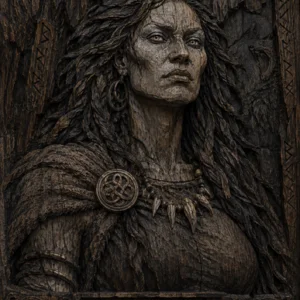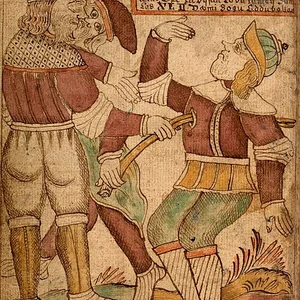

In Norse mythology, Hel is the daughter of Loki and the giantess Angrboða. Goddess of the dead, she rules over Niflheim (or Helheim), the underworld realm where those who died of illness or old age dwell. Her very name refers both to the deity and to the realm she governs.
Hel
Hel
9 min read
Frequently asked questions
Key Facts
- Daughter of Loki (god of trickery) and Angrboða (a giantess), and sister of the wolf Fenrir and the serpent Jörmungandr — a family symbolizing the forces of chaos in Norse mythology
- Odin entrusts her with rulership over Niflheim, the realm of those who died without glory (through illness, old age, or accident), as opposed to Valhalla, reserved for warriors slain in battle
- Her body is described as half-living, half-dead: one side of normal flesh, the other black or blue — symbolizing the boundary between life and death
- She plays a central role in the myth of the death of Baldr (Odin's son): despite the gods' pleas, she refuses to release the god's soul as long as a single being in the world refuses to weep for him
- Her name gave rise to the English word 'Hell', a testament to the influence of Norse mythology on European languages and cultures
Works & Achievements
Hel is charged by Odin with ruling over Niflheim and welcoming all who die of illness, old age, or any death not fallen in battle. This cosmic role makes her an essential figure in the balance between life and death in Norse mythology.
Hel sets the condition for Baldr's release: every living creature must weep for the god of light. This decision seals Baldr's fate until Ragnarök and reveals Hel's absolute power over the destinies of the dead.
At Ragnarök, Hel releases the inhabitants of her realm to board the Naglfar. Her participation in the final battle illustrates her central place in Norse eschatology.
The principal text describing Hel, her appearance, her hall, and her attributes. Snorri Sturluson provides a systematic portrait that remains the primary reference for understanding this mythological figure.
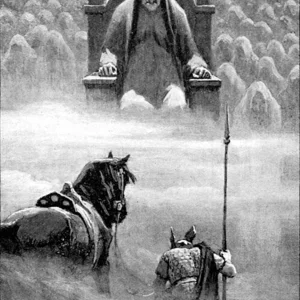
An Eddic poem recounting Odin's journey to the gates of Hel's realm to learn the fate of Baldr. It offers a striking image of Niflheim and of Hel's power.
A great cosmogonic and eschatological poem evoking Niflheim and Hel's role in the end of the world. One of the most important texts in the Eddic tradition.
Anecdotes
According to Snorri Sturluson's Prose Edda, Odin himself entrusted Hel with the governance of Niflheim and power over all who died of illness or old age. This division of the world among the gods reflects the Norse cosmic order: warriors who fell in battle went to Valhöll, while the vast majority of mortals fell under Hel's domain.
Hel is described as having a striking appearance: one half of her body is that of a living woman, while the other half is bluish or blackish, evoking the flesh of a corpse. This physical duality symbolizes her nature as the boundary between the world of the living and the realm of the dead.
After the death of the god Baldr, the Æsir sent Hermóðr riding to Niflheim to beg Hel to release the beloved god. Hel agreed to free him on one condition: that every being in the world, living and dead, weep for Baldr. The giantess Þökk — most likely Loki in disguise — refused to shed a tear, and Baldr remained a prisoner of the underworld until Ragnarök.
The name 'Hel' is the origin of the English word 'Hell,' but the Norse Hélheim is not a place of punishment — it is simply the abode of the ordinary dead. This distinction is important for understanding that the Norse vision of the afterlife carries no moral judgment, unlike the Christian conceptions that later shaped the language.
In the Eddic texts, Hel rules a vast domain containing a hall called Éljúðnir ('Damp with Sleet'), a plate called Hungr ('Hunger'), a knife called Sultr ('Famine'), and a bed called Kör ('Sickness'). These symbolic furnishings make her hall a grim, inverted mirror of the grand feasting halls of the gods.
Primary Sources
Hel was cast into Niflheim, and authority was given to her over nine worlds, so that she should allot abodes to all those who were sent to her: those who died of illness or old age.
Odin rode into the depths and reached the high hall of Hel; he saw the benches strewn with gold, where Hel awaited her illustrious guest.
I see a hall far from the sun, on the shores of Náströnd; its doors face north. Drops of venom fall through the smoke-vents.
Hermóðr rode nine nights through dark and deep valleys, seeing nothing, until he reached the river Gjöll and crossed the bridge covered in gleaming gold.
Loki addressed the gods and invoked his children: the wolf Fenrir, the serpent Miðgarðsormr, and Hel who rules over the dead.
Key Places
The underworld kingdom ruled by Hel, located in the frozen depths of the Norse cosmos. This is where ordinary dead souls dwell, in a state of eternal semi-darkness.
It was in Iceland that Norse myths, including those about Hel, were first committed to writing in the 12th and 13th centuries, most notably by Snorri Sturluson at Reykholt. The island is the primary keeper of Norse mythology.
The estate of Snorri Sturluson, author of the Prose Edda (c. 1220), a major source on Hel and Norse cosmology. This site represents the transition from oral Scandinavian tradition to the written word.
A major religious center of medieval Scandinavia, where the Norse gods were worshipped. The temple at Uppsala was one of the places where myths involving Hel and the Norse cosmos were recited during great gatherings.
A mythical river separating the world of the living from Niflheim, crossed by the bridge Gjallarbru. Its name echoes throughout the Eddic tradition as the ultimate boundary of existence.
Typical Objects

The funeral ship built from the nails and hair of the dead. At Ragnarök, Hel uses it to carry the deceased from her realm to the final battle against the gods.

A gold-covered bridge spanning the river Gjöll at the gates of Niflheim. Guarded by the giantess Móðguðr, it marks the impassable boundary between the world of the living and Hel's realm.

Furnishings at Hel's table in her hall Éljúðnir: Hungr means 'Hunger' and Sultr means 'Famine.' These objects embody the bleakness of the realm of the dead, where no food ever truly satisfies.

Hel's bed in her palace bears the name 'Sickness.' It serves as a reminder that the goddess's domain receives those taken by old age and illness, as opposed to the glorious war dead.

The threshold of Hel's hall bears the name 'Stumbling Block,' embodying the irreversible passage between life and death that every mortal must cross.

The gates and barriers of Niflheim hold the dead within Hel's realm. None may leave without her permission, as demonstrated by the failure of Hermóðr's mission to free Baldr.
School Curriculum
Vocabulary & Tags
Key Vocabulary
Daily Life
Morning
Hel begins her day by receiving the newly arrived in her great hall, Éljúðnir. She listens to the stories of the dead — farmers, women, children, the elderly — and assigns each their place in the vast underground realm. Her presence is silent and impartial, neither cruel nor kind.
Afternoon
In the afternoon, Hel sits upon her throne and settles the affairs of her kingdom: who may remain together, who must be kept apart. Unlike the gods of Valhöll who feast and revel, Hel presides over a world of cold stillness, where time no longer flows the same way as it does on the surface.
Evening
In the evening, Hel withdraws to her darkened chambers, attended by servants with symbolic names — Ganglot ('Slow and Shuffling') and Gangleri ('Weary from the Journey'). She waits, patient, knowing that every living being will eventually belong to her.
Food
In the Eddic texts, Hel's table offers only hunger and want — her dish is called Hungr ('Hunger') and her knife Sultr ('Famine'). Food in her domain is purely symbolic of the emptiness of existence after death, neither a true feast nor a true famine.
Clothing
Hel is described as wearing dark, drab garments, in stark contrast to the gleaming finery of the gods of Ásgarðr. Her robes reflect the duality of her nature: on one side, pale fabrics like the skin of the living; on the other, bluish and blackened hues evoking death.
Housing
Hel's dwelling, Éljúðnir ('Misery's Storm'), is a vast underground hall with walls of frozen stone, its gates known as Hélgrind ('The Gates of Hel'). The palace is richly furnished with funereal symbols — its threshold is called 'Precipice of Peril,' and its walls seep with the eternal cold of Niflheim.
Historical Timeline
Period Vocabulary
Visual Style
Esthétique viking sombre et sublime : Hel mi-vivante mi-morte, salles glacées de Niflheim éclairées d'une lumière bleu-vert froide, entrelacs nordiques.
Sound Ambience
Ambiance glaciale et caverneuse du royaume souterrain de Niflheim : vents lointains, gouttes d'eau gelée, silence pesant des morts.
Liens externes & ressources
Références
Œuvres
Gouvernement de Niflheim
Temps mythique
Jugement de Baldr
Temps mythique
Rassemblement des morts pour Ragnarök
Temps mythique (fin des temps)
Edda en prose — Gylfaginning (Snorri Sturluson)
vers 1220
Edda poétique — Baldrs draumar
vers XIIe siècle
Völuspá — La Prophétie de la voyante
vers Xe–XIe siècle