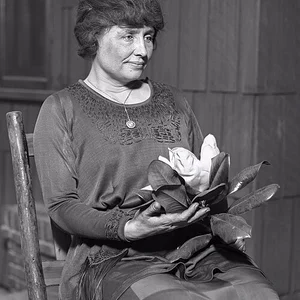

Deaf-blind since the age of 19 months, Helen Keller learned to communicate thanks to her teacher Anne Sullivan and became a writer and activist. She devoted her life to defending the rights of people with disabilities and women.
Helen Keller(1880 — 1968)
Helen Keller
États-Unis
8 min read
Frequently asked questions
Famous Quotes
« Life is either a daring adventure or nothing at all.»
« Alone we can do so little; together we can do so much.»
Key Facts
- 1882: loses her sight and hearing at 19 months following an illness
- 1887: Anne Sullivan becomes her teacher and teaches her to communicate through touch
- 1904: graduates from Radcliffe College, the first deaf-blind person to earn a university degree
- 1903: publishes her autobiography *The Story of My Life*
- 1920: co-founds the ACLU (American Civil Liberties Union)
Works & Achievements
Autobiography written at age twenty-two, tracing her childhood, her illness, and her relationship with Anne Sullivan. Translated into more than fifty languages, it is one of the most widely read works on disability and resilience.
A short philosophical essay in which Helen Keller develops her conviction that hope and human will can triumph over any adversity, including physical.
A collection of essays in which she describes with precision how she perceives the world through touch, smell, and vibration. A foundational text for understanding non-visual sensory perception.
A collection of political writings in which Helen Keller champions socialism, workers' rights, and women's suffrage, revealing that she was far more than an inspirational figure.
An autobiographical sequel covering her adult life, her political commitments, and her travels around the world as an advocate for the rights of people with disabilities.
A biographical tribute to Anne Sullivan, who died in 1936, tracing their unique relationship of more than fifty years and the decisive influence of the teacher on every aspect of Helen's life.
Anecdotes
In April 1887, Anne Sullivan led young Helen, then seven years old, to a water pump in the family garden. She spelled the word 'water' into the child's hand as the water flowed over her fingers. In that instant, Helen suddenly understood that every thing has a name — she ran to touch all the objects around her to learn their words. This moment remains one of the most celebrated scenes in the history of education.
In 1904, Helen Keller earned her Bachelor of Arts degree from Radcliffe College (Harvard), becoming the first deaf-blind person ever to achieve such an academic credential. Throughout her studies, Anne Sullivan sat beside her and spelled lectures into her hand. Exams were written in Braille, and her professors consistently praised the quality of her essays.
Helen Keller became a committed political activist, joining the Socialist Party of America in 1909 and co-founding the American Civil Liberties Union (ACLU) in 1920. When journalists who had once praised her turned critical of her political views, she replied with characteristic wit that those same journalists had found her ideas "brilliant" before they knew she was a socialist.
Mark Twain, who had met her when she was a child, declared she was one of the two most remarkable people of the nineteenth century — the other being Napoleon. He introduced her to financier Henry Rogers, who funded much of her education at Radcliffe. The friendship lasted until Twain's death in 1910.
During a lecture tour in the 1920s, Helen Keller and Anne Sullivan performed on stage in vaudeville theaters across the United States. Helen answered audience questions by speaking aloud — in a voice difficult to understand but unmistakably real — while Anne spelled the questions into her hand. The show allowed them to fund their activist work.
Primary Sources
The most important day I remember in all my life is the one on which my teacher, Anne Mansfield Sullivan, came to me. I am filled with wonder when I consider the immeasurable contrasts between the two lives which it connects.
I have walked with people whose eyes are full of light, but who see nothing in wood, sea, or sky, nothing in city streets, nothing in books. What a witless masquerade is this seeing!
I am no worshipper of cloth of any color, but I love the red flag and what it symbolizes to me and other socialists. I have a little flag; it is not red — it is a rainbow flag.
It is a terrible thing to see and have no vision. The most pathetic person in the world is someone who has sight but no vision.
Security is mostly a superstition. It does not exist in nature, nor do the children of men as a whole experience it. Avoiding danger is no safer in the long run than outright exposure.
Key Places
Helen Keller's birthplace, now a national museum. It was in this garden, at the water pump, that Helen's pivotal awakening to language took place in 1887.
A pioneering institution for the education of the blind where Anne Sullivan had herself studied. Helen stayed there and deepened her learning under the direction of Michael Anagnos.
A women's college affiliated with Harvard where Helen Keller earned her Bachelor of Arts in 1904, becoming the first deaf-blind person to graduate from a higher education institution.
The home where Helen Keller spent the last decades of her life and where she passed away in 1968. The original house having burned down in 1946, a new one was built so she could continue her work.
The federal capital where Helen Keller repeatedly lobbied Congress on behalf of the rights of people with disabilities, women, and workers, and where she received the Presidential Medal of Freedom in 1964.
Typical Objects

A communication technique in which each letter is spelled into the palm of the hand. Anne Sullivan used this method from the very first day, and Helen mastered it so thoroughly that within a few years she could 'read' at a remarkable speed.

Helen Keller acquired most of her general knowledge through braille, in several languages. She owned an extensive personal embossed library and campaigned for braille to be standardized at the national level.

Helen wrote her essays, letters, and books on an adapted typewriter. She also typed in standard print to communicate with readers who were unfamiliar with braille.

The water pump on the family property in Tuscumbia has become a worldwide symbol of inclusive education. It was at this pump that Helen first connected a word to a physical sensation, opening the door to language.

In the final decades of her life, Helen Keller was accompanied by a guide dog — a Japanese Akita given to her during her tour of Japan in 1937. She helped popularize the use of guide dogs in the United States.

Helen Keller owned a small red flag symbolizing her socialist commitments. She mentioned it in her essays as an emblem of her fight for social justice, which earned her sharp criticism from the conservative press.
School Curriculum
Vocabulary & Tags
Key Vocabulary
Tags
Daily Life
Morning
Helen Keller rose early and began her day reading braille — newspapers, letters, books — at a speed her contemporaries found impressive. She would then dictate her correspondence to a secretary or type directly on a typewriter. Anne Sullivan's constant presence at her side, spelling printed content into her hand, was indispensable for any exchange with the outside world.
Afternoon
Afternoons were often devoted to lectures, appearances before Congressional committees, or meetings with association leaders. During lecture tours, Helen would take the stage before hundreds of people, answering audience questions by speaking aloud while Anne relayed the questions to her through finger-spelling. She also enjoyed walking and appreciated contact with nature.
Evening
In the evenings, Helen Keller liked to listen to music by placing her hands on the piano or loudspeakers to feel the vibrations. She wrote her essays and book chapters at night, in the quiet. Conversations with family and friends took place entirely through finger-spelling, a mode of communication that had become perfectly natural for those closest to her.
Food
Helen Keller had simple eating habits, typical of the early twentieth-century American Protestant middle class: roasted meats, vegetables, and homemade breads. She was particularly fond of strong flavors and aromas, her senses of taste and smell being highly developed to compensate for her lack of sight and hearing.
Clothing
Helen Keller wore understated, practical outfits suited to her extensive travels on the lecture circuit. She paid particular attention to fabric textures, her only means of appreciating her clothes. On stage, she wore elegant dresses in keeping with the standards of respectability expected of activists who wished to be taken seriously.
Housing
Helen Keller lived for many years in homes on the American East Coast, notably in Wrentham (Massachusetts) and later at Arcan Ridge (Connecticut). Her homes were arranged so that she could move through them independently, with carefully placed tactile markers. The Arcan Ridge house, rebuilt after the 1946 fire, was surrounded by a garden she could walk through alone, guided by habit and spatial memory.
Historical Timeline
Period Vocabulary
Liens externes & ressources
Références
Œuvres
The Story of My Life
1903
Optimism — An Essay
1903
The World I Live In
1908
Out of the Dark — Essays on Socialism
1913
Midstream: My Later Life
1929
Teacher — Anne Sullivan Macy
1955