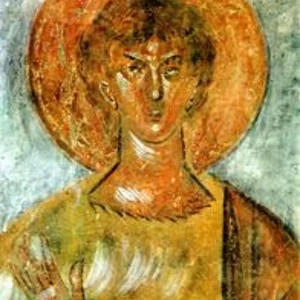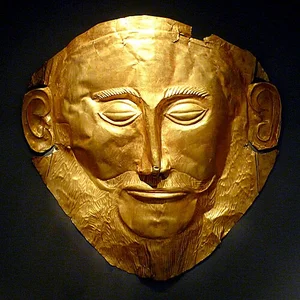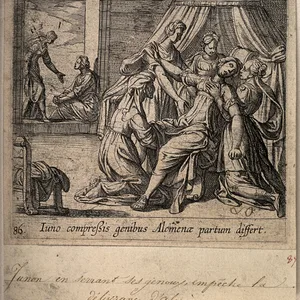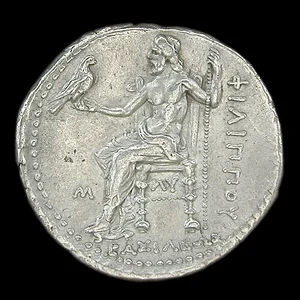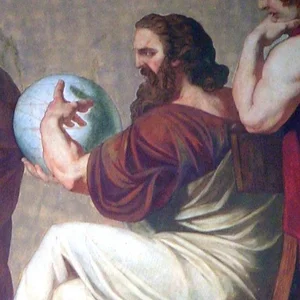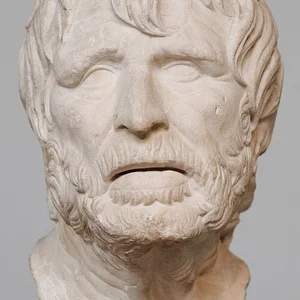

Greek poet of the 8th–7th centuries BCE, a contemporary of Homer, born in Ascra in Boeotia. He is the author of the Theogony and Works and Days, two foundational works of Greek literature and mythology.
Hesiod(775 av. J.-C. — ?)
Hesiod
Cymé
8 min read
Frequently asked questions
Famous Quotes
« The greatest wealth is health.»
« Do not put off until tomorrow what you can do today.»
Key Facts
- Hesiod was born around 750 BCE in Ascra, in Boeotia (central Greece).
- He composed the Theogony, an account of the birth of the Greek gods and the origins of the world.
- He wrote Works and Days, a didactic poem on agriculture, justice, and the ages of humanity.
- He is one of the first Greek poets to speak about himself in his own work.
- Along with Homer, he is considered a founding father of Greek literature.
Works & Achievements
The first systematic account of the birth and genealogy of the Greek gods, from the primordial Chaos to the reign of Zeus. This work of over a thousand lines is the foundation of Greek mythology as the Western world knows it.
A didactic poem of 828 lines addressed to Hesiod's brother Perses, teaching him the values of hard work, justice, and reverence for the gods. It includes a detailed agricultural calendar and the myths of Pandora and the Five Ages of Man.
A poem describing the shield forged by Hephaestus for the hero Heracles, attributed to Hesiod in antiquity, though modern scholars generally regard it as the work of a disciple or imitator from the 6th century BC.
A work surviving only in fragments that catalogued the unions between gods and mortal women, from which the Greek heroes were born. It served as a kind of sequel to the Theogony, bridging the divine world and the human world.
Anecdotes
Hesiod himself recounts in Works and Days that he was shepherding on the slopes of Mount Helicon when the Muses appeared to him and breathed into him the gift of poetry. They handed him a staff of laurel, a symbol of his divine election, and commanded him to sing the truth.
According to an ancient tradition recorded by Plutarch, Hesiod won a poetry contest against Homer himself at Chalcis, during the funeral games held in honor of Amphidamas. The judges awarded him the victory because he sang of peace and agriculture, virtues they considered superior to tales of war.
Hesiod is one of the first poets of antiquity to speak of himself in the first person in his works. He mentions his father, a ruined sailor who came from Cyme in Aeolia to settle in Ascra — a village Hesiod himself describes as 'miserable, harsh in winter, wretched in summer, never pleasant.'
In Works and Days, Hesiod invents the myth of the five ages of humanity — the ages of gold, silver, bronze, heroes, and iron — to explain the progressive decline of the world. This pessimistic vision of human history has profoundly shaped Western thought to this day.
Hesiod was murdered at Oenoe in Locris, according to ancient tradition, by the brothers of a young woman he had allegedly seduced. His body was said to have been thrown into the sea, then carried back to shore by dolphins — a sign, the ancients believed, of his divine protection by the Muses.
Primary Sources
From the Heliconian Muses let us begin our song. They dwell on the great and holy mountain of Helicon, and dance on soft feet around the dark spring and the altar of the mighty son of Cronos.
The gods have hidden from men the means of life. Otherwise, you could work easily in a single day enough to last you a whole year, without needing to work any more.
Before that, the tribes of men lived on earth apart from evils, free from hard toil and painful diseases. But the woman lifted the great lid of the jar and scattered its contents; she brought bitter misery upon mankind.
First of all, the immortals who dwell on Olympus made a golden race of mortal men. They lived like gods, with hearts free from care, apart from toil and grief and misery.
Key Places
Hesiod's birthplace, located at the foot of Mount Helicon in Boeotia. Hesiod himself describes it as a harsh and difficult place to live, yet it was here that he grew up and worked as a shepherd before becoming a poet.
The sacred mountain of the Muses and the site of Hesiod's poetic revelation, as he recounts in the Theogony. The Muses danced around the Hippocrene spring there, bestowing inspiration upon chosen poets.
A city on the island of Euboea where Hesiod reportedly took part in the famous poetic contest against Homer at the funeral games of Amphidamas — a contest that, according to ancient tradition, Hesiod won.
The place of Hesiod's death according to ancient Greek tradition. He is said to have been killed there and his body thrown into the sea, only to be carried back to shore by dolphins — a sign of divine favor in the eyes of the ancients.
The hometown of Hesiod's father, who left this region of Asia Minor to settle in Ascra after suffering financial setbacks in maritime trade.
Typical Objects

The laurel is the sacred plant of Apollo, god of poetry. According to Hesiod himself, the Muses presented him with a flourishing laurel branch during his poetic revelation on Mount Helicon.

Before papyrus became widespread, the Greeks wrote their texts on wax-coated tablets using a stylus. Hesiod's poems were able to be set down in writing thanks to the recent adoption of the alphabet.

A fundamental farming tool in archaic Boeotia, the scratch plow is ever-present in Works and Days, where Hesiod gives precise advice on when to plow according to the agricultural and stellar calendar.

Olive oil is at the heart of the Boeotian economy described by Hesiod. In his writings, he recommends tending one's olive trees carefully and storing oil with care for the winter.

A stringed instrument used by Greek bards to accompany the recitation of epic poems. Hesiod, like Homer, sang his verses with musical accompaniment — either playing himself or having someone play for him.

The large clay jar from which Pandora released the evils of the world is a central object in the foundational myth told by Hesiod in Works and Days, symbolizing both hope and human misfortune.
School Curriculum
Vocabulary & Tags
Key Vocabulary
Daily Life
Morning
Hesiod rises before dawn to watch over his flocks on the slopes of Mount Helicon. As a true Boeotian farmer, he studies the sky and the position of the stars to plan his work according to the agricultural calendar he would himself codify in his poetry. On winter mornings, he wraps himself in a goatskin to ward off the cold winds of Boeotia.
Afternoon
The afternoon is devoted to farm work according to the season: plowing with an ox-drawn ard, pruning the vines, harvesting barley or olives. Hesiod himself preaches the value of steady labor and condemns idleness in his verses: 'Shame ever attends the poor man.'
Evening
In the evenings, gathered with family and neighbors, Hesiod composes and recites his verses in dactylic hexameter — the same meter used by Homer. He reflects on the justice of Zeus and the human condition. Poets of his era transmitted their art orally, even as alphabetic writing was beginning to spread.
Food
Hesiod's diet is that of a Boeotian peasant of the 8th century BC: barley flatbreads (maza), olives, dried figs, sheep's cheese, and garden vegetables. Meat is reserved for sacrifices and religious festivals. Watered-down wine is the daily drink, produced from the very vines he describes with such care in his poetry.
Clothing
Hesiod wears the simple dress of an archaic Greek farmer: a coarse wool chiton fastened at the shoulder, and a chlamys (cloak) for outdoor work. In winter, he covers himself with a sewn goatskin — exactly as he himself recommends in Works and Days to endure the cold of Boeotia.
Housing
Hesiod lives in a stone-and-mud-brick house in Ascra, at the foot of Mount Helicon. The archaic Boeotian home consists of a large common room with a central hearth, storage space for amphorae of oil and grain, and an adjoining pen for livestock. He likely shares this house with his brother Perses, to whom his poem is addressed.
Historical Timeline
Period Vocabulary
Visual Style
Style inspiré de la céramique géométrique et proto-corinthienne grecque, avec silhouettes noires sur fond terre cuite ocre, dans une composition à la fois archaïque et solennelle évoquant l'univers agreste et divin d'Hésiode.
Sound Ambience
Ambiance rurale et montagnarde de la Béotie archaïque, mêlant les sons du travail agricole quotidien, du troupeau et de la récitation poétique accompagnée de lyre.
Liens externes & ressources
Références
Œuvres
Théogonie
vers 720-700 av. J.-C.
Les Travaux et les Jours
vers 700 av. J.-C.
Le Bouclier d'Héraclès
vers 600 av. J.-C. (attribution discutée)
Catalogue des femmes (Éhées)
vers 700-650 av. J.-C. (fragments)