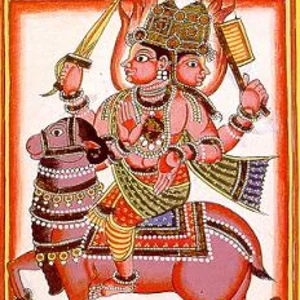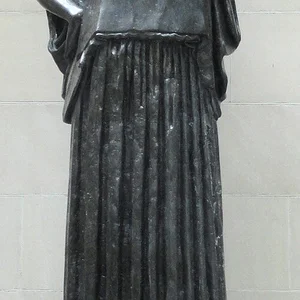

Hestia is the Greek goddess of the hearth, domestic fire, and family in ancient Greek mythology. Daughter of Cronus and Rhea, sister of Zeus, she is one of the twelve Olympian deities. An eternal virgin, she embodies stability, purity, and the sacred heart of the home.
Hestia
Hestia
7 min read
Frequently asked questions
Key Facts
- Hestia was the first child swallowed by Cronus and the last to be released, according to Greek mythological tradition as recorded by Hesiod (c. 8th century BCE)
- She refused the marriage proposals of Poseidon and Apollo, and obtained from Zeus the right to remain a virgin forever
- Every Greek meal began and ended with an offering to Hestia — she received the first portion of every sacrifice
- Her Roman equivalent is Vesta, whose sacred fire was tended by the Vestal Virgins in Rome
- The hearth (hestia in Greek) served as both a domestic place of worship and a symbol of the city — every Greek polis had a public hearth dedicated to Hestia
Works & Achievements
Two short hymns in the Homeric corpus are dedicated entirely to her. They are the principal ancient poetic sources on the nature and attributes of the goddess.
Hesiod places Hestia at the head of the list of children born to Cronus and Rhea, granting her a symbolic primacy in the Greek divine genealogy.
A Greek ritual practice in which a newborn was carried around the hearth to be placed under Hestia's protection. This rite marked the child's official integration into the family.
Hestia is at the origin of the prytaneum, the public building in each Greek city where her sacred fire burned continuously, symbolizing the political and religious unity of the community.
When founding new colonies, settlers ritually carried Hestia's fire from their mother city. This founding gesture ensured cultural and religious continuity between the metropolis and its colony.
Plato cites Hestia as the only deity who remains motionless in the dwelling of the gods, making her a philosophical symbol of essence and the immutability of being.
Anecdotes
When the Olympians divided their domains, Hestia refused to take part in the quarrels and rivalries. She gave up her place among the twelve Olympians to Dionysus, preferring to tend the sacred fire at the heart of Olympus. This act of voluntary withdrawal is celebrated as a model of wisdom and humility.
Both Poseidon and Apollo sought Hestia's hand in marriage, but she swore on Zeus's head to remain a virgin forever. Moved by this vow, Zeus rewarded her with the right to receive the first libation of every sacrifice and the honor of being invoked at the beginning and end of every prayer.
In every Greek city, a sacred fire dedicated to Hestia burned continuously in the prytaneum, the central public building. When a colony was founded, the settlers carried a flame taken from this sacred fire to light in their new home — a symbolic gesture that bound the new city to its mother city.
Unlike the other Olympian gods, Hestia almost never appears in myths involving adventure or conflict. This remarkable absence is itself meaningful: she symbolizes permanence and stability, always remaining in her place while the world stirs around her.
In every Greek household, the hearth (in Greek: hestia) bore the goddess's own name. When a child was born, the father carried it around the hearth as a sign of welcome into the family — a ritual called the amphidromia, held under Hestia's protection.
Primary Sources
Hestia, you who tend the holy dwellings of the immortal gods and the homes of men who walk upon the earth, you have received as your portion eternal glory and an honored place.
Hestia, in the high dwellings of all the immortal gods and of all men upon the earth, you hold your eternal throne, the highest of privileges.
Rhea, united with Cronus, bore a glorious offspring: Hestia, Demeter, and golden-sandaled Hera, mighty Hades, Poseidon, and wise Zeus.
Hestia alone remains in the dwelling of the gods; she takes no part in their procession.
In the prytaneion at Olympia burns a perpetual fire in honor of Hestia; it is never extinguished, neither in summer nor in winter.
Key Places
Official building where a perpetual fire burned in honor of Hestia. Pausanias attests to its constant maintenance; Olympic victors were banqueted there.
Civic and religious center of Athens where Hestia's fire symbolized the unity of the city. Honorary guests and benefactors of the city were received there.
The Roman equivalent of Hestia's cult, maintained by the Vestal Virgins. This circular temple housed the eternal flame of the Roman city until 394 AD.
The navel of the world (omphalos) according to the Greeks, Delphi had a sacred hearth of Hestia in its prytaneion. Colonies set out from Delphi carrying the goddess's flame.
Sacred island and center of the Greek world, it housed a prytaneion with a fire of Hestia venerated by delegations from all the cities of the Delian League.
Liens externes & ressources
Références
Œuvres
Hymnes homériques à Hestia (XXIV et XXIX)
VIIe-VIe siècle av. J.-C.
Théogonie — Hésiode
Vers 700 av. J.-C.
Culte du foyer domestique (rites amphidromiques)
Depuis l'époque archaïque
Institution des prytanées civiques
VIIe-Ve siècle av. J.-C.
Transmission du feu lors des fondations coloniales
VIIIe-VIe siècle av. J.-C.
Phèdre — Platon
IVe siècle av. J.-C.