 flip
flipSeksu of Tangier with Lamb and Root Vegetables
Seksu of Tangier with Lamb and Root Vegetables
Why this dish? Born in Tangier, Ibn Battuta grew up with semolina couscous, the mother dish of the Maghreb already described in Andalusian and Maghrebi cookbooks of his century. It is the comfort food of home that he left at age 21 and was moved to rediscover upon his return.
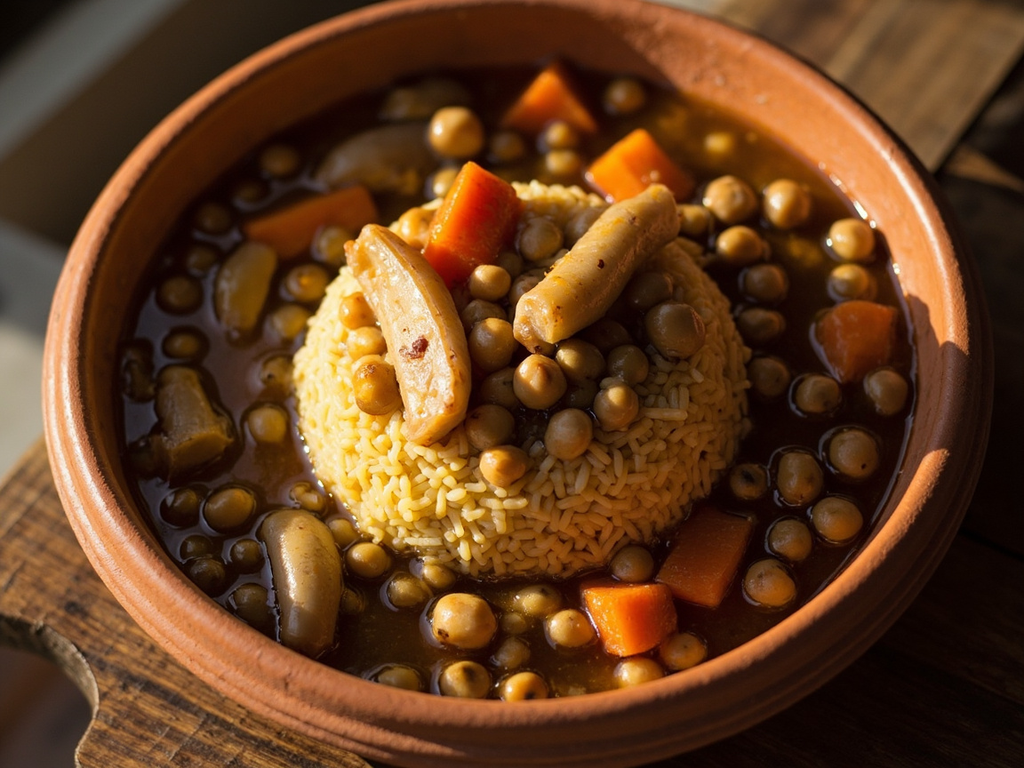
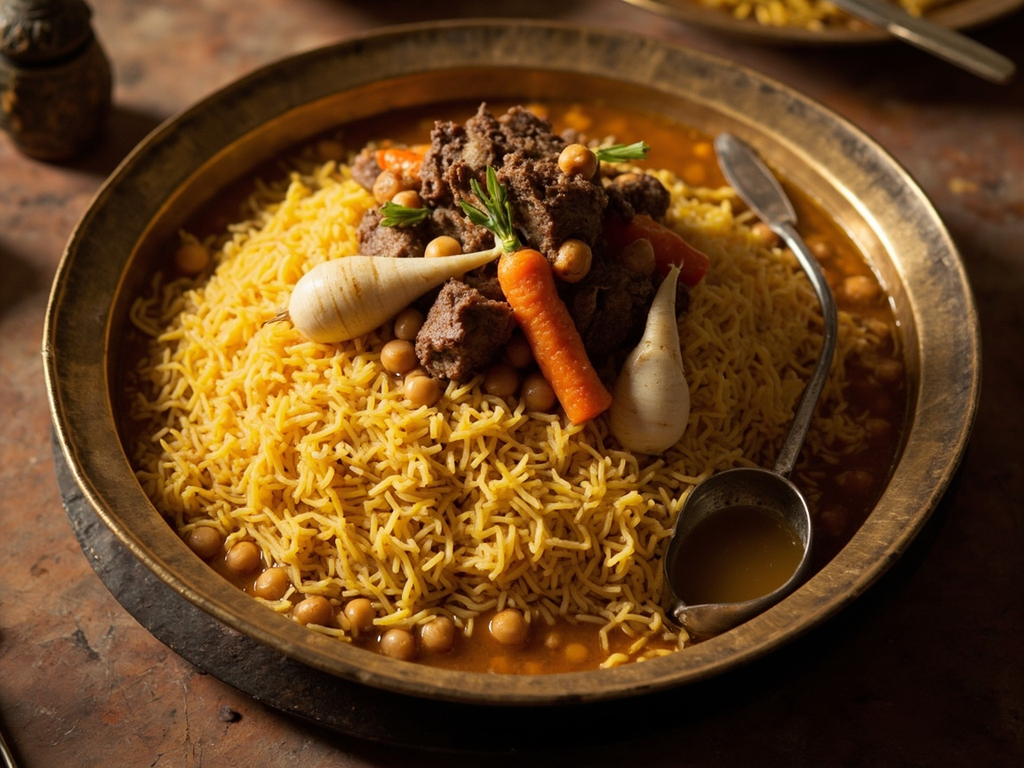
A mountain of fine hand-rolled semolina, steamed over a saffron-scented lamb broth, crowned with turnips, carrots, and chickpeas. The ultimate communal dish, shared with the right hand around a single large platter.
Praise be to God who guides the traveler to his table! Know, friend, that before treading deserts and seas, I ate this ta'âm in Tangier, rolled between my mother's palms grain by grain. It is laid upon the broth perfumed with saffron, crowned with meat and roots, and one dips the right hand after naming God. Believe me: nowhere in my twenty-nine years of wandering, neither in Delhi nor in China, have I found such sweetness as the semolina of my homeland.
- •Durum wheat semolina — a large platter (base, hand-rolled)
- •Lamb shoulder — a fine piece (broth meat)
- •Chickpeas — a handful, soaked (legume)
- •Turnips and carrots — as available in season (melting roots)
- •Onions — a few (broth base)
- •Saffron and pepper — a pinch (color and heat)
- •Smen (aged clarified butter) — a knob (fragrant binder)
Seksu of Tangier with Lamb and Root Vegetables
A mountain of fine hand-rolled semolina, steamed over a saffron-scented lamb broth, crowned with turnips, carrots, and chickpeas. The ultimate communal dish, shared with the right hand around a single large platter.
Why this dish? Born in Tangier, Ibn Battuta grew up with semolina couscous, the mother dish of the Maghreb already described in Andalusian and Maghrebi cookbooks of his century. It is the comfort food of home that he left at age 21 and was moved to rediscover upon his return.
Praise be to God who guides the traveler to his table! Know, friend, that before treading deserts and seas, I ate this ta'âm in Tangier, rolled between my mother's palms grain by grain. It is laid upon the broth perfumed with saffron, crowned with meat and roots, and one dips the right hand after naming God. Believe me: nowhere in my twenty-nine years of wandering, neither in Delhi nor in China, have I found such sweetness as the semolina of my homeland.
Ingredients (period version)
- Durum wheat semolina — a large platter (base, hand-rolled)
- Lamb shoulder — a fine piece (broth meat)
- Chickpeas — a handful, soaked (legume)
- Turnips and carrots — as available in season (melting roots)
- Onions — a few (broth base)
- Saffron and pepper — a pinch (color and heat)
- Smen (aged clarified butter) — a knob (fragrant binder)
Ingredients
- Medium couscous semolina — 400 g (base)
- Lamb or mutton shoulder, cut into pieces — 800 g (meat)
- Chickpeas, soaked overnight — 150 g (legume)
- Turnips — 3 (root)
- Carrots — 4 (root)
- Onions — 2 (broth)
- Saffron threads — 1 pinch (color, fragrance)
- Smen or butter — 30 g (binder)
- Salt, pepper, ground ginger — to taste (seasoning)
Method
- Brown the lamb and sliced onions in a little butter in the bottom of a couscoussier; add water, saffron, pepper, ginger, salt, and the chickpeas.
- While the broth simmers, moisten the semolina with salted water and aerate it by hand, then steam it above the broth in three rounds, breaking up clumps between each.
- Halfway through cooking, add turnips and carrots to the broth.
- Mound the semolina on a large platter, make a well, place the meat and vegetables in it, and drizzle with broth and a knob of smen.
- Serve at the center of the table, each person eating from the portion in front of them with the right hand.
How it was made : Maghrebi and Andalusian cookbooks from the 13th century (notably that of Ibn Razîn al-Tujîbî) already describe hand-rolled couscous cooked in a tiered steamer. The semolina was rolled by the women of the house, a long and collective task, then dried for later days.
The contemporary twist : Serve each guest a small dome of semolina with its ribbon of broth in an individual bowl—a "travel map" style, one vegetable per stage.
Sources : Ibn Razîn al-Tujîbî, Fadâlat al-Khiwân (Andalusian-Maghrebi cuisine, 13th c.) · Charles Perry (trans.), Medieval Arab Cookery
Ibn Battûta · Charactorium