
Indra is the king of the gods and the master of the sky in the Vedic mythology of ancient India. A warrior god of thunder, storms, and rain, he fights demons with his weapon, the thunderbolt (vajra). He is one of the central deities of the Rig Veda.
Indra
Indra
5 min read
Frequently asked questions
Key Facts
- A major deity of the Rig Veda, a collection of hymns composed around 1500–1200 BCE
- King of the gods (Devas) and lord of Svarga, the Vedic heavenly paradise
- God of storms and war, he slays the serpent-demon Vritra with his vajra (the thunderbolt) to release the waters
- According to tradition, the gods released their energy to create the goddess Durga; Indra gave her his weapon
- His central cult in the Vedic era later declined in favor of Vishnu and Shiva in classical Hinduism
Works & Achievements
Indra's founding feat: he kills the dragon Vritra and releases the pent-up waters, restoring fertility to the world.
Indra breaks open the cave of the demon Vala to free the cows (or the dawns) imprisoned within, restoring the light.
As god of the storm, Indra brings the rain needed for the harvests, a vital function for the Vedic peoples.
Indra reigns over the other deities and defends the cosmic order against the demons (asuras).
In classical Hinduism, Indra becomes one of the guardians of the cardinal points, protector of the eastern direction.
Anecdotes
In the Rig Veda, Indra is celebrated for having slain the serpent-dragon Vritra, who held the world's waters prisoner. By striking him with his thunderbolt (vajra), he releases the rivers and allows life to flourish: this is the feat upon which all his glory rests.
Indra is renowned for his immense appetite for soma, a sacred, intoxicating drink. Many hymns describe how he drinks prodigious quantities of it before going into battle, which multiplies his warrior strength.
Over time, Indra's place in Indian religion declines. In classical Hinduism and later texts, he remains king of the gods (devas) and guardian of the east, but he is largely supplanted by greater deities such as Vishnu and Shiva.
The vajra, Indra's thunder-weapon, became a major symbol: it was taken up in Buddhism, where it denotes both a ritual object and the indestructibility of spiritual truth.
Indra commands the Maruts, a troop of storm and wind deities who accompany him into battle like a thundering army riding upon the clouds.
Primary Sources
I will proclaim the manly deeds of Indra, the first that he performed, he who wields the thunderbolt: he slew the serpent, released the waters and split open the flanks of the mountains.
Drink, O Indra, the soma pressed for you; may it intoxicate and strengthen you, you who are the lord of the thunderbolt and the slayer of Vritra.
May Indra of a thousand powers protect us, he who brandishes the thunderbolt and brings rain down upon the parched earth.
Key Places
The celestial paradise where Indra resides, a realm of pleasures and the abode of the righteous in Hindu tradition. It is the seat of his divine kingship.
A legendary celestial city, the capital of Indra's kingdom, described in the texts as a place of infinite opulence and splendor.
The cosmic mountain at the center of the world in Indian cosmology, around which the heavens of the gods are arranged, including that of Indra.
The region of the “seven rivers” in northwestern India, the cradle of Vedic culture where the hymns celebrating Indra were composed.
Typical Objects

Indra's divine weapon, the thunderbolt made flesh, fashioned according to tradition from the bones of a sage. It symbolizes irresistible, indestructible power.

A vessel holding soma, the sacred, intoxicating drink that Indra consumes to increase his strength. Soma is also a deity in its own right.

In the Indian tradition, the rainbow is called “Indra's bow.” It evokes the shooting weapon of the storm god and the link between heaven and earth.

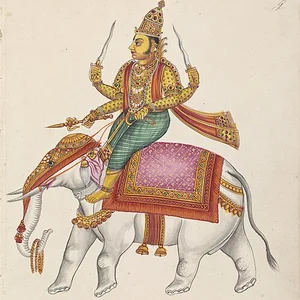
Indra's mount (vahana) in later tradition: a majestic white elephant, sometimes endowed with several tusks, guardian of the clouds and the rain.

The thundering chariot on which Indra rides across the sky to fight demons, often associated with thunder and storm clouds.
School Curriculum
Vocabulary & Tags
Key Vocabulary
Daily Life
Morning
A mythological figure, Indra has no human daily routine. The hymns imagine him awake in his celestial palace of Amaravati, ready to roam the sky and watch over the order of the world.
Afternoon
He is pictured leading his battles against the demons, wielding the vajra and unleashing rain upon the earth, surrounded by the Maruts, deities of the storm.
Evening
In the mythical evening, Indra savors the soma offered by humans during sacrifices, a drink that strengthens his power and his joy.
Food
His “food” is above all soma, a sacred intoxicating drink, as well as the oblations (offerings of milk, clarified butter, and grains) poured into the fire during sacrifices.
Clothing
Indra is described adorned like a king: sumptuous garments, golden ornaments, and armed with his thunderbolt. His appearance reflects his celestial sovereignty.
Housing
He dwells in the celestial paradise of Svarga, whose capital Amaravati is portrayed as a city of opulence located on or near Mount Meru, the center of the cosmos.
Historical Timeline
Period Vocabulary
Liens externes & ressources
Références
Œuvres
Le meurtre de Vritra
mythe védique
La libération des vaches (mythe de Vala)
mythe védique
La maîtrise de la pluie et de l'orage
tradition védique
Roi des dieux (Devaraja)
tradition védique et hindoue
Gardien de l'Est (Lokapala)
tradition hindoue