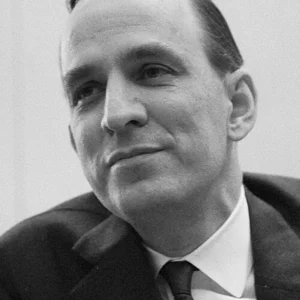

Swedish film director, screenwriter, and theater director (1918–2007), considered one of the greatest filmmakers in history. His work explores faith, death, solitude, and human relationships with unparalleled psychological intensity.
Ingmar Bergman(1918 — 2007)
Ingmar Bergman
Suède
10 min read
Frequently asked questions
Famous Quotes
« Film is my mistress. The theater is my wife.»
« No art passes through human darkness as directly as cinema.»
Key Facts
- 1918: Born in Uppsala, Sweden
- 1957: The Seventh Seal and Wild Strawberries, two masterpieces released the same year
- 1960: The Virgin Spring wins the Academy Award for Best Foreign Language Film
- 1963–1966: Artistic director of the Royal Dramatic Theatre in Stockholm
- 2003: Fanny and Alexander earns him four Academy Awards, his cinematic testament
Works & Achievements
An allegorical medieval film in which a crusader knight plays chess with Death. An absolute masterpiece on faith and mortality, it defined the image of Bergman's cinema and remains one of the most influential films in the history of the seventh art.
A portrait of an aging professor reflecting on his life during a road trip. A bittersweet meditation on time and regret, awarded the Golden Bear at the Berlin Film Festival, this film is often cited as Bergman's most accessible and most moving work.
A radical experimental film about the merging of two female identities — a mute actress and her nurse. Formally enigmatic and revolutionary, it continues to influence filmmakers and film theorists around the world to this day.
A film shot in deep red tones depicting the agony of a dying woman surrounded by her sisters. An emotionally grueling experience for the viewer, it received five Oscar nominations and is considered one of the pinnacles of intimate filmmaking.
A six-episode television series following the disintegration of a Swedish bourgeois couple, starring Liv Ullmann and Erland Josephson. A social phenomenon in Sweden — where it is said to have triggered a wave of divorces — it was later re-edited as a film for international release.
Bergman's testament film, a three-hour family epic tracing a boy's childhood in early twentieth-century Sweden. Awarded four Oscars including Best Foreign Language Film, it stands as the filmmaker's artistic and autobiographical farewell.
A literary autobiography in which Bergman recounts his oppressive childhood, his loves, his working methods, and his metaphysical anxieties. Translated into twenty languages, it is one of the most profoundly moving accounts ever written by an artist about their own creative journey.
Anecdotes
The son of a strict Lutheran pastor, Ingmar Bergman grew up in fear of corporal punishment and hell. His father would sometimes lock his children in a dark closet as punishment. This atmosphere of guilt and religious dread profoundly permeated his entire body of work, particularly his trilogy on the silence of God.
At the age of ten, Bergman traded his tin soldiers for a magic lantern belonging to his brother. Fascinated by the device that projected moving images onto a wall, he spent hours exploring its mechanisms. He named his autobiography 'Laterna Magica' in tribute to the object that, he said, determined the course of his entire life.
The filming of The Seventh Seal (1957) was completed in just thirty-five days on a shoestring budget. The iconic chess game between a crusading knight and Death was improvised beneath a cloudy sky that Bergman deemed perfect. Rushed into production, the film went on to become one of the most referenced images in the history of world cinema.
In January 1976, Bergman was arrested in the middle of a rehearsal at the Royal Dramatic Theatre in Stockholm on charges of tax fraud. Although later cleared, the shock was so severe that he fell into deep depression and left Sweden. He lived in exile for several years in Germany and France before returning to his home country.
Bergman maintained an almost monastic writing routine on the island of Fårö, a windswept rock in the Baltic Sea where he had settled after filming Persona in 1966. He rose each morning at dawn, wrote for hours, took a solitary walk, then watched a film every evening. He refused to leave the island even to collect his international awards.
Primary Sources
My greatest fear has always been the fear of humiliation. I still remember the dark closet, the smell of wood, and the absolute terror I felt inside it. That is where all my ghosts come from.
Cinema is a matter of rhythm. It is rhythm that defines the individual, not plot. The inner pulse of a film is its soul, and if that pulse is false, everything collapses.
I want my films to breathe. I want them to be as uncertain as life itself. I am not trying to give answers — I am trying to ask questions the audience did not dare to formulate.
Cinema is a language I taught myself — a language with no fixed grammar, made of faces, light, and silence. Silence has always seemed more eloquent to me than any dialogue.
For a long time I believed that Sweden had betrayed me. Today I understand that it was I who had betrayed something within myself by believing that the law did not apply to me. Exile made me humbler.
Key Places
University city in central Sweden where Bergman was born on July 14, 1918. His childhood there was shaped by the strictness of his pastor father and by his earliest experiences as a cinema-goer.
Sweden's most prestigious theatrical institution, of which Bergman served as artistic director from 1963 to 1966. He continued to direct plays there throughout his life, using the theatre as his laboratory for exploring the human soul.
A remote island in the Baltic Sea where Bergman settled permanently after filming *Persona* (1966) there. He lived in near-hermit seclusion for four decades and died there on July 30, 2007. The island is today a place of pilgrimage for film lovers around the world.
The city where Bergman took refuge from 1976 to 1978 during his voluntary exile from Sweden, following his arrest on charges of tax fraud. He made several German-language films there and worked with the Residenztheater.
The international film festival where Bergman first came to the world's attention in 1956 with *Smiles of a Summer Night*. He won several awards there and was regularly celebrated as one of the masters of world cinema.
Typical Objects

Bergman's primary creative tool, operated in close collaboration with his cinematographer Sven Nykvist. Together they developed a visual style built on extreme close-ups of human faces and natural light of rare dramatic intensity.

A mechanical optical device that projects painted glass images onto a white surface using a light source. Bergman owned one from childhood and identified it as the founding object of his vocation as a filmmaker.

Bergman wrote all his screenplays by hand before typing them up. These manuscripts, composed at his home on Fårö, stand as literary works in their own right — published and studied independently of the films themselves.

A pervasive symbol throughout Bergman's work, made famous by the chess match between the knight Antonius Block and Death in *The Seventh Seal*. It represents humanity's struggle against its own mortality and the desperate search for meaning in existence.

Bergman held a film screening every evening at his Fårö home — an unwavering ritual he kept up until the end of his life. He watched classics and contemporary films alike, feeding a voracious passion for cinema.

A working tool at the Royal Dramatic Theatre in Stockholm, where Bergman recorded his acting notes, set sketches, and reflections on texts by Ibsen, Strindberg, and Shakespeare. His theatre work was considered just as revolutionary as his filmmaking.
School Curriculum
Vocabulary & Tags
Key Vocabulary
Daily Life
Morning
Bergman invariably rose at dawn on his island of Fårö, around five or six in the morning. He devoted the first hours of the day to writing, seated at his desk facing the sea, sometimes for four or five hours at a stretch. He regarded this moment of morning solitude as sacred and refused any interruption.
Afternoon
The afternoon was reserved for reading, solitary walks along the island's beaches, or, during filming periods, long days on set. Bergman worked with absolute concentration alongside a small group of loyal collaborators — including cinematographer Sven Nykvist — with whom he developed a shared visual language over the decades.
Evening
Every evening, Bergman organized a film screening in his home — a ritual he maintained until the end of his life. He watched Hollywood classics and avant-garde European cinema alike, sometimes recording his impressions in notebooks. He went to bed early, by ten o'clock, in order to preserve his creative energy for the morning.
Food
Bergman followed a simple, regular Nordic diet, with no particular excesses. He appreciated meals shared with family or collaborators as moments of relaxation after work. During filming, he ate quickly and frugally so as not to interrupt the rhythm of the set.
Clothing
Bergman dressed plainly, with no particular concern for style — a simple sweater or jacket, wool trousers, with no concession to fashion or social image. In portraits, he is often seen in casual dress, reflecting his indifference to appearances in favor of an intense inner life.
Housing
Bergman lived in a modest, functional house on the island of Fårö, which he had arranged to encourage work and solitude. The island, with its lunar landscapes of limestone and water, matched his aesthetic: spare, melancholic, outside of time. He also had a private screening room there.
Historical Timeline
Period Vocabulary
Liens externes & ressources
Références
Œuvres
La Lanterne magique (Laterna Magica)
1987