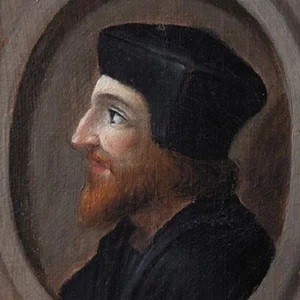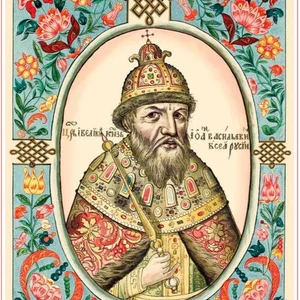

The first tsar of Russia, Ivan IV unified and centralized Russian power in the 16th century. His reign was marked by significant territorial conquests and the brutal repression of the aristocracy through the oprichnina.
Ivan IV(1530 — 1584)
Ivan IV
grande-principauté de Moscou, tsarat de Moscou
7 min read
Frequently asked questions
Key Facts
- 1533: became Grand Prince of Moscow at the age of three following the death of his father Vasily III
- 1547: crowned the first Tsar of All the Russias, asserting the supremacy of his power over the princes
- 1552–1556: conquest of the Khanates of Kazan and Astrakhan, greatly expanding Russian territory
- 1565–1572: establishment of the oprichnina, a political police force that terrorized the nobility (boyars)
- 1584: death of Ivan IV, leaving behind a centralized but weakened Russia after years of violence
Works & Achievements
A major legal reform unifying Russian law, establishing elected local courts and curbing judicial corruption. This code modernized the country's administration.
A council bringing together clergy and nobility to reform the Russian Orthodox Church in one hundred chapters (Stoglav). Ivan used it to assert the inseparable bond between spiritual and temporal power.
A decisive military victory that annexed the vast Tatar territory and opened the way for the colonization of Siberia. It is commemorated by the construction of Saint Basil's Cathedral.
Religious musical compositions attributed to Ivan IV, preserved in Russian monastic manuscripts. They reveal the mystical and cultured side of his character.
A political and philosophical exchange of letters with the exiled Prince Andrei Kurbsky. These letters are an exceptional document on the absolutist conception of royal power in the 16th century.
The establishment of a state within a state, with its own army, secret police, and territory, designed to break the power of the great boyars. It became the central instrument of authoritarian centralization.
Anecdotes
Ivan IV was crowned tsar at just 16 years old in 1547, becoming the first Russian ruler to officially bear this title derived from the Latin 'Caesar'. The ceremony, inspired by Byzantine rites, was designed to legitimize his rule over all of Russia as heir to Constantinople.
In 1570, Ivan ordered the massacre of the city of Novgorod over five weeks, suspecting its inhabitants of treason in favor of Poland. Thousands of people were drowned in the Volkhov River, burned, or tortured by the oprichniki, his personal secret police dressed in black.
Ivan killed his own son and heir, Ivan Ivanovich, with a blow from an iron-tipped staff in November 1581, during a violent argument. Overcome with remorse, he spent days weeping over his son's body. Ilya Repin's painting depicting this scene is one of the most celebrated works in Russian art.
Ivan IV was a deeply learned man with a passion for theology. He composed liturgical music himself and maintained a philosophical correspondence with Prince Andrei Kurbsky, an exiled boyar who challenged him intellectually from the Polish-Lithuanian Commonwealth.
Near the end of his life, Ivan had the bells of the city of Pskov locked away as a symbolic punishment, after sparing its inhabitants at the intervention of a holy fool (yurodiviy). These 'fools for Christ' were the only people who could speak truth to him without fear of death.
Primary Sources
You say your conscience is clear... I declare that I have the right to punish my rebellious subjects as I see fit, for God has entrusted me with authority over them.
No one shall pass judgment without the presence of elected elders and clerks. Judges who have rendered unjust verdicts shall be punished at our pleasure.
The grand prince himself ravaged villages and towns with his oprichniki. People fled into the forests; those who were found were put to death.
The tyranny of Ivan Vasilyevich exceeded all bounds. He established a guard of six thousand men called oprichniki, who could kill, plunder, and destroy without any restraint.
Key Places
The main residence of Ivan IV and the center of tsarist power. It was here that the ceremonies, audiences, and public executions ordered by the tsar took place.
Built on the orders of Ivan IV between 1555 and 1561 to celebrate the victory over Kazan. Its colorful onion-domed silhouette has become the symbol of Russia recognized the world over.
A fortified town 100 km from Moscow where Ivan IV established his court between 1564 and 1572, making it the true center of the Oprichnina and his personal reign of terror.
Capital of the Tatar Khanate, conquered by Ivan IV in 1552 after a lengthy siege. This victory marked Russia's eastward expansion and the integration of Turco-Muslim peoples.
A major trading city in the northwest, devastated by Ivan IV in 1570 during a massacre that lasted several weeks. This episode stands as the peak of Ivan's reign of terror.
Liens externes & ressources
Références
Œuvres
Sudebnik (Code de lois)
1550
Réforme de l'Église (Stoglav)
1551
Conquête du khanat de Kazan
1552
Hymnes liturgiques (Stichères)
vers 1560
Correspondance avec Kourbski
1564-1579
Création de l'opritchnina
1565