
Japanese goddess of creation and death, wife of Izanagi, from the Shinto tradition. According to the Kojiki (c. 8th century), she and Izanagi gave birth to the islands of Japan and the primordial deities. Her death during the birth of the fire god led her to reign over the land of the dead, Yomi.
Izanami
Izanami
8 min read
Frequently asked questions
Key Facts
- Izanami and Izanagi create the islands of the Japanese archipelago by stirring a celestial spear in the primordial ocean, according to the Kojiki (written down in 712)
- She dies giving birth to the fire god Kagutsuchi, burned from within
- Her husband Izanagi descends into Yomi (the land of the dead) to bring her back, but she has already been corrupted by death — a myth that parallels the story of Orpheus
- After the divine couple's separation, Izanami becomes ruler of Yomi and vows to kill a thousand humans each day, marking the origin of death in the world
- The story of Izanami is preserved primarily in the Kojiki (712) and the Nihon Shoki (720), Japan's two great mythological chronicles
Works & Achievements
Izanami, together with Izanagi, gave birth to the eight great islands of Japan and numerous smaller ones, a founding act that shaped the country's geographical and spiritual identity.
Izanami gave birth to the deities of the seas, mountains, winds, and rivers, populating the Shinto universe with sacred natural forces still venerated today.
After her death, Izanami became the ruler of Yomi, establishing the structure of the afterlife in Shinto cosmology and defining the boundary between the world of the living and the dead.
The final pact between Izanami and Izanagi — one thousand deaths against one thousand five hundred births per day — serves as the mythical explanation for the natural growth of the human population.
The first Japanese text to record the myths of Izanami, written on the orders of Empress Genmei. It is considered the founding text of Japanese civilization.
The second written account of the founding myths, offering variant versions of the Izanami narrative and consolidating her role in legitimizing the Japanese imperial lineage.
Anecdotes
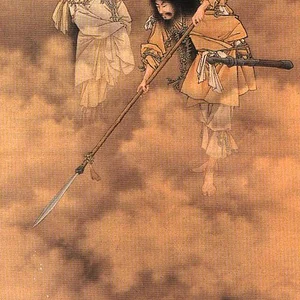
Izanami and Izanagi stood upon the Floating Bridge of Heaven (Ama-no-Ukihashi) and stirred a jeweled spear into the primordial ocean. When they lifted it out, the droplets that fell formed the first island, Onogoroshima, where they settled and gave birth to the islands of Japan.
During the birth of Kagutsuchi, the god of fire, Izanami was so severely burned that she died from her wounds. Her husband Izanagi, mad with grief, cut the newborn into pieces, and from those pieces sprang new deities — illustrating how, in Shinto mythology, even death and violence can give rise to life.
Izanagi descended into the realm of the dead (Yomi) to bring Izanami back. She asked him not to look at her while she negotiated with the gods of the underworld. But he lit a tooth from his comb to pierce the darkness and discovered her rotting body. Horrified, he fled — and Izanami, humiliated and enraged, vowed to kill one thousand people each day. Izanagi answered that he would bring one thousand five hundred new lives into the world each day in return.
After Izanagi's escape, Izanami became the great goddess of death, Yomotsu Ōkami, ruler of Yomi. According to Shinto tradition, this myth explains the natural balance between death and birth: every day, one thousand people die and one thousand five hundred are born, forever maintaining life's surplus over death.
Primary Sources
Izanagi-no-mikoto and Izanami-no-mikoto received the command of the heavenly deities to consolidate and give shape to the drifting land. They were given the heavenly jeweled spear and, standing upon the Floating Bridge of Heaven, plunged the spear into the waters and stirred.
Izanami, having given birth to the god of fire, was burned and died. She was buried on Mount Hiba, at the border of Izumo and Hōki. Izanagi, stricken with grief, wept for a long time around her tomb.
The local accounts of Izumo evoke the places associated with Izanagi's descent into Yomi and the purification rituals he performed upon his return, establishing the practices of misogi.
The norito (Shinto ritual prayers) invoke the primordial deities, including Izanami and Izanagi, as ancestors of the kami and as the founding forces of the Japanese archipelago and cosmic order.
Key Places
The mythical burial site of Izanami according to the Kojiki and Nihon Shoki, located on the border of the ancient provinces of Izumo and Hōki. A shrine dedicated to the goddess still stands there today.
One of the oldest Shinto shrines in Japan, dedicated to Izanami. It is considered one of the most sacred sites associated with the creator deities of the Japanese archipelago.
The land of the dead in Shinto cosmology, located beneath the earth or at the boundary of the world of the living. Izanami rules over Yomi after her death and becomes its eternal sovereign.
The celestial bridge from which Izanami and Izanagi created the first lands. It is symbolically associated with Amanohashidate Bay, in the province of Tango (Kyoto).
The first island created by Izanami and Izanagi by stirring the heavenly spear in the primordial ocean. Traditionally identified with Awaji Island (Hyōgo) or a small islet in the Seto Inland Sea.
Typical Objects

A jewel-adorned spear given by the heavenly gods to Izanami and Izanagi to solidify the floating earth. It is the primary instrument of creation of the Japanese archipelago.

Izanagi lit one of the teeth of his comb to illuminate Yomi. This act triggered the final break between the divine couple and illustrates the transgression of the forbidden gaze in Japanese mythology.

An enormous boulder placed by the gods at the entrance to Yomi to separate the world of the living from that of the dead after Izanagi's escape. It symbolizes the uncrossable boundary between life and death.

A sacred rope used in Shinto shrines to mark off sacred spaces. In the myth, Izanagi used a variant of it to seal off Yomi, a ritual considered the origin of this practice.

Ritual beads and mirrors associated with Japanese funerary rites since prehistoric times. Izanami, queen of the dead, is symbolically linked to these objects found in tombs from the Kofun period.

Fire, embodied by the god Kagutsuchi whose birth killed Izanami, is an ambiguous symbol: a creative and destructive force at once. Shinto shrines dedicated to Izanami include rituals connected to fire.
School Curriculum
Vocabulary & Tags
Key Vocabulary
Daily Life
Morning
At the beginning of each cosmic cycle, Izanami symbolically emerges from the primordial waters alongside Izanagi, receiving from the celestial gods the mission of shaping the world. Her day begins in the very act of creation: stirring the jeweled spear Ame-no-nuboko through the formless ocean to draw forth the lands.
Afternoon
Izanami presides over the ceaseless birth of kami — divine beings embodying the forces of nature: sea, wind, mountain, and fire. She embodies divine fertility in its fullest expression, bringing forth the natural order of the Japanese cosmos through her creative power alone.
Evening
From her throne in Yomi, Izanami receives the souls of the dead and presides over the mysteries of death. Night is her domain: a darkness filled with shadows and presences, the boundary between the world of the living and the realm of spirits, over which she rules with absolute authority.
Food
As a deity, Izanami does not eat as mortals do. In Yomi, she is associated with the food of the dead (Yomotsu hirasaka) — food cooked in the underworld that makes return to the world of the living impossible, symbolizing the final, irreversible break from life.
Clothing
Izanami is depicted wearing the most splendid court robes of the ancient Japanese aristocracy: layered silks (kasane-no-irome) in colors ranging from pure white (life) to black and deep red (death). Her long black hair falls freely, a sign of her state in Yomi.
Housing
Izanami dwells in the underground palace of Yomi (Yomotsu Hirasaka), a shadowy kingdom beneath the earth, separated from the world of the living by an enormous boulder. Before her death, she lived with Izanagi on the island of Onogoroshima, in a celestial palace with a central pillar (mihashira) around which the two deities circled to perform their marriage rite.
Historical Timeline
Period Vocabulary
Visual Style
Style emaki et ukiyo-e japonais : robes de cour somptueuses évoluant vers l'ombre, entre lumière créatrice et ténèbres du royaume des morts.
Sound Ambience
Ambiance sonore du Japon mythique : océan primordial, forêts sacrées des montagnes, cavernes souterraines du Yomi et rituels shinto antiques.
Liens externes & ressources
Références
Œuvres
Création de l'archipel japonais (Kuni-umi)
Temps mythiques
Naissance des kami primordiaux (Kami-umi)
Temps mythiques
Fondation du Yomi (Royaume des morts)
Temps mythiques
Établissement du cycle vie-mort
Temps mythiques
Kojiki (古事記) — récit de création
712 apr. J.-C.
Nihon Shoki (日本書紀) — chroniques impériales
720 apr. J.-C.