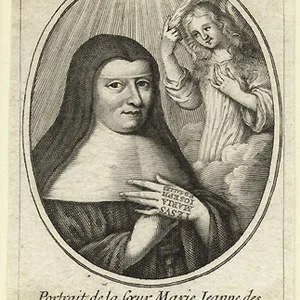

French Ursuline nun, mother superior of the convent of Loudun. She was the central figure in the affair of the possessed nuns of Loudun (1632-1634), claiming to be possessed by demons and accusing the priest Urbain Grandier of witchcraft, which led to his trial and execution at the stake.
Jeanne des Anges(1602 — 1665)
Jeanne de Belcier
France
6 min read
Frequently asked questions
Key Facts
- Born in 1602 in Cozes (Saintonge) into a noble family, she entered the Ursuline order and became mother superior of the convent of Loudun.
- From 1632 onwards, she and several nuns displayed signs of demonic possession, sparking the affair of the possessed nuns of Loudun.
- Her accusations contributed to the conviction of the priest Urbain Grandier, who was burned alive on 18 August 1634.
- After the public exorcisms, from 1638 onwards she undertook a triumphant pilgrimage across France, displaying the stigmata that had appeared on her hand.
- She wrote an Autobiography that constitutes a rare testimony to the inner experience of possession; she died in 1665.
Works & Achievements
Account dictated by Jeanne about her possessions and her inner life; a major source for understanding the affair from the inside.
A superiorship held for nearly forty years, which she retained despite the scandal of the possessions.
A staging of the possessions before crowds and authorities, which turned Loudun into a national religious and political spectacle.
The denunciation of the priest as a sorcerer, the trigger for the trial and execution that sealed the fame of the affair.
A journey across France to display her stigmata, transforming Jeanne into a venerated figure of devotion.
Anecdotes
Jeanne des Anges claimed that seven demons inhabited her body, among them Asmodeus, Leviathan and Behemoth. During the public exorcisms, she would writhe, speak in a guttural voice and hurl insults, before the eyes of thousands of onlookers who had come from all over France.
After the burning of Urbain Grandier at the stake in 1634, Jeanne claimed that stigmata had appeared on her left hand: the names of Jesus, Mary, Joseph and François de Sales were supposedly engraved there in reddish letters. She displayed this hand during a triumphant tour across the kingdom.
In 1638, Jeanne was received by Louis XIII and Queen Anne of Austria, and then by Cardinal Richelieu. The queen is said to have asked to see and touch the famous stigmatized hand, which had become a veritable living relic.
The Jesuit Jean-Joseph Surin, sent to exorcise her, was in turn overtaken by a strange affliction: he sank into a long depression and a form of madness that lasted for years, as if he had absorbed part of the nun's torment.
Near the end of her life, Jeanne dictated an *Autobiography* in which she half-admitted the element of playacting and pride in her so-called possessions, a rare document that sheds light from within on the workings of a collective hysteria.
Primary Sources
The devil deceived me very often through a kind of complacency that I found in all the agitations and other extraordinary things he wrought in my body.
We have declared the said Grandier duly attainted and convicted of the crime of sorcery, malefice, and possessions… condemned to be burned alive and his ashes scattered to the wind.
I have fallen into a state in which it has been impossible for me to pray, to read, to speak, or to give an account of anything whatsoever.
The Mother Superior, seized by furious convulsions, answered the exorcist's questions in Latin and named the demons that possessed her.
Key Places
Monastery where Jeanne was the mother superior and where the fits of possession that made the affair famous first began.
Small town in Poitou, scene of the public exorcisms and the sensational trial of 1632-1634.
Site of the execution of Urbain Grandier, burned alive before the crowd on 18 August 1634.
Home region of the Belcier family, the Poitevin nobility from which Jeanne descended.
Jeanne was received here during her tour of 1638, presenting her stigmatized hand to the king, the queen, and Richelieu.
Typical Objects

Black robe, white wimple and veil worn by Ursuline nuns. During her fits, Jeanne would sometimes tear pieces of it off in her convulsions.

Cross held by the exorcist and brandished before the possessed woman to command the demons to reveal themselves or depart.

Liturgical manual containing the Latin formulas of exorcism, read aloud to question and drive out spirits.

Alleged contract signed with the demons, produced as evidence at the trial and written backwards in Latin to appear supernatural.

Jeanne's left hand bearing the holy names supposedly engraved by Heaven, displayed as a miraculous relic during her tour.

Sulfur-soaked tunic in which those condemned to the fire were dressed; Grandier wore it during his execution on the square of Loudun.
School Curriculum
Vocabulary & Tags
Key Vocabulary
Daily Life
Morning
Woken before dawn by the bell, Jeanne rose for matins and lauds sung in the choir. A superior's day began with prayer, meditation and Mass, before overseeing the community.
Afternoon
The afternoon was divided between teaching the boarders, managing the convent's material affairs and further offices. During the affair, public exorcisms overran these hours, turning the cloistered routine into a spectacle.
Evening
Evening brought vespers and compline, followed by the great monastic silence. Jeanne would then withdraw for personal prayer and the examination of conscience, sometimes disturbed by her nocturnal fits.
Food
Meals followed the rule: bread, vegetables, soups, fish on days of abstinence, and meat only rarely. Fasts and abstinences paced the liturgical calendar, with Lent imposing severe privations.
Clothing
Jeanne wore the black habit of the Ursulines, the wimple and the veil, girded with a rosary. The dress erased all vanity in favour of the sign of religious consecration.
Housing
She lived within the convent's enclosure, in an austere cell furnished with a narrow bed, a crucifix and a few devotional objects. The monastery was arranged around the cloister, the chapel and the choir.
Historical Timeline
Period Vocabulary
Liens externes & ressources
Références
Œuvres
Autobiographie spirituelle
vers 1644
Direction du couvent des Ursulines de Loudun
1627-1665
Cycle des exorcismes publics de Loudun
1632-1637
Accusation d'Urbain Grandier
1632-1634
Tournée de la main stigmatisée
1638