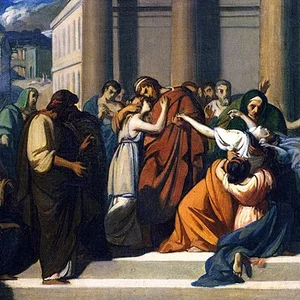

Queen of Thebes in Greek mythology, Jocasta is the mother and wife of Oedipus. Unaware of the true identity of the man she had married, she took her own life upon the revelation of the incest. Her story is at the heart of Sophocles' tragedy Oedipus Rex.
Jocasta
Jocasta
Thèbes
9 min read
Frequently asked questions
Key Facts
- Wife of King Laius of Thebes, she received the oracle that he would be killed by his own son
- Her son Oedipus, condemned to death at birth, was abandoned but survived
- Mentioned under the name Epicaste by Homer in the Odyssey (Book XI)
- After the death of Laius, she married Oedipus without knowing he was her son
- Upon the revelation of the truth by the seer Tiresias, she hanged herself in her palace
Works & Achievements
The absolute masterpiece of Greek tragedy, this play places Jocasta at the center of the drama. She embodies the temptation to deny the oracle and refuse the truth — until the moment she perceives it even before Oedipus does.
In this play, Jocasta has survived the revelation of incest and desperately tries to reconcile her sons Eteocles and Polynices. Her character takes on an even stronger and more heartbreaking maternal dimension here.
In this sequel, Jocasta is dead but her memory haunts Oedipus throughout his exile. The curse bearing down on her children shows that the consequences of her tragic union extend far beyond her death.
Homer is one of the earliest sources to mention the character, under the name Epicaste. Odysseus encounters her in the Underworld, attesting to how deeply rooted the myth already was in the Greek tradition.
This Latin version of the tragedy amplifies the horrific elements of the myth. Jocasta is portrayed with great dramatic intensity, and her death by sword — rather than by hanging as in the Greek versions — marks a significant departure.
A modernist retelling of the myth, with a libretto by Cocteau written in Latin. Jocasta is interpreted as a tragic figure who chooses willful blindness in the face of an unbearable truth.
Anecdotes
Before Oedipus was born, the oracle at Delphi had warned King Laius that his son would kill him and marry his own mother. Terrified by this prophecy, Jocasta handed the infant to a shepherd with orders to abandon him on Mount Cithaeron, his ankles pierced and bound — hence the name Oedipus, meaning 'swollen-footed' in ancient Greek.
When the Sphinx was terrorizing Thebes by devouring anyone who could not answer its riddle ('What creature walks on four legs in the morning, two at noon, and three in the evening?'), Jocasta, widowed after King Laius's death, had declared she would marry whoever freed the city. Oedipus solved the riddle — the answer being 'man' — and the Sphinx hurled itself into the void. Jocasta married him, not knowing he was her own son.
For years, Jocasta and Oedipus ruled Thebes together and had four children: Eteocles, Polynices, Antigone, and Ismene. The truth only came to light when a terrible plague struck the city and a seer, Tiresias, followed by a messenger from Corinth, revealed piece by piece the true identity of Oedipus. Jocasta was the first to understand and tried to convince her husband-son to abandon the investigation.
When the full truth of the incest and patricide was revealed, Jocasta fled into the palace and hanged herself with her own belt — or, in some versions, with a veil. Oedipus, upon finding her, tore the brooches from her dress and used them to blind himself. This double catastrophe stands as one of the most devastating endings in all of ancient Greek tragedy.
In Euripides' 'Phoenician Women', the myth takes a different turn: Jocasta does not kill herself immediately after the revelation. She survives and desperately tries to reconcile her sons Eteocles and Polynices, who are fighting over the throne of Thebes, only to die at the end on the battlefield between their corpses — an even more maternal and tragic portrayal.
Primary Sources
Jocasta: 'Many men before you, in their dreams, have shared their mother's bed. Those who bear such things most lightly live most easily.' (lines 981-983)
Homer calls the character 'Epicaste': 'She had married her own son, who had slain his father. The gods soon made these things known among men. He remained in Thebes, ruling over the Cadmeans, but she descended to the house of mighty Hades.'
Jocasta: 'O my sons, your quarrel drives your aged mother to despair. Eteocles, I turn to you first, as you are the elder... Why do you prize Tyranny so highly — that injustice raised to a god?'
Apollodorus recounts the prophecy given to Laius, the exposure of Oedipus on Mount Cithaeron with his ankles pierced, and the fateful fulfilment of the oracle, noting that Jocasta hanged herself in shame upon the revelation of the incest.
Aeschylus evokes the curse weighing upon the lineage of Laius and the consequences of Oedipus's transgressions, inherited by his sons Eteocles and Polynices, children of the accursed union.
Key Places
Capital of Jocasta's kingdom, Thebes is the main setting of the Oedipus myth. It is in her palace that the revelation of the incest and Jocasta's death take place.
It was at Delphi that the fateful prophecy was uttered, foretelling to Laius that his son would kill him and marry his mother. The oracle is the invisible driving force behind the entire tragedy of Jocasta.
A mountain range between Boeotia and Attica where the infant Oedipus was left to die on the orders of Laius and Jocasta. It was there that a shepherd took pity on the child and saved him.
The 'three-way road' near Daulis in Phocis, where Oedipus killed Laius during a quarrel over right of way, not knowing the man was his father. This place seals the first act of the prophecy.
The city where Oedipus grew up, raised by King Polybus who had taken him in. It was while fleeing Corinth to escape a prophecy that Oedipus headed toward Thebes, thus walking straight into his fate.
Liens externes & ressources
Références
Œuvres
Œdipe Roi — Sophocle
vers 429 av. J.-C.
Les Phéniciennes — Euripide
vers 411 av. J.-C.
Œdipe à Colone — Sophocle
401 av. J.-C. (posthume)
Odyssée, chant XI (Nékyia) — Homère
VIIIe siècle av. J.-C.
Œdipe — Sénèque le Jeune
Ier siècle apr. J.-C.
Œdipe — Jean Cocteau (pièce) et Igor Stravinski (opéra-oratorio)
1927