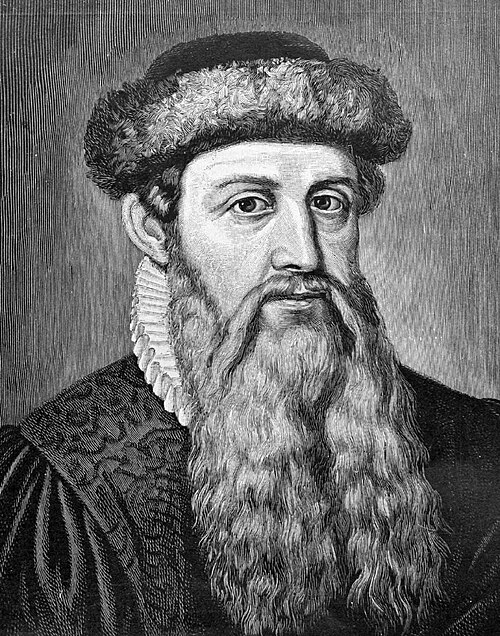
Johannes Gutenberg
Johannes Gutenberg
1400 — 1468
Saint-Empire romain germanique
Johannes Gutenberg was a German goldsmith and typographer of the 15th century. He is famous for inventing the movable metal type printing press around 1450, revolutionizing the spread of knowledge across Europe. His 42-line Bible, printed around 1455, is one of the first printed books in history.
Key Facts
- Born around 1400 in Mainz, in the Holy Roman Empire
- Around 1450, he perfected the printing press using cast movable metal type
- Around 1455, he printed the Gutenberg Bible (the 42-line Bible), the first major printed work in Europe
- His technique spread rapidly across Europe: by 1500, more than 250 cities had printing presses
- Died in 1468 in Mainz, having lost his workshop following a lawsuit with his business partner Johann Fust
Works & Achievements
Gutenberg's masterpiece, printed in Latin in two volumes of approximately 1,280 pages. It is the first major book printed with movable type in Europe, of which 49 copies survive worldwide.
One of the earliest printed documents attributed to Gutenberg, a single-sheet calendar. It testifies to the first practical commercial applications of his invention before the major book projects.
A printed fragment considered one of Gutenberg's very earliest printing experiments in Strasbourg. Its attribution to Gutenberg is debated, but it illustrates the first trials of the new technique.
Official Church documents printed in series at Gutenberg's workshop, among the earliest commercial records of the printing press. Several copies survive, some filled in by hand with the buyers' names.
A printed pamphlet calling for a crusade following the fall of Constantinople, one of the earliest examples of printing used for propaganda and rapid political communication.
Anecdotes
Gutenberg kept his invention secret for several years by having his associates sign confidentiality agreements. He feared that other craftsmen might copy his technique before he could profit from it. This caution shows that as early as the 15th century, protecting inventions was already a genuine concern.
To finance the printing of his Bible, Gutenberg borrowed a considerable sum from a wealthy Mainz banker named Johann Fust. Unable to repay his debts, he was forced in 1455 to hand over his workshop and printing presses to this creditor. Gutenberg died nearly penniless, never seeing the fortune his invention would generate for others.
The Gutenberg Bible, printed around 1455, was so carefully executed that many contemporaries believed they were looking at hand-copied manuscripts. The letters were perfectly uniform and the layout deliberately imitated the illuminated bibles produced in monastic scriptoriums, so as not to unsettle readers accustomed to handwritten manuscripts.
Gutenberg was trained as a goldsmith, and it was precisely this expertise in metalworking that allowed him to design movable type made from an alloy of lead, tin, and antimony. This alloy, which he developed after extensive experimentation, melted easily and solidified quickly, making it possible to produce thousands of identical characters.
It is estimated that Gutenberg printed between 160 and 180 copies of his 42-line Bible. Today, 49 complete or partial copies survive worldwide, held in libraries and museums. Each is worth several million euros and stands as a treasure of world cultural heritage.
Primary Sources
Item ist zu wissen, das ich Johannes Gutenberg zu Mencze... This notarial act records the financial dispute between Johann Fust and Gutenberg, attesting to the existence of the printing workshop and the sums invested in 'the work of the books'.
I have seen, most distinguished man, some of the writing said to have been produced at Mainz... The script was very clean and correct, and you could read it without glasses. Several people have bought copies.
This noble and remarkable art of printing was invented at Mainz on the Rhine... and was first invented and practiced in the city of Mainz, in the German nation.
Printed and completed by the art of printing invented by Johannes Gutenberg at Mainz.
Key Places
Gutenberg's birthplace and the cradle of printing. It was in Mainz that Gutenberg set up his workshop and printed his famous Bible around 1455. The Gutenberg Museum there preserves one of the few surviving original copies.
The city where Gutenberg lived in exile from around 1428 to 1448, and where he began his first experiments with printing. Court records from 1439 confirm that he was already working on a secret process with local partners.
The address of Gutenberg's printing workshop in Mainz, located in a patrician courtyard belonging to his family. This is where he set up his presses and printed the first major works in the history of printing.
Home of the great trade fair where the Gutenberg Bible was presented and sold in 1455. Frankfurt was at that time the main commercial crossroads of central Europe, making it an ideal place to distribute printed books.
Gallery

Anonymous portrait of Johannes Gutenberg dated 1440, Gutenberg Museum
Wikimedia Commons, Public domain — Unidentified painter

Frankfurt am Main, Gutenberg-Denkmal -- 2015 -- 6749
Wikimedia Commons, CC BY-SA 4.0 — Dietmar Rabich

Frankfurt am Main, Gutenberg-Denkmal -- 2015 -- 6751
Wikimedia Commons, CC BY-SA 4.0 — Dietmar Rabich

Frankfurt am Main, Gutenberg-Denkmal -- 2015 -- 6752
Wikimedia Commons, CC BY-SA 4.0 — Dietmar Rabich

L’Invention de l’imprimerie, à Strasbourg, en 1436
Wikimedia Commons, Public domain — Gabriel-Christophe Guérin

Strasbourg, place Gutenberg, statue de Gutenberg, David d'Angers 12
Wikimedia Commons, CC BY-SA 3.0 — Coyau

Luminale 2012 - Resonate-1
Wikimedia Commons, CC BY-SA 3.0 — Photo: Thomas Wolf, www.foto-tw.de , light art: FH Mainz Gestaltung Innenarchitektur in cooperation with Hochschule

History of education infographic
Wikimedia Commons, CC BY-SA 3.0 — Mushlya / Boundless.com

Turning points in the world's history
Wikimedia Commons, Public domain — Mann, Henry, 1848-1915

Historical sketch of the Rhine, in connection with the education, the schools, the fine arts, and industry of Germany
Wikimedia Commons, Public domain — Schenck, Friedrich