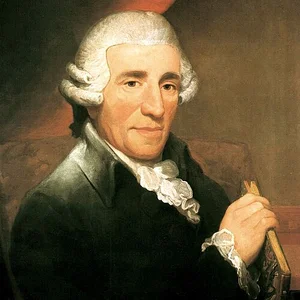

Joseph Haydn (1732-1809) was an Austrian composer regarded as the "father of the symphony" and the string quartet. Long in the service of the Esterházy family, he profoundly influenced Mozart and Beethoven. His monumental body of work includes more than 100 symphonies and represents the pinnacle of Viennese Classicism.
Joseph Haydn(1732 — 1809)
Joseph Haydn
Saint-Empire romain germanique
8 min read
Frequently asked questions
Famous Quotes
« "I was cut off from the world, and so I was forced to become original."»
Key Facts
- Born on 31 March 1732 in Rohrau, Austria, the son of a wheelwright.
- Kapellmeister in the service of the Esterházy family from 1761 to 1790.
- Composed more than 104 symphonies, establishing the classical form of the symphony.
- Friend and mentor of Wolfgang Amadeus Mozart; teacher of Ludwig van Beethoven.
- Died on 31 May 1809 in Vienna, shortly after Napoleonic troops entered the city.
Works & Achievements
In this symphony, Haydn devises a finale where the musicians leave the stage one by one, as a way of signaling to Prince Esterházy that his musicians wished to return home. A masterpiece of humor and musical ingenuity.
These six quartets represent a revolution in chamber writing, establishing an equal dialogue among all four instruments. Haydn develops the four-movement form that would become the standard.
These twelve symphonies, composed for London audiences, represent the pinnacle of classical symphonic art. Symphony No. 94 'Surprise' and No. 104 'London' are the most celebrated among them.
Inspired by the Book of Genesis and Milton's Paradise Lost, this oratorio for soloists, chorus, and orchestra is a monumental work depicting the creation of the world through music. It was celebrated throughout Europe.
Haydn's second great oratorio, illustrating the four seasons of the year with remarkable descriptive energy. It was the last major work the composer completed, at the age of sixty-nine.
Written for the newly invented keyed trumpet, this concerto is today one of the most frequently performed in the repertoire. It reflects Haydn's enduring curiosity about new instrumental possibilities.
Composed against the backdrop of the Napoleonic Wars, this mass weaves martial kettledrums and trumpets into the liturgical text. It captures the anguish of a Europe in the grip of political upheaval.
Anecdotes
Haydn was nicknamed 'Papa Haydn' by the musicians who worked under his direction at the Esterházy palace, so kind and fatherly was he toward them. Far from being a mere term of endearment, this title reflected his role as a mentor to an entire generation of composers, including Mozart and Beethoven.
In 1772, Prince Esterházy's musicians, exhausted after long months away from their families, were desperate to return home. Haydn composed Symphony No. 45, known as the 'Farewell' Symphony: at the end of the final movement, the musicians blow out their candles and leave the stage one by one. The Prince understood the message and granted his orchestra leave to go home.
During his visits to London in 1791 and 1794, Haydn was welcomed as an international star. He received an honorary doctorate from Oxford University, and his concerts at the Hanover Square Rooms drew enormous crowds. The composer, then in his sixties, experienced true worldwide popular fame for the first time.
Legend has it that Haydn composed some of his finest works in a state of deep spiritual concentration. He made a habit of dressing carefully before sitting down to compose — including putting on the gold ring given to him by King Frederick William II of Prussia — viewing the act of composition as both a religious and an artistic ritual.
Haydn maintained a deep and genuine friendship with Mozart, who was twenty-four years his junior. When Leopold Mozart worried about his son leaving for Prague, Haydn reportedly told him: 'Your son is the greatest composer I know.' When Mozart died in 1791, Haydn was devastated and confided to friends that he would never be able to console himself for the loss.
Primary Sources
"Here I sit in my solitude, like a poor orphan, almost without human company, sad, full of the memory of past days of glory — yes, past, alas!"
"My music travels around the world; everywhere I go, people know me."
"The said Joseph Haydn undertakes to conduct himself as an honest, sober and frugal servant, to behave with propriety [...] and to compose according to the wishes of His Highness."
"I declare before God, as an honest man, that your son is the greatest composer I know, either personally or by reputation."
Haydn kept a catalogue of his own works from 1765 onwards, carefully noting each composition with its musical incipit — a rare testament to an 18th-century composer's concern for his legacy.
Key Places
Haydn's birthplace, where he was born in 1732 into a modest family. His childhood home is now a museum commemorating the composer's humble origins.
Haydn served as a choirboy here from 1740 to 1749, receiving his foundational musical training. It was in this Gothic landmark that he developed his mastery of singing and counterpoint.
Known as the "Versailles of Hungary," this grand château was Haydn's primary workplace for nearly thirty years. It was here that he composed the majority of his symphonies and operas.
The London concert hall where Haydn conducted his triumphant performances during his two visits to England (1791–1792 and 1794–1795). His success there surpassed that of any other composer of the era.
Haydn purchased this house in the Viennese suburb of Gumpendorf in 1793 — his first personal property. He composed his final major works there and died in the house in 1809.
Haydn received an honorary doctorate from this prestigious university in 1791, during his first stay in England. In recognition of the honor, he composed Symphony No. 92, known as the "Oxford" Symphony.
Typical Objects

Haydn composed and improvised on these instruments throughout his career. The transition from harpsichord to fortepiano during his lifetime reflects the evolving sound of Viennese classicism.

Haydn wrote out his scores himself with a quill pen, revising and correcting them with great care. His manuscripts, carefully preserved, bear witness to his rigorous organization and working method.

The King of Prussia presented Haydn with this ring as a token of admiration after commissioning string quartets from him. Haydn wore it faithfully when composing, attaching great symbolic and spiritual significance to it.

The libretto for this oratorio, inspired by Milton's Paradise Lost, was brought to Haydn from London. Translated and adapted into German, it was the source of inspiration for one of his most ambitious works.

Haydn had a permanent orchestra at the Esterházy palace, made up of oboes, horns, bassoons, and flutes. This unique resource allowed him to innovate in orchestration and to perfect the symphonic form.

Haydn kept a handwritten catalogue of all his compositions, including the opening bars of each work. This document, exceptionally rare for the period, shows his keen awareness of his own artistic legacy.
School Curriculum
Vocabulary & Tags
Key Vocabulary
Daily Life
Morning
Haydn rose early and dressed carefully — he considered proper attire essential to his dignity as a composer in the prince's service. He began his day with prayer, then settled at his harpsichord or fortepiano to compose, making the most of the morning quiet to work on his scores.
Afternoon
Afternoons were devoted to rehearsals with Prince Esterházy's orchestra or to teaching the musicians under his direction. Haydn also had to manage the administrative side of the musical chapel: instrument maintenance, concert organization, and sometimes composing on urgent commission.
Evening
Evenings at Esterházy Palace were filled with concerts, operas, and performances for which Haydn conducted or played himself. These social events, attended by Hungarian and Austrian aristocracy, formed the heart of his professional and social life.
Food
Haydn dined at the servants' table at Esterházy Palace, sharing meals with the upper household staff rather than with the princes. His diet, typical of the 18th-century Austrian middle class, included soups, roasted meats, dark bread, and beer or table wine.
Clothing
As Kapellmeister, Haydn was required to wear the Esterházy household livery: a navy blue coat embroidered in silver, white waistcoat, white breeches and stockings, powdered wig, and cocked hat. This uniform of a 'noble servant' sometimes weighed on him, but he wore it with pride in his position.
Housing
Haydn was provided with living quarters at Esterházy Palace — comfortable but without excessive luxury. It was not until 1793, after thirty years of service, that he was able to purchase his own home in Gumpendorf, a suburb of Vienna, where he permanently settled his belongings and his musical library.
Historical Timeline
Period Vocabulary
Visual Style
Le style visuel associé à Haydn évoque l'élégance sobre du classicisme viennois : salons dorés, instruments à cordes et lumières de bougies, entre rigueur formelle et chaleur aristocratique du XVIIIe siècle.
Sound Ambience
L'univers sonore de Haydn oscille entre la sérénité studieuse du compositeur à son bureau et l'effervescence des grandes salles de concert européennes, nourri par les sons du palais Esterházy et des rues de Vienne.