
Juno is the queen of the gods in Roman mythology, wife of Jupiter and goddess of marriage and motherhood. Identified with the Greek Hera, she belongs to the Capitoline Triad and plays a central role in Virgil's epic, the *Aeneid*.
Juno
(3) Juno
9 min read
Frequently asked questions
Key Facts
- Daughter of Saturn and Rhea, sister and wife of Jupiter in the Roman pantheon
- Member of the Capitoline Triad with Jupiter and Minerva, venerated on the Capitoline Hill in Rome
- Identified with the Greek Hera through the process of *interpretatio graeca*
- Central figure in Virgil's *Aeneid* (1st century BC), where she opposes the hero Aeneas
- The month of June (*Junius*) is traditionally dedicated to her in the Roman calendar
Works & Achievements
The founding epic of Latin literature, in which Juno is the principal antagonistic deity; her opposition to Aeneas and her love for Carthage form the dramatic driving force of the work, a staple of secondary-level Latin studies.
A mythological collection in fifteen books featuring Juno in numerous episodes: her jealousy toward Io (Book I), the punishment of Callisto (Book II), the destruction of Semele (Book III), and the persecution of Hercules.
A poem of the Roman religious calendar describing Juno's festivals (the Matronalia, the festival of Juno Lucina), a precious source on actual cultic practices and the goddess's role in everyday Roman life.
The founding Greek epic in which Hera, the Greek counterpart of Juno, plays an active role alongside the Greeks against Troy; she deceives Zeus to reverse the course of battle, revealing her cunning and determination.
A Roman comedy built around the miraculous birth of Hercules, son of Jupiter and Alcmena; Juno's jealousy lurking in the background fuels the plot and illustrates the enduring popularity of the divine marital rivalry theme on stage.
A lost masterpiece by the sculptor Polyclitus, made for the Heraion of Argos and described by ancient authors as a seated, crowned Hera holding a pomegranate and scepter; it established the iconographic canon of the goddess for all of Antiquity.
Anecdotes
In Virgil's *Aeneid*, Juno is the chief enemy of Aeneas, the Trojan hero considered the ancestor of the Romans. Driven by love for Carthage and bitterness toward Troy, she unleashes storms and obstacles to thwart his divine mission. This spectacular opposition shapes the entire epic and places Juno at the heart of the Latin literature studied in secondary school.
The sacred geese of Juno saved Rome from disaster in 390 BC. During a night attack by the Gauls on the Capitoline Hill, the guards were asleep — but the geese consecrated to Juno Moneta raised the alarm with their piercing cries, waking Marcus Manlius in time to repel the assault. In memory of this episode, the geese kept on the hill received a special form of veneration.
Juno Lucina was invoked by Roman women during childbirth. Her epithet "Lucina" comes from the Latin *lux* (light), as she was believed to "bring newborns into the light." Roman matrons offered her flowers and sacrifices during the Matronalia, a festival celebrated every year on the first of March.
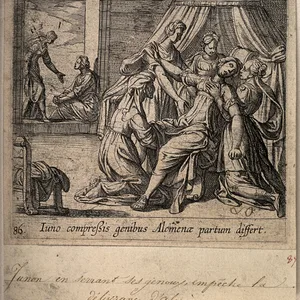
Juno's rivalry with Hercules is one of the most famous in all of mythology. Jealous because Hercules was Jupiter's illegitimate son by the mortal Alcmene, Juno tried to kill him at birth by sending two serpents into his cradle. Later, it was she who drove the hero to madness, causing him to unknowingly kill his own family — the event that set the Twelve Labors in motion.
The month of June takes its name from Juno (*Junius* in Latin). It was considered the most auspicious month for marriage in Rome, as Juno, goddess of weddings, extended her protection to newlyweds. This tradition has endured through the centuries: a June wedding is still widely regarded as a sign of good fortune.
Primary Sources
Urbs antiqua fuit... Karthago... quam Iuno fertur terris magis omnibus unam / posthabita coluisse Samo. “There was an ancient city... Carthage... which Juno, it is said, cherished above all other lands, even more than Samos.”
Iuno... sensit et in niveam descendit Iuno iuvencam / Inopinataque illi formam laudavit et unde / esset et cuius et qua de gente rogavit. “Juno... sensed the ruse and descended, praising the snow-white heifer, asking who she was, where she came from, and to what family she belonged.”
Matronae... templa Lucinae petunt : Lucina dea parta levat, / quae gravis es, supplex illi tua vota resolve. “The matrons... make their way to the temple of Lucina: Lucina the goddess eases childbirth; you who carry a burden, humbly address your prayers to her.”
Iuno autem et soror est Iovis et coniunx. Iunonem a iuvando credo nominatam. “Juno is both the sister and the wife of Jupiter. I believe Juno takes her name from the verb *iuvare*, to aid.”
Anseres in summa inopia cibi neglecti, quos Iunoni sacros esse constat, servavere rem publicam. “The geese, neglected amid the direst shortage of food — geese which are, as everyone knows, sacred to Juno — saved the Republic.”
Key Places
Seat of the Capitoline Triad temple where Juno was venerated alongside Jupiter and Minerva, the religious heart of Rome. It was also home to the sacred geese of Juno Moneta, whose sanctuary would later house the Roman mint.
One of the best-preserved ancient temples in the world, built around 480–460 BC in the Valley of the Temples; it bears witness to the reach of the Hera-Juno cult throughout Magna Graecia and remains a hallmark of classical Doric architecture.
The birthplace of Hera according to Greek tradition and site of the Heraion of Samos, one of the oldest and most powerful sanctuaries of the goddess. Virgil explicitly states that Juno cherished Samos above all other lands.
Juno's beloved city in Virgil's Aeneid, where the goddess held her chief temple and aspired to make it the capital of the world. The conflict between Carthage and Rome forms the central dramatic engine of Virgil's epic.
Site of the Temple of Juno Lacinia, one of the most venerated sanctuaries in the western Greek world, where Hannibal had his own exploits engraved on bronze tablets. Only a single column survives today (Cape Colonna).
Typical Objects

The peacock is Juno's sacred animal par excellence, a symbol of her majesty and vigilance. According to Ovid, she placed the hundred eyes of Argus — the giant slain by Mercury to free Io, whom Juno had transformed into a heifer — upon the peacock's plumage.

Royal insignia of the queen of the gods, invariably present in depictions of Juno. The crown (a diadem or cylindrical *polos*) and scepter proclaimed her absolute sovereignty over gods and mortals alike.

The saffron-colored veil worn by Roman brides at the wedding ceremony, consecrated to Juno Pronuba, patroness of marriage. The lifting of the veil by the groom was a gesture placed under the divine protection of the goddess.

A fruit symbolizing fertility and marital union, often depicted in the hand of Hera-Juno in ancient sculpture. It evokes both her role as goddess of motherhood and the many family bonds she watches over.

An attribute of Roman wedding ceremonies held under Juno's aegis. A pine-wood torch was carried in procession during the nuptial cortège, symbolizing the divine light the goddess bestowed upon the new household.

Juno's celestial mode of transport in artistic representations. This divine chariot, harnessed to peacocks with shimmering plumage and described by Latin poets, illustrates her power and majesty as queen of Olympus.
School Curriculum
Vocabulary & Tags
Key Vocabulary
Daily Life
Morning
At sunrise, priestesses and matrons light the sacred fire of Juno's temple and perform ritual ablutions with pure water. Pregnant women come to implore Juno Lucina for a safe delivery, laying garlands of flowers and spelt bread upon the altar.
Afternoon
Public ceremonies are held in broad daylight, notably during the Matronalia on March 1st, when Roman matrons carry flower offerings in procession and receive gifts from their husbands in honor of the goddess. Magistrates consult the auspices within the sacred precinct before any important decision.
Evening
At sunset, the temple doors are closed after a closing rite accompanied by song. During full moon nights, hymns are recited in honor of Juno Lucina, whose name evokes the light of the moon; young newlywed wives address prayers to her for the fertility of their household.
Food
Juno receives specific food offerings: spelt flour cakes (mola salsa), whole pomegranates, honey, pure wine, and flowers. These plant-based and fruit offerings reflect her role as goddess of feminine fertility and the home, distinct from the bloody animal sacrifices reserved for other warrior deities.
Clothing
Juno is depicted wearing a long white or purple stola — a color reserved for gods and emperors — adorned with golden embroidery, with a palla (large veil) over her head and a golden crown (diadem or cylindrical polos). Her belt (ceston), passed down from Hera, was said to possess irresistible powers of attraction, according to the Greek poets.
Housing
Juno resides on Olympus in a palace of marble and gold shared with Jupiter, whose wife and jealous rival she is in equal measure. On earth, her principal temple on the Capitoline Hill serves as her symbolic dwelling: a white marble building with golden columns dominating Rome, affirming the permanent presence and protection of the queen of the gods over the city.
Historical Timeline
Period Vocabulary
Visual Style
Style inspiré des fresques pompéiennes et de la grande statuaire gréco-romaine, représentant Junon dans sa majesté royale : vêtements pourpre et or, couronne dorée, présence de paons, atmosphère solennelle d'un sanctuaire antique.
Sound Ambience
Atmosphère solennelle d'un temple romain dédié à Junon au lever du jour, mêlant chants rituels de matrones, crépitement de la flamme sacrée, parfums d'encens et cris lointains de paons dans la cour à colonnades.
Liens externes & ressources
Références
Œuvres
L'Énéide — Virgile
29-19 av. J.-C.
Les Métamorphoses — Ovide
8 apr. J.-C.
Les Fastes — Ovide
8 apr. J.-C.
L'Iliade — Homère (Héra)
VIIIe siècle av. J.-C.
Amphitryon — Plaute
IIe siècle av. J.-C.
Statue chryséléphantine d'Héra — Polyclète (perdue)
v. 420 av. J.-C.