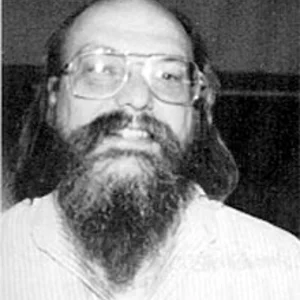

American computer scientist, Ken Thompson is the co-creator of the Unix operating system with Dennis Ritchie at Bell Labs in the 1970s. He also designed the B programming language, the ancestor of C, and co-developed the Go language.
Ken Thompson(1945 — ?)
Ken Thompson
Royaume-Uni
9 min read
Frequently asked questions
Famous Quotes
« One of my most productive days was throwing away 1000 lines of code.»
« When in doubt, use brute force.»
Key Facts
- 1943: Born in New Orleans, Louisiana
- 1969: Creation of Unix at Bell Labs with Dennis Ritchie
- 1969–1970: Design of the B language, precursor to C
- 1983: Turing Award (with Dennis Ritchie) for the creation of Unix
- 2007: Co-creation of the Go language at Google
Works & Achievements
Co-created with Dennis Ritchie at Bell Labs, Unix revolutionized computing with its founding principles — everything is a file, simple programs that can be combined, portability. It is the direct ancestor of Linux, macOS, Android, and virtually all modern operating systems.
A programming language designed by Thompson as a simplification of BCPL to program Unix on the PDP-7. B is the direct ancestor of C, developed by Ritchie, which itself became the foundation for the majority of modern programming languages.
Thompson formalized regular expressions in computer science and implemented them in the QED editor and later in Unix. His syntax is still universally used today across all code editors, programming languages, and search tools.
Built with Joe Condon, Belle was one of the first dedicated high-level chess computers. World computer chess champion in 1980, it anticipated the brute-force search methods that would triumph with Deep Blue in 1997.
An encoding standard co-invented with Rob Pike on a paper placemat in a restaurant. UTF-8 is now the dominant encoding on the Web, enabling the characters of every language in the world to be displayed in a backward-compatible way.
An experimental successor to Unix, co-developed with Ritchie and Pike. Plan 9 pushes Unix principles to their logical extreme — everything, including the network, is represented as a file — and has influenced many concepts found in modern operating systems.
A programming language co-developed with Rob Pike and Robert Griesemer at Google, designed to be simple, efficient, and well-suited to distributed systems. Go is now used in critical infrastructure such as Docker, Kubernetes, and many cloud services.
Anecdotes
In 1969, Ken Thompson developed Unix in a matter of weeks on an old PDP-7 abandoned in the hallways of Bell Labs. The starting point was unexpected: he simply wanted to run his own video game, 'Space Travel', on a faster computer. This hobby gave birth to one of the most influential operating systems in the history of computing.
In 1984, during his Turing Award lecture, Thompson astonished his audience by revealing that he had modified the C compiler to quietly insert an undetectable backdoor — even when reading the source code. His demonstration, titled 'Reflections on Trusting Trust', proved that it is impossible to trust software you have not written entirely yourself, a founding principle of modern cybersecurity.
In the 1970s, Thompson and his colleague Joe Condon built Belle, a computer specially designed to play chess. In 1980, Belle won the World Computer Chess Championship and was awarded the title of Master by the United States Chess Federation — an extremely rare distinction granted to a machine. Thompson, passionate about chess since childhood, considered this project one of his most personally satisfying accomplishments.
In 1992, Thompson and Rob Pike designed the UTF-8 encoding on a paper napkin at a restaurant in New Jersey. This universal encoding, conceived in a single night, makes it possible to display characters from every language in the world in a way that is compatible with existing systems. Today, UTF-8 is the dominant encoding across the entire World Wide Web.
At over 60 years old, Thompson joined Google in 2006 and co-developed the Go programming language with Rob Pike and Robert Griesemer. Far from a quiet retirement, he started from scratch to design a modern language suited to distributed infrastructures. Go is now used in critical tools such as Docker and Kubernetes, confirming the exceptional and lasting reach of Thompson's influence.
Primary Sources
Unix is a general-purpose, multi-user, interactive operating system for the Digital Equipment Corporation PDP-11/40 and 11/45 computers. Its most important features are: a hierarchical file system incorporating demountable volumes; compatible file, device, and inter-process I/O; the ability to initiate asynchronous processes.
You can't trust code that you did not totally create yourself. No amount of source-level verification or scrutiny will protect you from using untrusted code. In demonstrating the possibility of this kind of attack, I picked on the C compiler.
A method for locating a match for a string specified by a regular expression in an arbitrary text string is described. The method bypasses compiling the regular expression into a machine and directly simulates the nondeterministic machine.
Go is a general-purpose language designed with systems programming in mind. It is strongly typed and garbage-collected and has explicit support for concurrent programming.
Key Places
Birthplace of Ken Thompson, born on February 4, 1943. A culturally diverse metropolis in the American South, it represents Thompson's family roots before his journey to the West Coast.
The institution where Thompson earned his bachelor's degree in electrical engineering in 1965, followed by his master's degree in 1966. Berkeley was at the time one of the most dynamic centers of the emerging computing field in the United States.
The research center where Thompson worked from 1966 to 2000 and created the bulk of his life's work: Unix, the B programming language, Belle, UTF-8, and Plan 9. Bell Labs offered its researchers exceptional intellectual freedom, free from short-term commercial pressures.
Thompson joined Google in 2006 and co-developed the Go programming language there alongside Rob Pike and Robert Griesemer. It was on this campus that Thompson, at over 60 years old, contributed to a programming language that would go on to achieve worldwide success.
Typical Objects

Minicomputer on which Thompson wrote the first version of Unix in 1969. This machine, abandoned in the hallways of Bell Labs, became the cradle of one of the most influential operating systems in computing history.

Text interface used by Thompson to interact with Unix: results were printed on paper before the era of screens. These terminals gave their name to the '/dev/tty' files still present in every Unix and Linux system today.

Successor to the PDP-7, on which Unix was ported and rewritten in C in 1973. This transfer demonstrated for the first time that an operating system could be portable — independent of the hardware it runs on.

Specialized computer built by Thompson and Joe Condon in the 1970s. Capable of analyzing several million positions per second, Belle won the Computer Chess World Championship in 1980 and was awarded the title of Chess Master.

The primary medium for storing and distributing software in the 1970s. Thompson distributed Unix on magnetic tapes to American universities, enabling the spread of a shared computing culture.

The standard input interface of the 1970s, using ASCII encoding to transmit characters. Thompson contributed greatly to standardizing the input/output conventions that persist in every modern terminal and console.
School Curriculum
Vocabulary & Tags
Key Vocabulary
Tags
Daily Life
Morning
In the 1970s at Bell Labs, Thompson would arrive mid-morning in a deliberately flat research environment. Researchers enjoyed rare intellectual freedom: no imposed projects, no short-term commercial targets. Mornings often began with checking internal email on shared terminals, followed by informal hallway conversations with Ritchie, Kernighan, or McIlroy.
Afternoon
Most of Thompson's work happened in the afternoon at a terminal, writing code in C or assembly, testing programs, and debugging Unix. Bell Labs culture prized spontaneous conversations and technical exchanges: an idea could come up at the coffee machine and become a standard Unix tool by the next day. Thompson also spent time reviewing his colleagues' code and responding to requests from universities using Unix.
Evening
Thompson was known for long evening work sessions — a common practice in the early days of computing, when the nighttime quiet made it easier to concentrate. An avid chess player, he devoted part of his evenings to analyzing games and improving the Belle program with Joe Condon. He would then drive home to the New Jersey suburbs.
Food
Like most of his Bell Labs colleagues, Thompson ate at the company cafeteria, a central hub of intellectual socializing where ideas flowed as freely as food. Meals were simple and functional — sandwiches, typical American hot dishes — with diet rarely a priority for researchers absorbed in their work.
Clothing
Thompson dressed in the casual style typical of Bell Labs computer scientists: plaid or solid shirts, slacks, no tie. This comfortable attire, suited to long hours at terminals, stood in sharp contrast to the suit-and-tie dress code that prevailed at most American companies of the era. Bell Labs imposed no strict dress code on its researchers.
Housing
Thompson lived in the Murray Hill, New Jersey area, close to Bell Labs. Engineers and researchers at Bell Labs settled in quiet residential suburbs of New York City, in single-family homes with yards — typical of the upper-middle-class American lifestyle of the 1960s and 70s.
Historical Timeline
Period Vocabulary
Liens externes & ressources
Références
Œuvres
Unix (système d'exploitation)
1969
Langage B
1969
Formalisation des expressions régulières
1968
Belle (ordinateur d'échecs)
1973-1980
UTF-8 (encodage universel)
1992
Plan 9 from Bell Labs
1992
Langage Go
2009