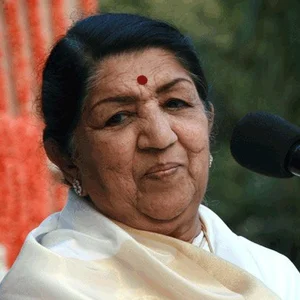

Nicknamed the “Nightingale of India”, Lata Mangeshkar (1929–2022) is the most celebrated playback singer in Indian cinema. Over a career spanning more than 70 years, she recorded over 30,000 songs in some thirty languages, becoming a national cultural icon.
Lata Mangeshkar(1929 — 2022)
Lata Mangeshkar
Inde
8 min read
Frequently asked questions
Famous Quotes
« Music is the universal language of mankind.»
Key Facts
- Born on September 28, 1929, in Indore, in British India
- Began her professional career at age 13 following her father's death in 1942
- Recorded more than 30,000 songs in 36 languages over a 70-year career
- Received the Bharat Ratna in 2001, India's highest civilian honour
- Passed away on February 6, 2022, in Mumbai; a national period of mourning was declared in India
Works & Achievements
Playback song for the romantic film Mahal that introduced Lata Mangeshkar to the Indian public at large. Her ethereal voice combined with images of actress Madhubala created a striking effect and launched her national career.
Patriotic song composed by C. Ramchandra with lyrics by Kavi Pradeep, dedicated to Indian soldiers who died in the Sino-Indian War. Performed live before a tearful Nehru, it became one of the most iconic songs of independent India.
Considered one of Lata's most beautiful performances, this melancholic song is regularly cited in rankings of the greatest Hindi songs of all time, a testament to her ability to express pure, timeless emotion.
An iconic duet with Kishore Kumar for the film Aandhi, showcasing Lata's ability to bring complex emotions to life across registers ranging from tenderness to heartbreak.
One of Bollywood's greatest commercial successes of the 1990s, this film made Lata a multigenerational figure, proving at over 60 years of age that she remained the defining voice of an entire industry.
Institutional compilation representing the full body of her work for the record label Saregama (formerly HMV India), which holds the largest catalogue of Lata's recordings — a testament to a career unparalleled in the history of world music.
Anecdotes
At just 5 years old, Lata Mangeshkar would slip backstage at her father's theater to watch his rehearsals. When Deenanath died in 1942, she was only 13 and immediately became the family's breadwinner, seeking roles in the nascent Hindi film industry to support her mother and four siblings.
In 1945, a Bombay producer turned her away, declaring that her voice was "too thin and too nasal" for cinema. Lata spent years honing her technique under the guidance of Hindustani classical music masters. That same producer later asked to meet her, but she politely declined — by then, she had already won over all of India.
On January 26, 1963, during the Republic Day parade in Delhi, Lata sang "Ae Mere Watan Ke Logon
a patriotic song dedicated to the soldiers who fell in the 1962 Sino-Indian War. Prime Minister Jawaharlal Nehru, seated in the audience, could not hold back his tears. This moment has remained etched in India's collective memory as the day a song became a national monument.
Lata Mangeshkar almost always wore white saris, a color symbolizing purity and devotion in Hindu culture. She explained that white helped her "focus on the music rather than on appearances
a deliberate contrast to the glamour of the actresses whose voices she brought to life.
In 1974, the Guinness Book of Records credited her with the title of the artist who had recorded the most songs in the world. Lata herself put the figure in perspective, noting that she never kept an exact count. By the time of her death in 2022, estimates ranged between 30,000 and 50,000 songs in more than 36 languages.
Primary Sources
“My father taught me that music is a prayer. Every time I sing, I think of him and I sing for God. If people love what I offer, that is an added grace.”
“For her exceptional contribution to Indian music and national cinema, having embodied for more than five decades the voice of India across all its languages and traditions.”
“When I was recording ‘Ae Mere Watan Ke Logon’, I was thinking of each one of those soldiers who died in the frozen mountains. I was not trying to move Nehru-ji — I was trying to pay tribute to nameless heroes.”
“I never thought of my career as work. Every recording was a new life, a new story to tell with my voice. I would have sung even if no one had paid me.”
Key Places
Birthplace of Lata Mangeshkar, born on September 28, 1929, into a family of musicians. Her father ran a musical theater troupe (sangeet-natak) there, in which young Lata made her first stage appearances.
The capital of Indian cinema and the heart of Lata's career. It was in Bombay's recording studios that she recorded the vast majority of her 30,000 songs, collaborating with the greatest Bollywood composers for over seven decades.
The historic venue where Lata performed "Ae Mere Watan Ke Logon" before Prime Minister Nehru on January 26, 1963, during Republic Day celebrations, in a moment that became legendary in Indian cultural history.
The city where Lata spent part of her childhood and began receiving serious classical musical training. Pune is also the heartland of the Marathi culture to which the Mangeshkar family belonged.
A Hindu temple dedicated to the god Ganesha that Lata visited regularly throughout her life. Her devotion and frequent visits to this temple reflected the central place that spirituality held in her daily routine.
Typical Objects

The cornerstone of her career, Lata spent decades in front of studio microphones in Bombay, refining a technique that allowed her to adapt her voice to every style, every language, and every emotional register.

A drone string instrument used in Hindustani classical music to support the voice, the tanpura accompanied Lata's daily vocal practice — she had been trained in classical music from childhood by her father.
📷 CC BY-SA 3.0 · Wikimedia Commons ↗
Lata's iconic garment: she wore almost exclusively white saris throughout her life, a symbol of spiritual devotion and a deliberate rejection of ostentation despite her worldwide fame.

Lata memorized her songs from scores annotated by hand by composers such as S.D. Burman or Shankar-Jaikishan, reflecting the close collaboration between singer and composers during the golden age of Bollywood.

India's highest civilian honor, conferred in 2001, symbolizes the Indian state's recognition of Lata's role as a national cultural ambassador for more than six decades.

In India during the 1950s–1970s, the portable transistor radio was the primary medium for spreading film songs; it was through this small device that hundreds of millions of Indians — in villages and cities alike — first discovered Lata's voice.
School Curriculum
Vocabulary & Tags
Key Vocabulary
Daily Life
Morning
Lata woke at dawn, disciplined from childhood in Hindustani classical music, which requires vocal exercises early in the morning when the voice is at its freshest. She devoted the first hour of her day to *riyaz* (vocal exercises), singing morning ragas to maintain the range and suppleness of her voice.
Afternoon
Her afternoons were often spent in recording sessions at Bombay's studios, sometimes lasting several hours. She was renowned for her professionalism and speed: she quickly memorized lyrics and melodies, rarely needing more than a few takes to achieve a satisfactory result.
Evening
Lata's evenings were devoted to prayer and reading. A woman of Hindu faith, she regularly performed *puja* (devotional rituals) at home. She was also passionate about cricket, following the Indian team's matches with an enthusiasm that often surprised those meeting her for the first time.
Food
A strict vegetarian out of religious conviction, Lata followed a very light diet, especially before recordings. She avoided excess spices and anything that might affect her vocal cords, favoring grain porridges, cooked vegetables, and warm milk with honey.
Clothing
Lata wore almost exclusively white saris, breaking with the tradition of Indian performers who favored colorful and eye-catching outfits. This deliberate choice, maintained for decades, was tied to her spiritual devotion and a philosophy of artistic humility: it is the voice that should shine, not the clothing.
Housing
Lata spent most of her adult life in an apartment in Bombay (in the Peddar Road neighborhood), in an understated residential setting. Despite considerable wealth, she led a life of great simplicity, surrounded by her close family — she never married — and far removed from the ostentatious lifestyle of many Bollywood stars.