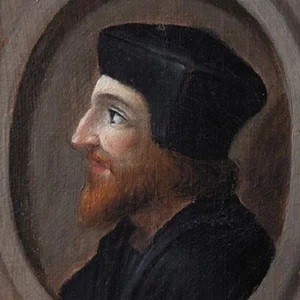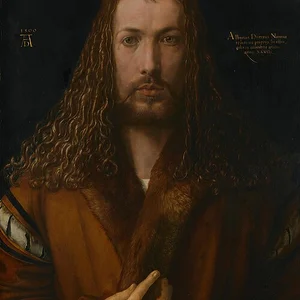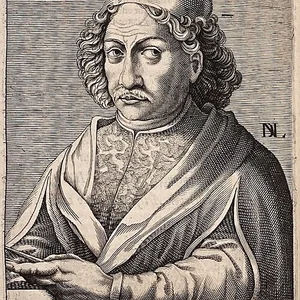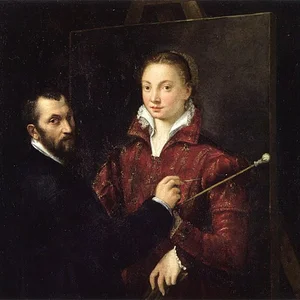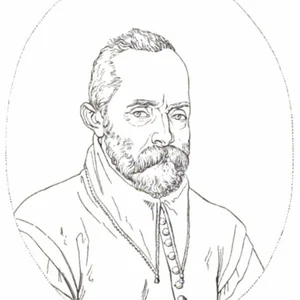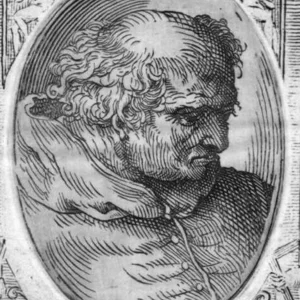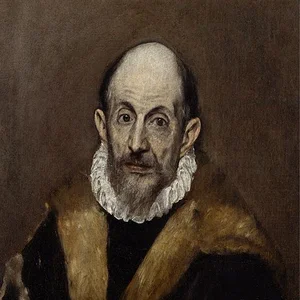

Painter, sculptor, and architect born in Crete in 1541, El Greco settled in Toledo, Spain, where he developed a unique style blending Byzantine, Venetian, and Mannerist influences. His works, characterized by elongated figures and intense colors, make him one of the forerunners of Expressionism.
El Greco(1541 — 1614)
El Greco
république de Venise, couronne de Castille
9 min read
Frequently asked questions
Key Facts
- 1541: Born in Candia (Crete), then under Venetian rule
- c. 1567: Trained in Venice in the workshop of Titian, master of color
- 1577: Settled permanently in Toledo, Spain, where he would spend the rest of his life
- 1586–1588: Created his masterpiece The Burial of the Count of Orgaz
- 1614: Died in Toledo; his work would go on to influence Cézanne, Picasso, and the Expressionists
Works & Achievements
A large oil on canvas housed in the Church of Santo Tomé in Toledo, depicting a miracle at the funeral of a Toledan nobleman. A masterpiece that synthesizes his mature style, with a division between the earthly and heavenly realms, and a group portrait of Toledo's elite of the time.
A large composition commissioned by Philip II for the Escorial and ultimately rejected by the king. The painting, now in the Escorial's collections, reflects the painter's radical originality — he placed the martyrdom scene in the background, defying conventional expectations.
A striking landscape depicting the city of Toledo beneath a stormy sky filled with dramatic clouds, housed at the Metropolitan Museum of Art in New York. It is one of the rare landscapes in the history of painting before the 17th century to treat landscape as its primary subject.
A late, visionary work depicting a passage from the Book of Revelation, featuring figures of extremely elongated proportions and a palette reduced to luminous blues and whites. Picasso drew direct inspiration from it for Les Demoiselles d'Avignon (1907).
A painting commissioned for the sacristy of Toledo Cathedral, depicting the moment soldiers strip Christ of his robe before the Crucifixion. The painter's first major Spanish work, it sparked a lengthy dispute with the cathedral chapter over its price.
El Greco's first major commission in Spain, comprising several paintings for the altars of this Toledan church. This altarpiece firmly established his reputation as a great master in Spain.
A painting depicting the knight Saint Martin sharing his cloak with a beggar, housed at the National Gallery of Art in Washington, D.C. A remarkable example of his ability to handle an equestrian figure with Mannerist elegance.
Anecdotes
El Greco, whose real name was Domínikos Theotokópoulos, was nicknamed 'El Greco' (the Greek) by the Spanish, who could not pronounce his Cretan name. Yet he always signed his paintings in Greek, even after decades spent in Spain, showing a deep attachment to his origins.
In 1580, El Greco attempted to secure a royal commission from Philip II to decorate the Escorial. He painted The Martyrdom of Saint Maurice, but the king did not care for it, finding the figures too elongated and the expression too dramatic. This rejection ended his ambitions at court and anchored him permanently in Toledo.
The philosopher and physician Francisco de Pisa reported that El Greco preferred to paint in a room with the shutters closed, because daylight seemed to him 'too harsh' for the inner light he sought to capture. This oft-cited anecdote illustrates his highly personal conception of light in painting.
El Greco lived in a twenty-four-room palace in Toledo, where he employed musicians to play during his meals. Despite a loyal clientele of aristocrats and Toledan clergy, he died in 1614 leaving behind debts, a testament to a lavish lifestyle that proved difficult to sustain.
Long regarded as a minor or even 'mad' painter, El Greco was rediscovered in the 19th century by artists such as Manet and Cézanne, and again in the 20th century by the Expressionists and Cubists. Picasso, who had studied his work, drew direct inspiration from The Opening of the Fifth Seal for several figures in Les Demoiselles d'Avignon.
Primary Sources
El Greco extensively annotated his copy of Vasari's Lives of the Artists, notably criticizing Michelangelo: 'Michelangelo was a good man, but he did not know how to paint.' These annotations reveal his artistic thinking and his independence from Italian canons.
The contract drawn up with the parish of Santo Tomé in Toledo specified in detail the subject, dimensions, and payment terms for the work. El Greco subsequently had to take legal action to obtain the full agreed sum, as the amount had been disputed by the patrons.
The records of the Toledo tribunal preserve the testimonies of experts who assessed the value of El Greco's paintings. These legal documents constitute one of the few direct sources on the contemporary reception of his work and on his social standing in Toledo.
The inventory drawn up following his death in 1614 lists more than a hundred unfinished canvases in his studio, sculptures in wax and clay, and an extensive library. This document attests to the scale of his output and his humanist culture.
Key Places
El Greco's birthplace, then under Venetian rule, where he received his early training as an icon painter in the Cretan Byzantine tradition. This dual Greek and Venetian heritage formed the foundation of his unique art.
El Greco stayed here around 1567 and frequented the workshop of Titian, master of color. He absorbed the Venetian technique of colorism and light, which profoundly shaped his artistic development.
El Greco spent time in Rome around 1570 within the humanist circle of Cardinal Farnese, where he studied the works of Michelangelo and the Mannerists. It was there that he developed his mastery of the elongated and expressive human figure.
The city where El Greco settled permanently in 1576 and spent the rest of his life. Once the capital of the Visigoth kingdom and a city of coexistence among Christians, Jews, and Muslims, it offered an intellectual climate and religious commissions that nourished his work.
Home to The Burial of the Count of Orgaz (1586), considered El Greco's absolute masterpiece. The work is still visible today in its original location.
Philip II had commissioned El Greco to paint The Martyrdom of Saint Maurice to decorate this palace-monastery, a symbol of Spanish Catholic power. The king's rejection of the work marked a decisive turning point in the painter's career.
Typical Objects

El Greco used a palette dominated by intense blues, golden yellows, and carmine reds. His distinctive mixtures, influenced by the Venetian glazing technique, allowed him to achieve the otherworldly luminous effects characteristic of his work.

The precision of faces and drapery in his canvases required very fine brushes. El Greco was renowned for the virtuosity of his brushwork, a legacy of his Byzantine training in manuscript illumination and icon painting.

Trained in the Cretan icon tradition, El Greco always kept Orthodox icons in his workshop. This influence can be seen in the hieratic quality of certain faces and in his treatment of gold and divine light in his compositions.

El Greco painted on large linen canvases coated with gesso (Bologna chalk mixed with glue), an Italian technique he adopted in Venice. The 1614 inventory lists more than a hundred canvases in progress in his workshop.

To compose his large multi-figure scenes, El Greco made small wax and clay figurines that he arranged in candlelit boxes. This method allowed him to study the effects of artificial light before painting.

El Greco owned an extensive library that included architectural treatises. He also produced architectural designs for Toledo and theorized on the relationships between architecture, painting, and sculpture in writings that survive only in fragments today.
School Curriculum
Vocabulary & Tags
Key Vocabulary
Daily Life
Morning
El Greco began his day early in his vast studio in the palace of the Marquis of Villena in Toledo, where he occupied twenty-four rooms. He organized the work of his assistants and his son Jorge Manuel, preparing canvases, grinding pigments, and sketching out large compositions in charcoal before painting the most important passages himself.
Afternoon
The afternoon was devoted to sittings with patrons, negotiations with representatives of the Church or religious brotherhoods, and visits from Toledo's aristocratic clientele. El Greco also received scholars and humanists, as he was himself a cultivated intellectual who spoke Greek, Spanish, and Italian.
Evening
In the evenings, according to contemporary accounts, El Greco would have musicians play at his table and entertained lavishly. He studied treatises on architecture, optics, and philosophy from his personal library, and wrote theoretical notes on painting. He sometimes closed the shutters of his studio to work by the artificial light of candles.
Food
Like the aristocrats and great Spanish artists of his time, El Greco led a sumptuous table life, at odds with his often strained finances. His diet included the typical Mediterranean products of Toledo: roasted meats, fish from the Tagus, olive oil, Castilian wines, and dried fruits. Imported spices — pepper, saffron, and cinnamon — seasoned festive dishes.
Clothing
El Greco dressed like a Spanish gentleman of rank, wearing dark velvet doublets, white lace ruffs, fine cloth cloaks, and buckled shoes. This careful attention to dress, visible in the self-portraits attributed to him, reflected his desire to be recognized as an artist of high social standing, and not merely as a craftsman.
Housing
For many years, El Greco rented a large apartment in the palace of the Marquis of Villena, in the heart of Toledo's Jewish quarter. This luxurious twenty-four-room residence served simultaneously as his studio, a showroom for works available for sale, and his family home. He never owned property and died leaving considerable unpaid rent.
Historical Timeline
Period Vocabulary
Visual Style
Style pictural inspiré du maniérisme de Le Greco : figures allongées et expressives, couleurs intenses (bleus cobalt, rouges cramoisis, jaunes acides), lumière surnaturelle et dramatique mêlant influences byzantines, vénitiennes et espagnoles.
Sound Ambience
Ambiance sonore de Tolède à la fin du XVIe siècle : cloches d'église, chants grégoriens, sons d'un atelier de peintre animé et musique de viole jouée par des musiciens engagés par Le Greco.
Liens externes & ressources
Références
Œuvres
L'Enterrement du comte d'Orgaz
1586
L'Ouverture du cinquième sceau
vers 1608-1614