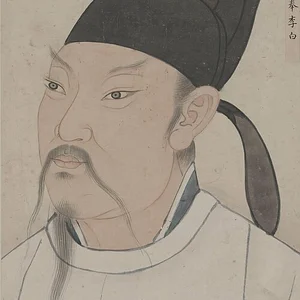

Li Bai (701–762) is considered one of the greatest poets of imperial China, known as the "Drunken Genius" or the "Immortal Poet." He lived during the Tang dynasty, the golden age of Chinese poetry. His work, deeply influenced by Taoism, celebrates nature, friendship, wine, and the moon.
Li Bai(701 — 762)
Li Bai
dynastie Tang
9 min read
Frequently asked questions
Famous Quotes
« Before my bed, a beam of moonlight — I thought it was frost upon the ground.»
« We drink together, the mountain and I, until the moon sets between us.»
Key Facts
- Born in 701, probably in Central Asia (in the region of present-day Kazakhstan or in Sichuan)
- Lived at the court of Emperor Xuanzong around 742–744, before being dismissed
- Wrote more than 1,000 poems, many celebrating nature, the moon, and wine
- Exiled following the An Lushan Rebellion (755–763), he wandered through southern China
- Died in 762 in Dangtu (Anhui province); legend holds that he drowned while trying to grasp the moon's reflection in the water
Works & Achievements
A four-line poem among the most memorized in all of Chinese literature, evoking homesickness by moonlight. Its apparent simplicity and emotional depth make it a timeless masterpiece.
A long lyric poem celebrating wine, friendship, and the refusal to yield to melancholy in the face of time's passage. Considered one of the pinnacles of the ancient-style poetry (gushi) of the Tang period.
A compilation of Li Bai's poetic works assembled by his cousin shortly before his death, gathering around 1,000 poems. This collection forms the foundation of all later editions of his work.
A poem composed during the difficult years following his exile, bearing witness to his ability to find beauty and serenity in the midst of personal hardship and the turmoil gripping the empire.
A sequence of three poems composed after his dismissal from court, expressing both frustration at life's obstacles and an unshakeable faith in the future. This cycle is emblematic of his genius for transforming personal experience into art.
Anecdotes
Li Bai was famous for his love of wine. It is said that he composed his finest poems in a state of intoxication, dictating verses to servants who rushed to write them down. Emperor Xuanzong himself is said to have admired this singular talent and invited the poet to court to enliven the imperial festivities.
Around 742, Li Bai was invited to join the court at Chang'an as an official poet. But his independent nature and excessive drinking quickly displeased the courtiers. After only two years, the emperor dismissed him with a generous reward — a polite way of ridding himself of this uncontrollable genius.
The most famous legend surrounding his death holds that he drowned trying to embrace the reflection of the moon in a lake from his boat, tumbling into the water while drunk. Though this story was almost certainly invented, it perfectly captures the image of the romantic, moon-struck poet that posterity has chosen to remember.
Li Bai considered himself a follower of Taoism and pursued the quest for immortality. He is said to have spent several years wandering from mountain to mountain, seeking Taoist hermits who could teach him the secrets of longevity. This spiritual quest deeply shaped his poetry, in which nature and the cosmos hold a central place.
During the An Lushan Rebellion (755–763), Li Bai rashly joined the retinue of a prince who had risen up against the reigning emperor. Arrested and sentenced to exile, he was ultimately pardoned along the way thanks to the intervention of an admiring general. This tragic episode, lived out in his old age, cast a shadow over the final years of his life.
Primary Sources
Before my bed, the bright moonlight — it looks like frost upon the ground. I raise my head and gaze at the brilliant moon; I lower my head and think of home.
Do you not see the waters of the Yellow River descend from heaven, rushing to the sea and never returning? Do you not see in the high halls men lamenting their white hair, black as silk in the morning, white as snow by evening?
I dream of you often, my friend — a sign of how deep my affection runs. You dwelt among forests and lakes, yet you haunted my thoughts.
Li Bai, free-spirited and unburdened by worldly cares, loved wine and the composition of poetry. He traveled the mountains and rivers of the entire empire, and his reputation spread beyond the borders of China.
Key Places
The imperial capital of the Tang Empire and one of the largest cities in the world at the time, Chang'an was the center of cultural and political life where Li Bai resided at the court of Emperor Xuanzong between 742 and 744.
This iconic mountain range, celebrated for its mists and waterfalls, inspired one of Li Bai's most famous poems, 'Viewing the Waterfall at Mount Lu', and reflects his deep love for majestic landscapes.
The place where Li Bai died in 762, having taken refuge with his cousin Li Yangbing. It was here that his poems were gathered and edited, and where he was buried at the foot of Mount Qingshan.
Li Bai traveled extensively along China's great river and celebrated it in many poems. The Three Gorges in particular, with their dizzying cliffs, fired his poetic imagination.
A garrison town on the western frontier of the Tang Empire, considered the most likely birthplace of Li Bai, bearing witness to the vast reach and cultural diversity of the empire at its height.
Typical Objects

Wine was inseparable from Li Bai's life and poetic creativity. Refined cups of jade or chased silver, typical of Tang aristocracy, symbolize his art of transforming intoxication into inspiration.

The essential tool of the Chinese scholar, the animal-hair brush and the black ink stick ground on stone allowed Li Bai to set his verses down on paper or silk, often in an inspired and rapid stroke.

Tang dynasty poems were copied onto silk or paper scrolls, precious materials that poets exchanged as gifts. Several of Li Bai's poems have survived thanks to these carefully preserved manuscript copies.

A plucked string instrument very popular during the Tang dynasty, the pipa often accompanied the recitation or singing of poems. Li Bai frequently evokes music in his verses as a companion to night and wine.

In his youth, Li Bai trained in swordsmanship and dreamed of becoming a wandering knight-errant (youxia). The sword appears as a symbol of freedom and honor in several of his poems, reflecting an ideal of adventure and martial valor.

Li Bai spent much of his life traveling along China's rivers and waterways. The boat was both his means of transport and a place of poetic contemplation — especially for watching the moon's reflection shimmer on the water.
School Curriculum
Vocabulary & Tags
Key Vocabulary
Daily Life
Morning
Li Bai often woke late, especially after long evenings of drinking and poetic composition. He would begin his day with Taoist meditation or calligraphy exercises — essential practices for a cultivated scholar under the Tang dynasty. During his more settled periods, he sometimes received visitors or disciples who came seeking a poem.
Afternoon
Afternoons were often devoted to travel or walks in nature, his primary source of inspiration. He would spend long stretches observing landscapes — waterfalls, cliffs, clouds — before composing verses in his mind. When at court or in the city, he frequented the markets, taverns, and gardens where scholars and artists gathered.
Evening
Evening was Li Bai's favorite time: gatherings with friends over jars of rice or millet wine, poems recited by lantern light, and long contemplation of the moon. These celebrations — at once festive and melancholic — were the heart of his social life and creative work, with wine loosening his inhibitions and setting his imagination free.
Food
The everyday diet under the Tang dynasty centered on rice, millet, and noodles, served alongside stir-fried vegetables, tofu, and fish depending on the region. As an inveterate traveler, Li Bai sampled local specialties wherever he went, and had a particular fondness for rice wine (mijiu), sometimes infused with herbs — which, by his own poetic admission, he consumed in generous quantities.
Clothing
As a scholar and court poet, Li Bai wore long, wide-sleeved silk robes (pao), fastened with a jade or leather belt depending on the occasion. Clothing colors signaled social rank: white and blue for unofficial scholars, brighter hues and embroidery for imperial audiences. He wore a scholar's upturned-brim hat and straw sandals during his wanderings.
Housing
Li Bai had no fixed home and spent much of his life as a wanderer, staying in roadside inns (jiudian), welcoming Buddhist or Taoist monasteries, or with friends and patrons. During his time at the Chang'an imperial court, he had quarters within the palace. In his poems, he describes open wooden and bamboo pavilions set amid nature as his ideal dwelling.
Historical Timeline
Period Vocabulary
Visual Style
Peinture à l'encre de Chine de style Tang, avec des montagnes brumeuses, des lavis d'indigo et de jade, et un lettré solitaire en robes de soie contemplant la lune sur l'eau.
Sound Ambience
Ambiance nocturne au bord d'un fleuve sous la dynastie Tang : eau courante, luth pipa lointain, cloche de temple dans la brume des montagnes et murmures d'une veillée de poètes.
Liens externes & ressources
Références
Œuvres
Jing ye si (Pensées d'une nuit silencieuse)
vers 726
Jiang jin jiu (Qu'on apporte du vin !)
vers 752
Recueil des poèmes de Li Bai (Li Taibai ji)
762, édité par Li Yangbing
Bateau de nuit sur le fleuve Jing (Ye bo Niuhu)
vers 759
Les Difficultés de la route (Xing lu nan)
vers 744