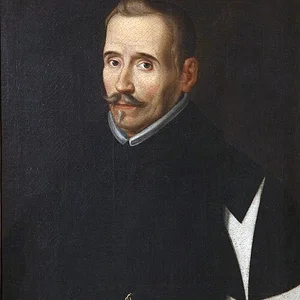

Lope de Vega (1562-1635) was the greatest playwright of the Spanish Golden Age. A remarkably prolific author, he revolutionized theater by breaking classical rules and popularizing the "comedia nueva." He was also a leading lyric and epic poet.
Lope de Vega(1562 — 1635)
Lope de Vega
Espagne
9 min read
Frequently asked questions
Famous Quotes
« Lo que fue ayer fue, y es ya cuento vano.»
Key Facts
- Born in Madrid in 1562, he led a turbulent life marked by numerous love affairs.
- He is said to have written between 800 and 1,800 plays, of which around 400 have survived.
- In 1609, he published the Arte nuevo de hacer comedias, a theoretical manifesto on the reform of Spanish theater.
- He was ordained a priest in 1614 while continuing to write.
- He died in Madrid in 1635; his funeral lasted three days, a testament to his immense popularity.
Works & Achievements
A three-act drama telling the story of an entire village rising up against a tyrannical commander. Considered one of the first works to stage the collective resistance of a people against oppression, it is still performed and studied around the world.
A theoretical manifesto in verse in which Lope justifies his break with the Aristotelian rules of classical theatre. This foundational text laid the groundwork for the Spanish comedia nueva and remains an essential document for understanding Baroque theatre.
A comedy of manners and intrigue exploring the theme of impossible love between a countess and her secretary. Its title became a proverb ('the dog in the manger, who neither eats nor lets others eat') and the play was adapted for the screen in 1996.
A lengthy epic poem in ten cantos celebrating the death of the English privateer Francis Drake, enemy of Spain. Lope expresses fervent patriotism and deep Catholic faith in the tradition of the great Renaissance epics.
A collection of religious poems composed after Lope's ordination and the deaths of those close to him. These sonnets, steeped in sincere repentance and mystical devotion, rank among the finest in all of Spanish poetry.
An autobiographical prose dialogue inspired by his youthful passion for Elena Osorio. A late-career work of great psychological depth, it is regarded as his literary testament and one of the masterpieces of seventeenth-century Spanish prose.
An honour drama centring on a peasant farmer who kills the nobleman who seduced his wife. An emblematic work of the honour-among-commoners theme in Golden Age theatre, it illustrates the dignity of ordinary people in the face of the powerful's arbitrary rule.
Anecdotes
Lope de Vega is one of the most prolific authors in the history of world literature: he is credited with more than 1,800 plays, of which around 400 have survived to this day. Even his contemporaries struggled to believe that a single man could produce such a quantity of quality works.
By the age of five, Lope de Vega could already read both Latin and Spanish. As a child, he would trade his toys for books belonging to older schoolmates, and is said to have composed his first verses before he even knew how to write, dictating them to friends.
In 1588, Lope de Vega sailed with the Spanish Armada sent against England. During the voyage, he wrote a long epic poem, La Dragontea, attacking the English admiral Francis Drake. The fleet was devastated by storms, but Lope returned home safely and continued writing without pause.
Lope led a turbulent love life: he was banished from Madrid for circulating defamatory pamphlets against his mistress Elena Osorio and her father. He then eloped with Isabel de Urbina, whom he married, was sent into exile, fought with the Armada, and went on to have numerous affairs. Late in life, having become a priest, he continued his clandestine romances nonetheless, which plunged him into profound spiritual torment.
Lope de Vega was so famous that the expression "es de Lope" (it's Lope's work) had become a popular Spanish phrase used to describe anything excellent or remarkable. His funeral in Madrid in 1635 drew an enormous crowd; he was mourned as a national figure.
Primary Sources
Como las paga el vulgo es justo hablarle en necio para darle gusto... Y cuando he de escribir una comedia, encierro los preceptos con seis llaves.
JUEZ: ¿Quién mató al Comendador? TODOS: Fuenteovejuna, señor. JUEZ: ¿Quién es Fuenteovejuna? TODOS: Todo el pueblo a una.
¿Qué tengo yo que mi amistad procuras? ¿Qué interés se te sigue, Jesús mío, que a mi puerta, cubierto de rocío, pasas las noches del invierno escuras?
Yo he pensado que tienen las ciudades sus fisonomías como los hombres; Madrid ha sido siempre para mí madre piadosa.
Key Places
Lope de Vega lived in this Madrid house from 1610 until his death in 1635. Now converted into a museum (Casa de Lope de Vega), it preserves his garden and period furnishings.
One of the two great popular theatres of Madrid where most of Lope's plays were first performed. This open-air corral de comedias welcomed all social classes, from commoners to nobles.
During his exile from Madrid (1588–1595), Lope spent time in Valencia, a city with a thriving theatrical scene. There he refined his dramatic style through contact with Valencian playwrights.
Lope served as secretary to the Duke of Alba at Alba de Tormes between 1592 and 1595. This aristocratic posting allowed him to observe court life and write in a stable environment, far from the bustle of Madrid.
In 1588, Lope set sail from Lisbon with the Spanish Armada. This military experience at sea, from which he miraculously survived, left a deep mark on his imagination and his epic works.
Typical Objects

Lope de Vega wrote at a prodigious speed, sometimes completing an entire play in just a few days. His quill was his most precious daily tool, a symbol of his legendary productivity.

Lope's plays circulated as manuscripts before being copied out for acting troupes. These pages, often hastily scrawled, were carefully guarded by theater company directors.

Ordained as a priest in 1614, Lope wore clerical dress while continuing to move in theatrical circles and pursue romantic relationships, embodying the tension between devotion and worldliness so characteristic of the Golden Age.

A deeply religious man despite his personal failings, Lope prayed daily and composed sacred poetry; his rosary was a genuine object of devotion, visible in portraits from his later years.

The corrales de comedias — inner courtyards converted into open-air theaters — were the natural home for Lope's works. He knew their staging constraints intimately and wrote directly for these popular venues.

Lope was a soldier before he became a priest: he bore a sword during military campaigns in the 1580s. This weapon symbolizes the virile, adventurous spirit of his youth, which lives on in the heroes of his comedias.
School Curriculum
Vocabulary & Tags
Key Vocabulary
Daily Life
Morning
Lope rose early, attended Mass in the chapel of his home or at the nearby Church of San Sebastián, then spent the first hours of the day writing with a focus and speed that astonished his contemporaries. He could compose several hundred lines of verse before the midday meal.
Afternoon
In the afternoons, Lope received friends, actors, and patrons in his drawing room, or visited rehearsals at the corrales de comedias. He personally supervised the staging of his plays, advising actors on diction and delivery. He also frequented literary academies where poets and scholars engaged in spirited debate.
Evening
Evenings were often devoted to theatrical performances, which Lope attended as a keen observer. In his later years, he spent his evenings in prayer, spiritual reading, or composing religious poetry, seeking to atone for a life he felt had been too given over to earthly passions.
Food
Seventeenth-century Madrid cuisine centered on cocido (a hearty stew of chickpeas, vegetables, and meat), bread, Castilian wine, and fresh market produce. As a member of a religious brotherhood, Lope strictly observed days of abstinence in his later years, limiting himself to fish, legumes, and dried fruits.
Clothing
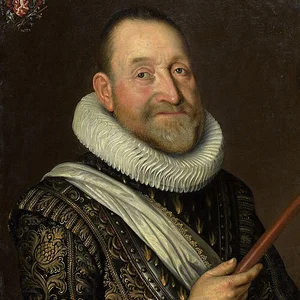
In his youth, Lope wore a black velvet doublet, a starched ruff (lechuguilla), and a gentleman's sword — the standard dress in Madrid's noble circles. After his ordination in 1614, he permanently adopted the black cassock, which he wore even when attending the theater — something that occasionally scandalized church authorities.
Housing
From 1610 until his death, Lope lived in a modest but comfortable house on the Calle de Francos, with a small garden he cherished and celebrated in several poems. The house included a private oratory, a well-stocked library, and a study where he wrote his countless plays and poems.
Historical Timeline
Period Vocabulary
Visual Style
L'esthétique visuelle évoque le Baroque espagnol du Siècle d'Or : clair-obscur dramatique à la Zurbarán, velours noirs et fraises blanches empesées, corrales animés baignés de lumière méditerranéenne contrastant avec les intérieurs recueillis d'un homme d'Église et de lettres.
Sound Ambience
L'univers sonore de Lope de Vega mêle le brouhaha populaire des corrales de comedias madrilènes, les cloches des églises baroques et le grattement incessant de la plume dans le silence de son cabinet de travail.
Liens externes & ressources
Références
Œuvres
Fuenteovejuna
c. 1612-1614
Arte nuevo de hacer comedias en este tiempo
1609
La Dragontea
1598
Rimas sacras
1614
La Dorotea
1632
Peribáñez y el Comendador de Ocaña
c. 1609-1613