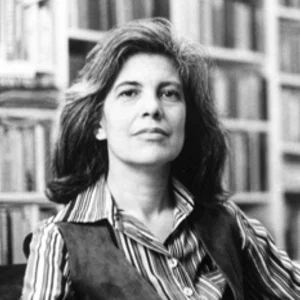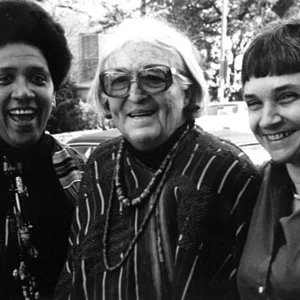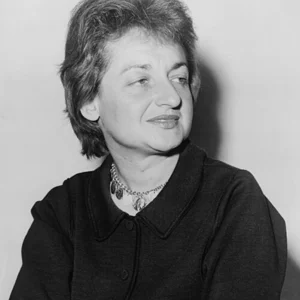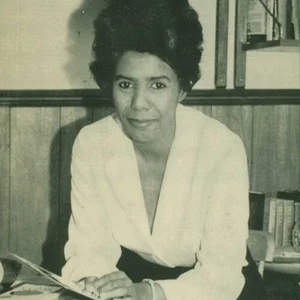

American playwright and author (1930–1965), Lorraine Hansberry was the first Black woman to have a play produced on Broadway with *A Raisin in the Sun* (1959). A civil rights activist, she wove art and political commitment together in her fight against racial segregation.
Frequently asked questions
Famous Quotes
« Never be afraid to sit awhile and think.»
« The thing that makes you exceptional, if you are at all, is inevitably that which must also make you lonely.»
Key Facts
- 1930: Born in Chicago into a Black middle-class family confronted with residential segregation
- 1959: *A Raisin in the Sun* premieres on Broadway — the first play by a Black woman ever produced on that stage
- 1959: Youngest playwright and first Black woman to win the New York Drama Critics' Circle Award
- 1961: Film adaptation of *A Raisin in the Sun*, starring Sidney Poitier
- 1965: Died at 34 from pancreatic cancer, leaving behind an unfinished body of work
Works & Achievements
The first play by a Black woman produced on Broadway, it follows a Black Chicago family trying to buy a home in a white neighborhood despite racist pressure. Winner of the New York Drama Critics' Circle Award, it is now considered a masterpiece of twentieth-century American theater.
Hansberry's second Broadway play, centered on a New York Jewish intellectual confronting his own political contradictions amid the turbulence of the 1960s. The play closed permanently on the day of the author's death.
An autobiographical work compiled after her death by her ex-husband Robert Nemiroff from her letters, diaries, and unfinished plays. It inspired Nina Simone's eponymous song, which became an anthem of the civil rights movement.
An unfinished play about the anticolonial struggle in Africa, published and staged after her death. It reveals Hansberry's commitment beyond the American racial question, toward a broader reflection on oppression and emancipation worldwide.
A photojournalism book accompanied by a text by Hansberry, documenting the American civil rights movement through the SNCC's striking photographs. A major historical record of the struggle for racial equality.
Anecdotes
In 1938, Lorraine Hansberry's father, Carl Hansberry, purchased a home in a white neighborhood of Chicago despite the so-called “restrictive covenants” — contractual clauses prohibiting sales to Black people. The family was harassed: neighbors threw a concrete block through the living room window. Carl Hansberry took the case all the way to the United States Supreme Court, which ruled in his favor in 1940 in Hansberry v. Lee. This family battle directly inspired the central plot of A Raisin in the Sun.
At the Broadway premiere of A Raisin in the Sun on March 11, 1959, Lorraine Hansberry was only 29 years old. The play won the New York Drama Critics' Circle Award, making her the first Black woman and the youngest person ever to receive this honor. Sidney Poitier, who played the lead role of Walter Lee Younger, became an international star thanks to this production.
In May 1963, as the civil rights movement reached a critical point, Lorraine Hansberry took part in a tense meeting with Attorney General Robert F. Kennedy. Together with other Black public figures including James Baldwin, she demanded that the federal government take concrete action against segregation. Kennedy was visibly shaken by the participants' candor; Hansberry reproached him for not personally standing up for activists who had been arrested in the South.
Diagnosed with pancreatic cancer in 1963, Lorraine Hansberry continued to write and to fight for civil rights despite her illness. Her play The Sign in Sidney Brustein's Window was kept running thanks to the efforts of friends and admirers who bought up tickets to save it from closing. She died on January 12, 1965, at just 34 years old — the very day the play closed for good.
The title A Raisin in the Sun is taken from the poem A Dream Deferred by Black poet Langston Hughes, which asks what becomes of a dream that is put off — “Does it dry up like a raisin in the sun?” Hansberry also corresponded in secret with the lesbian magazine The Ladder under a pseudonym, reflecting her multiple commitments at a time when LGBTQ+ visibility was nearly impossible for a woman in public life.
Primary Sources
WALTER: You see, this little liquor store we got in mind cost seventy-five thousand and we figured the initial investment on the place be 'bout thirty thousand, see. That be ten thousand each. Course, there's a couple of hundred you got to pay so's you don't spend your life just waiting for them clowns to let your license get approved.
I think it is about time that equipped women begin to take on some of the ethical questions which a male-dominated culture has produced and dissect and analyze them quite closely.
Petitioners, Negro citizens of Illinois, desire to purchase and occupy a dwelling in a neighborhood of Chicago in which they are prevented from doing so by the terms of a 'restrictive covenant' which provides that no part of the property shall be sold to persons of the Negro race.
I was born on the Southside of Chicago. I was born black and female. I was born in a depression after one world war, and came into my adolescence during another.
Key Places
The neighborhood where Lorraine Hansberry was born and raised in a middle-class Black family. It was here that her father waged his legal battle against restrictive covenants — a foundational experience that gave rise to *A Raisin in the Sun*.
The theater where *A Raisin in the Sun* had its world premiere on **March 11, 1959**. This Midtown Manhattan venue was the site of Hansberry's historic triumph — she became the first Black woman to have a play produced and performed there.
The bohemian Manhattan neighborhood where Lorraine Hansberry lived after moving to New York. There she moved in artistic and activist circles, rubbing shoulders with **James Baldwin**, **Nina Simone**, and other progressive intellectuals.
Lorraine Hansberry studied here in the late 1940s. It was there that she discovered the theater of **Sean O'Casey** and developed her political convictions, before leaving without a degree to move to New York.
Lorraine Hansberry took part in the **March on Washington** in **1963** and met with **Robert F. Kennedy** in this city that same year to advocate for civil rights at the highest levels of the federal government.
Typical Objects

Lorraine Hansberry's everyday tool for writing her plays, letters, and activist articles. She wrote much of *A Raisin in the Sun* in her Greenwich Village apartment in New York.

A militant newspaper founded by Paul Robeson, for which Hansberry worked as a journalist from 1950. She wrote articles denouncing racial segregation and colonialism.

Lorraine Hansberry kept numerous notebooks in which she developed her dramatic and political ideas. These personal writings made possible the posthumous publication of *To Be Young, Gifted and Black*.

An American lesbian publication to which Hansberry contributed letters under a pseudonym from 1957, reflecting her awareness of the multiple forms of oppression in conservative America.

Lorraine Hansberry drew directly on Hughes's poem *A Dream Deferred* for the title of her most celebrated play, rooting her work in the literary tradition of the Harlem Renaissance.

The Broadway posters announcing *A Raisin in the Sun* in 1959 have become historical documents, symbolizing the breakthrough of Black artists into mainstream American theater.
School Curriculum
Vocabulary & Tags
Key Vocabulary
Tags
Daily Life
Morning
Lorraine Hansberry rose early in her Greenwich Village apartment and began her day by reading the newspapers, particularly African American activist publications like the Chicago Defender. She reserved her mornings for creative writing, considering these hours the most conducive to dramatic work, before the political and social demands of the day began to pile up.
Afternoon
Afternoons were often taken up by activist meetings, debates with other intellectuals such as James Baldwin, or theatrical rehearsals. She was an active participant in New York's progressive circles, moving between civil rights advocacy groups and the avant-garde literary circles of the Village.
Evening
Evenings brought lively discussions in Greenwich Village cafes and apartments, often stretching late into the night. Hansberry frequented art openings, poetry readings, and jazz concerts — an activist culture where art and politics mingled naturally in the intellectual ferment of New York in the 1950s and 60s.
Food
Like many New York intellectuals of the era, Hansberry often ate at small restaurants in the Village or shared meals with artist and activist friends. African American Southern cooking — soul food inherited from her childhood in Chicago — remained a connection to her cultural roots, even at the heart of the New York bohemian scene.
Clothing
Lorraine Hansberry adopted an elegant and polished style, typical of the Black intellectual woman of the 1950s seeking to be taken seriously in environments dominated by white men. She wore tailored dresses and well-cut suits for her public appearances, combining visible dignity with an assertion of identity at a time when the gaze directed at Black women was laden with prejudice.
Housing
She lived in a modest but welcoming apartment in Greenwich Village, a neighborhood that at the time was home to artists, writers, and activists of all backgrounds. Her space was filled with books, piled manuscripts, and activist journals — a workspace as much as a living space, where she regularly hosted friends, collaborators, and committed intellectuals.
Historical Timeline
Period Vocabulary
Liens externes & ressources
Références
Œuvres
A Raisin in the Sun
1959
The Sign in Sidney Brustein's Window
1964
To Be Young, Gifted and Black
1969 (posthume)
Les Blancs
1972 (posthume)
The Movement: Documentary of a Struggle for Equality
1964