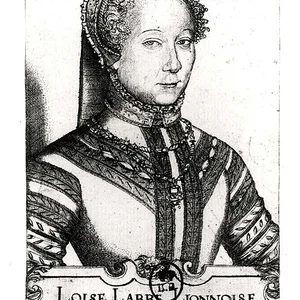

A 16th-century Lyonnaise poet nicknamed 'la Belle Cordière' (the Beautiful Ropemaker), Louise Labé is celebrated for her passionate love sonnets. An iconic figure of the French Renaissance, she championed women's access to education and literary creation.
Louise Labé(1524 — 1566)
Louise Labé
France
8 min read
Frequently asked questions
Famous Quotes
« I live, I die; I burn and drown at once.»
« As long as my eyes can shed their tears / To mourn with you the happiness we've lost.»
Key Facts
- Born around 1524 in Lyon, daughter of a ropemaker, which earned her the nickname 'la Belle Cordière'
- Published her complete works in 1555, a collection including a prose debate, 3 elegies, and 24 sonnets
- Hosted an intellectual salon at her Lyon home, welcoming poets and humanists
- As early as 1555, championed women's right to learn and write in her dedicatory epistle
- Died in 1566 in Parcieux-en-Dombes
Works & Achievements
The sole collection published by Louise Labé, gathering her complete works: a prose Debate, three elegies, and twenty-four sonnets. Its publication was a landmark literary event of the Lyonnais Renaissance.
A prose dialogue staging Folly and Love before the gods of Olympus. This playful allegorical work showcases Louise Labé's humanist culture and subtle irony.
Poems in decasyllabic verse expressing the torments and hopes of love. The elegies are distinguished by their melancholic tone and their assertion of an authentic feminine sensibility.
The heart of Louise Labé's poetic work, these Petrarchan sonnets explore the contradictions of desire with rare intensity. Sonnet VIII ('Je vis, je meurs') is the most celebrated and appears in many school textbooks.
The prefatory text of the collection, addressed to a friend, in which Louise Labé argues for women's right to education and literary creation. A manifesto ahead of its time, it is a major reference in the history of literary feminism.
Anecdotes
Louise Labé owes her nickname 'la Belle Cordière' (the Beautiful Ropemaker) to her marriage to Ennemond Perrin, a prosperous Lyon rope manufacturer. Far from confining herself to the role of a merchant's wife, she transformed their home into a genuine literary salon, welcoming the greatest humanist poets of her time.
According to several chroniclers of the era, Louise Labé reportedly took part, in her youth, in equestrian exercises and even armed tournaments, dressed in armor. While some historians still debate how much legend surrounds these accounts, they bear witness to the exceptional reputation for freedom and boldness that defined her public persona.
In 1555, Louise Labé entrusted her works to the Lyon printer Jean de Tournes, one of the most renowned in France. At the head of the collection, she addressed a dedicatory letter to her friend Clémence de Bourges, urging all women to cultivate their minds and not to 'scorn glory' — a remarkably daring act for the time.
Lyon in the sixteenth century was one of the most dynamic cities in Europe: a crossroads of trade and a cradle of French humanism. Louise Labé moved in the circle of the École lyonnaise, a group of Petrarchan poets that included Maurice Scève and Pernette du Guillet. This intellectual ferment directly shaped the sensibility and literary ambition of her sonnets.
At her death in 1566, Louise Labé left her belongings to friends and the poor, having no children. Her body of work — twenty-four sonnets, three elegies, and a prose Debate — is slender in volume but so intense in feeling that it secured her a lasting legacy, and her name remains synonymous with the female voice in French Renaissance literature.
Primary Sources
The time having come, Mademoiselle, when the harsh laws of men no longer prevent women from applying themselves to the sciences and disciplines: it seems to me that those who have the means ought to make use of this honorable freedom.
I live, I die: I burn and I drown. / I am consumed by heat while enduring bitter cold; / Life is to me both too soft and too hard.
In the time when Love, conqueror of men and gods, / Set my heart ablaze with its flame, / Igniting with its cruel rage / My blood, my bones, my spirit and my courage.
Love is blind, they say; and if that is so, he cannot see beauty, nor grace, nor anything worthy of being loved.
Key Places
Louise Labé's birthplace and home city, Lyon was one of Europe's leading economic and intellectual centers in the 16th century. Its international trade fairs and thriving printing houses made it a hub of French humanism.
The bourgeois residence where Louise Labé held her literary salon, welcoming poets, humanists, and musicians. It was here that the work of the 'Belle Cordière' took shape, at the heart of Lyon's intellectual life.
The workshop of printer Jean de Tournes, renowned for the quality of his illustrated editions, is where Louise Labé's Euvres were printed in 1555. Tournes was one of the most important printers of the French Renaissance.
A village in the Ain department where Louise Labé owned a property and spent her final years. It was here that she died in 1566 and chose to be buried.
Liens externes & ressources
Références
Œuvres
Euvres de Louïze Labé Lionnoize
1555
Débat de Folie et d'Amour
1555
Trois élégies
1555
Vingt-quatre sonnets
1555
Lettre dédicatoire à Clémence de Bourges
1555