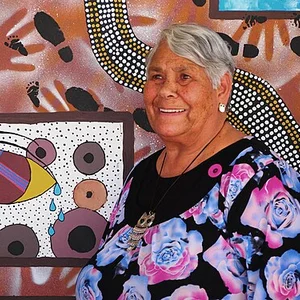

An Australian activist for Indigenous peoples' rights, Lowitja O'Donoghue was the first Aboriginal woman to lead ATSIC (the Aboriginal and Torres Strait Islander Commission). A trained nurse, she dedicated her life to defending civil rights and promoting reconciliation between Indigenous and non-Indigenous Australians.
Frequently asked questions
Key Facts
- 1932: born in Quorn, South Australia, into a Yankunytjatjara Aboriginal family
- 1950s: became a nurse, one of the first Aboriginal women to practise the profession
- 1990: appointed chairperson of ATSIC, the first Aboriginal woman to hold the position
- 2000: carried the Olympic torch at the Sydney Games, a symbol of reconciliation
- 2024: passed away at the age of 91, leaving a lasting legacy for Indigenous rights
Works & Achievements
As the first chairperson of ATSIC, Lowitja O'Donoghue led the primary institution representing Australia's Indigenous peoples before the federal government. Her tenure was marked by greater recognition of land rights and improvements in Indigenous health and education policies.
Her testimony before the inquiry into the Stolen Generations contributed to the drafting of this landmark report, which documented the forced removal of Aboriginal children and paved the way for the Australian government's formal apology in 2008.
Lowitja O'Donoghue was an active participant in the Council for Aboriginal Reconciliation from its inception, tirelessly advocating for dialogue between Indigenous and non-Indigenous peoples grounded in historical truth and mutual respect.
Before her national career, she developed accessible health services for Aboriginal communities in Adelaide, applying her nursing skills directly to the benefit of disadvantaged and marginalised populations.
At the age of 90, Lowitja O'Donoghue publicly declared her support for the referendum to enshrine an Indigenous 'Voice' to Parliament in the Australian Constitution. Despite the negative outcome, her endorsement was a testament to her unwavering commitment until the very end of her life.
Anecdotes
Lowitja O'Donoghue was born in 1932 in the Indulkana region of South Australia. At the age of two, she was forcibly removed from her family by Australian authorities and placed in the Colebrook Home mission — an experience that shaped her life profoundly and that she took decades to speak about publicly, before courageously bearing witness so that the history of the Stolen Generations would be officially recognised.
In 1954, Lowitja O'Donoghue became one of the first Aboriginal women to earn a nursing qualification in Australia, after overcoming repeated rejections from several institutions due to the colour of her skin. Her determination to enter the profession earned her recognition as a pioneer, long before her political activism began.
During the 1967 Australian referendum — which for the first time allowed Aboriginal people to be counted in the national census — Lowitja O'Donoghue campaigned actively for the Yes vote. Passed with more than 90% support, it remains one of the most broadly endorsed referendums in Australian history and marked a turning point in her life as an advocate.
In 1990, Lowitja O'Donoghue was appointed the inaugural chairperson of ATSIC (the Aboriginal and Torres Strait Islander Commission), becoming the first Aboriginal woman to lead a national representative body for Australia's Indigenous peoples. Her appointment was welcomed around the world as a symbol of reconciliation and civil rights recognition.
In 2000, at the Sydney Olympic Games, Lowitja O'Donoghue carried the Olympic torch — a deeply symbolic act embodying the nation's aspiration for reconciliation. She continued until her death in 2024 to carry the voice of Australia's Indigenous peoples onto the world stage.
Primary Sources
"We are not asking for charity. We are asking for justice, for recognition, for the right to determine our own futures as the first peoples of this land."
"I was taken from my mother at the age of two. For years, I did not know her name. The separation was not an act of kindness — it was an act of government policy that stole our identity."
"Reconciliation is not a gift that governments can bestow upon us. It must be built, day by day, between people, through truth, through listening, and through a shared commitment to a better future."
"Nursing taught me that every human life has equal value. That lesson never left me. It is the foundation of everything I have fought for."
Key Places
Village of the Yankunytjatjara people where Lowitja O'Donoghue was born in 1932. This remote outback location remains a symbol of her origins and her unbreakable bond with Indigenous culture.
A religious institution where Lowitja O'Donoghue was forcibly placed at the age of two. She spent her childhood there, far from her family — a painful experience that fuelled her lifelong fight for the recognition of the Stolen Generations.
The centre of Lowitja O'Donoghue's political work, where she championed the rights of Indigenous peoples for decades — notably as chairperson of ATSIC and during debates on reconciliation.
The city where Lowitja O'Donoghue worked as a nurse and developed her activist commitments from the 1950s and 60s onward. She also led community health services for Aboriginal people there.
At the opening ceremony of the 2000 Sydney Olympics, Lowitja O'Donoghue carried the Olympic torch, making this venue the global stage for a powerful gesture of national reconciliation.
Typical Objects

Lowitja O'Donoghue wore the white nurse's uniform with pride in the 1950s, at a time when Aboriginal women entering this profession was extremely rare. This uniform symbolises her two-fold struggle: the fight for professional equality and the fight for the dignity of her people.

This 689-page official document, produced by the Australian Human Rights Commission, gathered testimonies from members of the Stolen Generations. Lowitja O'Donoghue featured prominently within it, and its publication marked a decisive turning point in the public recognition of the violence endured by Indigenous peoples.

Awarded to her on multiple occasions, this official honour recognised her exceptional commitment to civil rights and reconciliation. She always wore it with humility, reminding others that the honour had been bestowed upon her on behalf of all Aboriginal and Torres Strait Islander Australians.

Carrying the Olympic flame at the Sydney Games was a deeply symbolic act for Lowitja O'Donoghue. Witnessed by billions of viewers around the world, this gesture embodied the reconciliation between Indigenous Australia and contemporary Australia.

Originally from the Indulkana region on the edge of the Australian desert, Lowitja O'Donoghue maintained a deep connection throughout her life to her Yankunytjatjara ancestral lands. Maps of this remote region illustrate the contrast between the isolation of her origins and the national reach of her life's work.

A formidable and respected public speaker, Lowitja O'Donoghue took the floor at countless national and international forums. The microphone was her instrument of choice for bringing the voice of Australia's Indigenous peoples to policymakers and the general public.
School Curriculum
Vocabulary & Tags
Key Vocabulary
Daily Life
Morning
During her activist years (1990s), Lowitja O'Donoghue started her mornings early, often reading the national press to identify issues affecting Indigenous rights. She had a simple breakfast before preparing her notes for institutional meetings or community visits.
Afternoon
Her afternoons were filled with parliamentary hearings, consultations with representatives of Indigenous communities across Australia, or meetings with government officials. During her visits to rural communities, she listened, took notes, and faithfully reported back on the needs people expressed.
Evening
In the evenings, she worked on drafting speeches and reports, or attended official receptions. Back in South Australia, she regularly spent time with members of her extended community, keeping alive the family and cultural ties that her childhood at the mission had so painfully interrupted.
Food
Throughout her life, Lowitja O'Donoghue maintained a strong connection to traditional food from central Australia, particularly during her visits to Indulkana: kangaroo meat, quandong seeds, and desert fruits. In the city, she ate a simple, unpretentious contemporary Australian diet.
Clothing
In her official roles, she dressed in a restrained and elegant style — structured suits, often in warm or neutral tones — proudly wearing her honorary decorations. She sometimes chose accessories incorporating patterns or colours evoking Aboriginal culture, visually affirming her identity.
Housing
She spent much of her adult life in Adelaide, in modest accommodation that reflected her values of simplicity. She nonetheless maintained a strong connection to the Indulkana region and regularly stayed in communities across central Australia, sometimes sleeping in traditional shelters or community housing.
Historical Timeline
Period Vocabulary
Visual Style
Palette désertique aux ocres chauds, traversée par le noir et le jaune du drapeau aborigène, entre paysages arides du centre australien et intérieurs institutionnels des décennies de combat politique.
Sound Ambience
Mélange du désert aride d'Australie centrale, berceau culturel de Lowitja O'Donoghue, et des salles institutionnelles où elle porta la voix de son peuple pendant plus de cinquante ans.
Liens externes & ressources
Références
Œuvres
Présidence de l'ATSIC (Aboriginal and Torres Strait Islander Commission)
1990–1996
Témoignage dans le rapport 'Bringing Them Home'
1996–1997
Rôle d'ambassadrice de la réconciliation australienne
1991–2024
Direction des services de santé communautaire autochtones (Adélaïde)
1967–1984
Participation au débat sur le référendum constitutionnel (Voice to Parliament)
2023