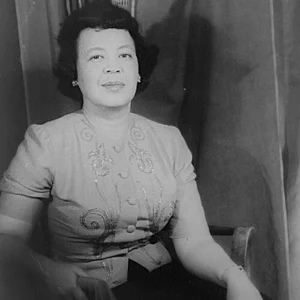

African American pianist and composer (1913–1972), Margaret Bonds was one of the first Black women to make her mark in American classical music. She blended gospel, blues, and European classical influences, and collaborated closely with Langston Hughes.
Margaret Bonds(1913 — 1972)
Margaret Bonds
États-Unis
8 min read
Frequently asked questions
Key Facts
- 1913: Born in Chicago into a family of musicians
- 1933: First Black woman to perform as a soloist with the Chicago Symphony Orchestra
- Long-term collaboration with poet Langston Hughes
- Composed 'The Ballad of the Brown King' (1954), a cantata on the Nativity
- 1972: Died in Los Angeles, leaving a body of work of over 200 compositions
Works & Achievements
A musical setting of Langston Hughes's celebrated poem, this art song for voice and piano stands as one of Bonds's earliest major collaborations with the poet and remains among her most performed works worldwide.
A Christmas cantata for chorus, soloists, and orchestra set to a text by Langston Hughes, celebrating one of the Magi as a Black figure. Premiered in a New York public school, the work has become a landmark of the African American choral repertoire.
A cycle of three songs for voice and piano set to texts by Langston Hughes, showcasing Bonds's mastery of the American art song by weaving together harmonic sophistication and African American sensibility.
A piano suite blending several traditional spirituals arranged and developed by Bonds, demonstrating her ability to elevate folk songs to the level of concert works without compromising their authenticity.
An orchestral work inspired by the Montgomery Bus Boycott (1955–1956), the first major act of the Civil Rights Movement. Through music, Bonds expresses the peaceful resistance and dignity of the African American community.
A virtuosic solo piano piece based on the spiritual 'Wade in the Water', widely regarded as Bonds's keyboard masterpiece, combining demanding classical technique with the emotional depth of the African American musical tradition.
Anecdotes
In 1933, at just twenty years old, Margaret Bonds became one of the first Black women to perform as a soloist with the Chicago Symphony Orchestra, at a concert at the Auditorium Theatre. This achievement took place in the depths of the Great Depression, in a deeply segregated America where Black musicians were systematically excluded from major concert halls.
When she enrolled at Northwestern University in Evanston, Margaret Bonds faced blatant discrimination: she was denied housing in university dormitories because of her skin color. She was forced to lodge with local residents, far from campus, while pursuing a demanding musical education.
Her meeting with the poet Langston Hughes gave rise to an artistic collaboration lasting more than thirty years. Together, they created numerous works blending poetry and music, including 'The Ballad of the Brown King', a Christmas cantata celebrating one of the Three Wise Men as a Black figure, first performed in 1954 at a New York public school.
Florence Price, a pioneering African American composer and close friend of the Bonds family, played a decisive role in Margaret's musical education. Under her mentorship, the young pianist learned to blend the techniques of European classical music with spirituals, blues, and gospel, forging her distinctive style.
Her piano work 'Troubled Water' (1967), based on the spiritual 'Wade in the Water', is today regarded as one of her most accomplished compositions. The piece demonstrates her ability to transform a sacred song of resistance, born during the era of slavery, into a modern concert work of considerable technical complexity.
Primary Sources
Their epistolary exchanges, held at the Beinecke Rare Book & Manuscript Library at Yale University, bear witness to a deep artistic collaboration and genuine friendship, discussing which texts to set to music and the aesthetic directions of their shared works.
The concert program from January 1933 lists Margaret Bonds as guest soloist, making her one of the first African American women to perform with this prestigious Chicago musical institution.
Chicago's leading African American newspaper regularly covered Margaret Bonds's career, celebrating her pianistic achievements and musical compositions as victories for the entire Black American community.
This setting of Langston Hughes's poem illustrates Bonds's technique of blending classical melody with gospel inflections, with expressive markings that reflect her pursuit of authenticity.
Key Places
Margaret Bonds's birthplace, where she grew up in a stimulating musical environment thanks to her pianist mother and the local Black musical community, enriched by the Great Migration.
The institution where Bonds studied music despite the racial discrimination that barred her from university housing. She nonetheless received a rigorous classical training there that formed the foundation of her technique.
The iconic center of African American culture where Bonds settled from the 1930s onward, at the heart of the Harlem Renaissance, rubbing shoulders with Langston Hughes, Duke Ellington, and other major figures.
The most prestigious concert hall in the United States, where Bonds performed as a pianist — a testament to her rise to the pinnacle of American musical life despite racial barriers.
The city where Margaret Bonds settled in the final years of her life, continuing to compose, teach, and advocate for the recognition of African American artists until her death in 1972.
Typical Objects

The central instrument in Margaret Bonds's life, on which she practiced daily and composed her works. She performed on it on the greatest American stages, from the Chicago Symphony Orchestra to Carnegie Hall.

Spirituals — songs born out of slavery — were a fundamental source of inspiration for Bonds, who wove them into her classical compositions to give them a powerful sense of identity and emotional resonance.

Bonds composed by hand on manuscript paper, filling pages with notes, harmonies, and expressive markings that blended classical notation with elements drawn from the African American oral tradition.

Hughes's poetry was the literary raw material from which Bonds shaped her songs and song cycles, annotating the texts to uncover their natural musical rhythms.

The long, elegant gown she wore for her stage performances was a symbol of the professional excellence Bonds insisted upon in a musical world that was often hostile to Black women.

These printed leaflets distributed at her recitals bore her name and biography, helping establish her reputation in the American classical music world and making a Black artist visible in a historically white space.
School Curriculum
Vocabulary & Tags
Key Vocabulary
Tags
Daily Life
Morning
Margaret Bonds began her mornings with long hours of piano practice, rehearsing works she was set to perform in concert. Like any high-level professional pianist, she maintained a rigorous daily discipline, working through virtuosic passages and refining the expressive nuances of her playing.
Afternoon
Her afternoons were often devoted to composition and teaching. She received students in her studio, passing on her vision of classical music rooted in African American traditions. She also collaborated by letter and in person with Langston Hughes, discussing texts to be set to music.
Evening
Bonds's evenings were frequently taken up with concerts, rehearsals, or cultural gatherings in Harlem salons. These evenings served as spaces of cultural resistance where Black artists, writers, and activists exchanged ideas in an atmosphere of creativity and commitment.
Food
Like many African Americans of her generation in Chicago and later New York, Bonds was familiar with Southern American cuisine — soul food — inherited from the Great Migration: fried chicken, sweet potatoes, beans, corn. In Harlem, she also discovered Caribbean cuisine, which had a strong presence in the neighborhood.
Clothing
On stage, Bonds wore long, elegant gowns, carefully chosen to assert her professional dignity in a musical world that often looked down on Black women. In everyday life, she dressed with understated elegance, in keeping with educated women of the Black American middle class.
Housing
In New York, Bonds lived in the African American neighborhoods of Manhattan, notably in Harlem, at the heart of Black cultural life. Her apartment was a gathering place for artists where musicians, poets, and civil rights activists came together in an atmosphere of creativity and political engagement.