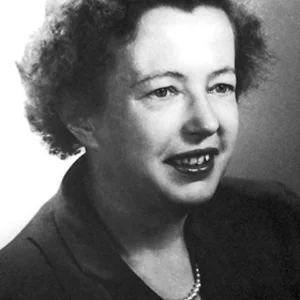

An American theoretical physicist of German origin, she developed the nuclear shell model of the atomic nucleus. In 1963, she became the second woman in history to receive the Nobel Prize in Physics, after Marie Curie.
Maria Goeppert Mayer(1906 — 1972)
Maria Goeppert-Mayer
États-Unis, Allemagne
8 min read
Frequently asked questions
Key Facts
- 1906: born in Kattowitz (German Empire, present-day Poland)
- 1930: earns her doctorate in physics from the University of Göttingen
- 1942–1945: contributes to the Manhattan Project (uranium isotope separation)
- 1949: publishes her nuclear shell model and the theory of magic numbers
- 1963: awarded the Nobel Prize in Physics, the second woman to receive it after Marie Curie (1903)
Works & Achievements
The first rigorous theoretical treatment of the simultaneous absorption of two photons by an atom. This work, thirty years ahead of its time, was not experimentally confirmed until the invention of the laser.
Maria contributed to classified research on the separation of uranium isotopes needed for the construction of the atomic bomb. This work deepened her understanding of nuclear physics.
A landmark paper published in Physical Review, presenting evidence for 'magic numbers' (2, 8, 20, 28, 50, 82, 126) corresponding to particularly stable nuclear configurations.
A decisive follow-up paper introducing spin-orbit coupling to mathematically explain the sequence of magic numbers, a cornerstone of the nuclear shell model.
A definitive reference work that synthesizes and develops the nuclear shell model. Co-written with the German physicist who had independently reached the same conclusions, this book became the standard textbook of the field.
Maria's Nobel Prize acceptance lecture, in which she clearly explains the intuition and intellectual journey that led her to the shell model, presented in a way accessible to non-specialists.
Anecdotes
During her years of study at the University of Göttingen, Maria Goeppert was one of the few women admitted into elite scientific circles. She earned her doctorate in 1930 under the supervision of Max Born, and her thesis on two-photon absorption processes was so remarkable that it would not receive experimental confirmation until thirty years later, with the invention of the laser.
After her marriage to chemist Joseph Edward Mayer and their move to the United States, anti-nepotism rules at American universities prevented Maria from obtaining a paid position for years, simply because her husband was already a professor at the same institutions. She therefore worked without pay as an associate at Johns Hopkins and then at Columbia, all while producing first-rate research.
It was a brief question from Enrico Fermi that triggered Maria Goeppert-Mayer's decisive breakthrough. In 1948, as she was presenting her observations on nuclear 'magic numbers,' he asked her: 'Is there any indication of spin-orbit coupling?' Within a matter of hours, she had mathematically formalized this coupling — the cornerstone of her nuclear shell model.
When she received the Nobel Prize in Physics in 1963, the main San Diego newspaper where she lived ran a front-page headline reading: 'San Diego Mother Wins Nobel Physics Prize.' This framing, which reduced a brilliant physicist to her family role, made Maria smile — she had spent decades watching her scientific achievements be downplayed because of her gender.
Maria Goeppert-Mayer was one of the few women to participate in the Manhattan Project during World War II. She worked on the separation of uranium isotopes, highly classified work she was long unable to discuss publicly. This research into nuclear structure directly fed the thinking that would ultimately lead to her shell model.
Primary Sources
The binding energies of nuclei show discontinuities at certain values of N and Z which are suggestive of the existence of nuclear shells. These 'magic numbers' are 2, 8, 20, 28, 50, 82, 126.
The assumption of a strong spin-orbit coupling leads to a splitting of the energy levels which gives the correct magic numbers. The level order obtained accounts for the observed nuclear spins and magnetic moments.
The shell model provides a systematic framework for understanding nuclear properties. The ordering of single-particle levels, determined by the spin-orbit interaction, explains the sequence of magic numbers observed experimentally.
Long ago, when I first started to work in nuclear physics, I noticed that a few numbers kept recurring — 2, 8, 20, 28, 50, 82, 126. These were the magic numbers. I tried to find some simple reason for them.
This doctoral thesis presents the first complete theoretical treatment of the two-photon absorption phenomenon, demonstrating that an atom can simultaneously absorb two photons whose combined energies correspond to an electronic transition.
Key Places
Maria Goeppert's birthplace, then part of the German Empire. Her father was a professor and later rector of the university there, creating an intellectually stimulating environment that profoundly shaped Maria's calling as a scientist.
One of the world's leading centers for theoretical physics in the 1920s and 1930s, where Maria earned her doctorate in 1930 under the supervision of Max Born. There she worked alongside figures such as Werner Heisenberg and Enrico Fermi.
It was here, between 1946 and 1959, that Maria developed her nuclear shell model. She worked alongside Enrico Fermi, whose pivotal question about spin-orbit coupling sparked her theoretical breakthrough.
A federal research laboratory where Maria conducted research alongside her university work. It provided her with experimental resources that complemented her theoretical studies on nuclear structure.
In 1960, Maria finally secured her first full-time paid academic position here, at the age of 54. It was also here that she learned, in 1963, that she would be awarded the Nobel Prize in Physics.
Typical Objects

The blackboard was the central tool of theoretical physicists in the 20th century. Maria used it to develop her nuclear energy level diagrams and the mathematical formulas of the shell model.

Before the age of electronic calculators, the slide rule allowed for quick multiplication and division. Maria used it daily for her nuclear physics calculations.

This leading American scientific journal published Maria's foundational papers on the nuclear shell model. She subscribed to it and carefully read each issue to keep up with advances in the field.

Diagrams depicting the concentric shells of nucleons in the nucleus, analogous to electron shells, were at the heart of Maria's work. She drew them to explain her theories to students and colleagues.

Like all researchers of her era, Maria recorded her hypotheses, calculations, and observations in handwritten notebooks. These journals trace the evolution of her thinking toward the shell model.

Scientific papers of the time were typed on a typewriter before being submitted to journals. Maria used this tool to write her publications in both English and German.
School Curriculum
Vocabulary & Tags
Key Vocabulary
Tags
Daily Life
Morning
Maria starts her day early, often before her husband and children. She reads the latest articles received by mail in journals like Physical Review or Zeitschrift für Physik, takes notes in her notebooks, and prepares lectures she delivers voluntarily — without an official paid position for much of her career.
Afternoon
Afternoons are devoted to discussions with colleagues — Fermi, Teller, Wigner — in the hallways and offices of the Institute for Nuclear Studies in Chicago. She fills blackboards with energy level diagrams, debates her hypotheses about 'magic numbers,' and sometimes supervises young researchers.
Evening
Evenings alternate between academic gatherings in a social circle where her dual identity as a physicist and a professor's wife is constantly negotiated, and quiet work at her home desk. She regularly corresponds in German with former colleagues from Göttingen who remained in Europe.
Food
Accustomed to the bourgeois German cuisine of her childhood, Maria adapts to American cooking while holding onto European family traditions. Dinners at the Mayers' are known for bringing together leading names in world physics around a warm, convivial table.
Clothing
Maria adopts the dress standards of American academic women of the era: tailored suits, understated office dresses, neat hairstyling. In an almost exclusively male environment, she maintains a professional appearance without ostentation — aiming to be taken seriously for her ideas rather than noticed for her looks.
Housing
During the Chicago years, the Mayers live in a comfortable house on the South Side, close to the university campus. Maria's workspace there is set up in a personal study where books, journals, and sheets covered in calculations accumulate. In San Diego, they settle into a house with a view of the Pacific Ocean.
Historical Timeline
Period Vocabulary
Visual Style
Esthétique sobre et rigoureuse de l'Amérique universitaire des années 1940-1960, entre bureaux encombrés d'équations et cérémonies Nobel, incarnant la tension entre discrétion imposée et excellence scientifique reconnue.
Sound Ambience
Atmosphère feutrée d'un laboratoire de physique théorique américain des années 1940-1960, mêlant le silence studieux des calculs solitaires aux discussions animées entre physiciens de renommée mondiale.
Liens externes & ressources
Références
Œuvres
Thèse de doctorat sur l'absorption à deux photons
1930
Travaux sur la séparation isotopique (Projet Manhattan)
1942-1945
On Closed Shells in Nuclei
1948
On Closed Shells in Nuclei II
1949
Elementary Theory of Nuclear Shell Structure (avec J.H.D. Jensen)
1955
Conférence Nobel de physique
1963