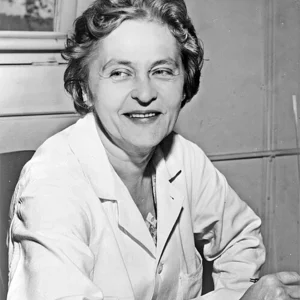

Hungarian-American biophysicist and inventor (1900-1995), nicknamed the “Queen of the Sun.” A pioneer of solar energy, she designed the first solar heating system for a home and a solar distiller used by the US Navy.
Mária Telkes(1900 — 1995)
Maria Telkes
Hongrie, États-Unis
8 min read
Frequently asked questions
Key Facts
- 1900: born in Budapest, Hungary
- 1937: joins MIT and begins her research on solar energy
- 1948: designs the first passive solar heating system for the Dover House (Massachusetts)
- 1952: invents a portable solar distiller used by the US Navy during World War II
- 1995: dies in Budapest, leaving a foundational legacy in the field of solar energy
Works & Achievements
An inflatable device using solar energy to produce fresh water from seawater, adopted by the United States Navy and deployed on survival rafts during World War II. It represents one of the first operational military applications of solar energy.
Built with architect Eleanor Raymond in Dover, Massachusetts, this house was entirely heated by solar energy during the winter of 1948–1949, thanks to a thermal storage system using Glauber's salt integrated into the walls. It is considered a founding milestone of modern solar architecture.
A cooking appliance operating solely by concentrating solar radiation, developed at New York University. Telkes aimed to provide an affordable tool for populations without access to electricity or fossil fuels.
A body of patents and publications defining the use of phase-change materials to store solar heat. This foundational work forms the basis of modern thermal storage technologies in construction and industry.
Participation in the design of a fully solar experimental house integrating advanced thermal storage and photovoltaic panels. This project demonstrated the maturity of the solar technologies Telkes had been developing since the 1940s.
Anecdotes
During World War II, Telkes designed a foldable solar still for US Navy survival rafts. This ingenious device used only the sun's heat to convert seawater into drinkable water, and was adopted by the US Navy as early as 1942. It was fitted on numerous inflatable rafts and helped save shipwrecked sailors in tropical waters.
In 1948, Telkes took on a challenge that many considered impossible: heating an entire house solely on solar energy through a Massachusetts winter. Working with architect Eleanor Raymond, she designed the Dover House, whose walls held tons of Glauber's salt, a mineral salt capable of absorbing solar heat by melting during the day and releasing it by solidifying at night. The house made it through the winter of 1948–1949 without any other heat source.
Telkes earned the nickname “Sun Queen” from her colleagues and the scientific press, so total and exclusive was her commitment to solar energy. While other researchers worked across multiple subjects, she devoted more than fifty years of her career to a single conviction: the sun could heat, cook, distill, and power all of humanity.
Frustrated by the MIT solar energy committee's refusal to fund her research on phase-change thermal storage, Telkes left the institute in the 1950s and joined New York University. There she developed a solar oven using concentrating mirrors that reached temperatures high enough to cook food, intended for populations without access to electricity or fossil fuels.
In the 1970s, as the oil crisis struck the world, Telkes's work — ignored for decades — suddenly became urgently relevant again. She was invited to the University of Delaware to take part in the Solar One project, a new experimental solar house. At over 70 years old, she contributed her expertise in thermal storage, proving that her vision had been well ahead of its time.
Primary Sources
The storage of solar heat is the most critical problem in solar house heating. Fusion heat materials, particularly sodium sulfate decahydrate (Glauber's salt), offer a heat storage capacity several times greater than water or rocks per unit volume.
An apparatus for distilling water by solar energy comprising an inflatable transparent enclosure, a black absorbing surface at the base, and channels for collecting condensed distillate along the inner walls, suitable for use on life rafts.
Tests conducted on inflatable solar stills demonstrated a production rate of approximately one quart of potable water per hour under full tropical sunlight, sufficient for minimum survival needs of shipwrecked personnel.
Phase-change materials provide latent heat storage at constant temperature, making them ideally suited for solar thermal applications where heat must be collected intermittently and released continuously on demand during sunless periods.
Key Places
Birthplace of Mária Telkes, where she grew up, pursued her higher education, and earned her doctorate in physical chemistry in 1924. She returned there later in life and passed away in Budapest in 1995.
Telkes's first position in the United States, starting in 1925, where she worked as a biophysics researcher and began developing her early ideas on converting solar energy into electricity.
The institution Telkes joined in 1939 as part of its solar energy research program. There she designed a solar distiller for the U.S. Navy and developed her first phase-change thermal storage systems.
The first modern house heated entirely by solar energy, inaugurated in 1948 and designed in collaboration with architect Eleanor Raymond. Telkes put her concept of Glauber's salt thermal storage into practice here, proving the feasibility of solar heating in a temperate climate.
Site of the Solar One project (1973), to which Telkes contributed during the 1970s. This university initiative integrated photovoltaic panels with advanced thermal storage, demonstrating the maturity of solar technologies in the context of the oil crisis.
Typical Objects

A transparent plastic device designed by Telkes for U.S. Navy survival rafts. Using only the sun's heat, it evaporated seawater and condensed the vapor into drinking water, producing roughly one liter per hour under tropical sun.

The central material in Telkes's research on thermal storage. This salt melts at 32 °C by absorbing a large amount of heat, then releases it upon solidifying — Telkes incorporated it into the walls of the Dover House to store daytime solar heat and release it at night.

A glazed surface facing due south that Telkes integrated into the architecture of the Dover House to capture solar radiation. The panels transferred heat to air circulating toward the Glauber's salt tanks housed in the walls.

A cooking device developed by Telkes at New York University in the 1950s. Parabolic mirrors focused solar rays onto a cooking chamber, reaching temperatures comparable to those of an electric oven without consuming any fossil fuel.

Tanks filled with Glauber's salt that melted and solidified through day-night cycles. Telkes built them into the walls and floors of her solar houses to provide nighttime heat release with no external energy input.

A heat-measuring instrument used by Telkes to precisely characterize the thermal properties of phase-change materials. Her rigorous measurements of the latent heat of fusion of Glauber's salt were decisive in validating her storage solutions.
School Curriculum
Vocabulary & Tags
Key Vocabulary
Tags
Daily Life
Morning
Maria Telkes began her days very early in her laboratory, recording the temperature data that had accumulated overnight in her Glauber's salt tanks. She meticulously logged measurements in laboratory notebooks and planned the day's experiments, often working alone or with one or two collaborators.
Afternoon
Afternoons were devoted to active experimentation: adjusting solar collectors, testing phase-change materials, performing thermal calculations. Telkes often worked in a white lab coat, personally handling the measuring instruments and prototypes, refusing to delegate critical checks to her assistants.
Evening
In the evenings, Telkes wrote her reports, answered scientific correspondence, and read publications from her European and American colleagues. A cultivated woman fluent in Hungarian, German, English, and French, she corresponded with researchers around the world on the prospects of solar energy.
Food
As a Hungarian immigrant in the United States, Telkes kept Central European eating habits — soups, stewed dishes, rye bread — while adapting to American cuisine. She ate simply and often on the go during long days of experimentation.
Clothing
In the laboratory, Telkes wore a white coat over plain, functional clothing. At conferences or institutional presentations, she chose elegant but understated feminine attire, deliberately seeking to be taken seriously in a scientific world that was overwhelmingly male.
Housing
Telkes lived in apartments close to her successive laboratories in Cleveland, Cambridge, New York, and Newark. Her living spaces were functional rather than luxurious; she poured her energy into research rather than domestic comfort, even though she had always dreamed of a home heated entirely by the sun.
Historical Timeline
Period Vocabulary
Liens externes & ressources
Références
Œuvres
Dover House — première maison à chauffage solaire
1948
Four solaire domestique
1952
Système de stockage thermique par matériaux à changement de phase (MCP)
1955
Contribution au projet Solar One — Université du Delaware
1973