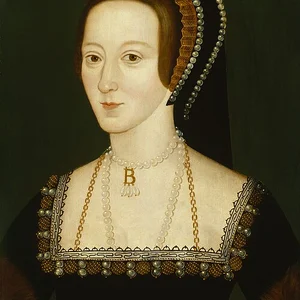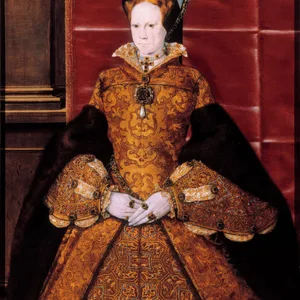

Queen of England and Ireland from 1553 to 1558, Mary I Tudor was the first woman to reign in her own right over England. The daughter of Henry VIII and Catherine of Aragon, she restored Catholicism and persecuted Protestants, earning her the nickname "Bloody Mary".
Mary I Tudor
Mary I Tudor
8 min read
Frequently asked questions
Key Facts
- 1516: Birth of Mary Tudor, daughter of Henry VIII and Catherine of Aragon
- 1553: Ascends the throne as England's first queen regnant
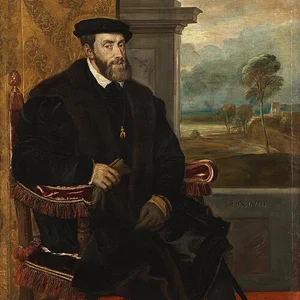
- 1554: Marries Philip II of Spain, strengthening the Catholic alliance
- 1554–1558: Restores Catholicism and has approximately 280 Protestants burned at the stake
- 1558: Loses Calais, the last English territory in France, and dies without an heir
Works & Achievements
An Act of Parliament repealing the Protestant religious legislation of Edward VI and restoring Catholic practices in England, the first major legislative measure of Mary's reign.
A diplomatic agreement governing Mary's union with the Habsburg heir, with safeguards designed to protect English independence from Spanish influence.
A solemn ceremony in which the papal legate absolved Parliament of the Henrician schism, officially restoring England to the Roman Catholic Church.
The revival of old laws permitting the burning of heretics, leading to the execution of approximately 283 people and earning Mary the nickname Bloody Mary.
Mary and her advisors undertook an administrative reorganisation and strengthening of the English fleet, laying institutional foundations that her sister Elizabeth I would go on to exploit with great success.
Anecdotes
Declared illegitimate by her father Henry VIII in 1533, following the annulment of his marriage to Catherine of Aragon, young Mary was forced to sign a document acknowledging her own bastardy in order to avoid execution. This humiliation, which she never truly forgave, would shape her entire life and fuel her fervent attachment to Catholicism and to her mother's memory.
In 1554, a few months after her marriage to Philip II of Spain, Mary joyfully announced she was pregnant. Her belly grew, birth preparations were made, and the English people waited. But no child was born — it was a phantom pregnancy. The same phenomenon occurred again in 1558, leaving the queen without an heir and deeply wounded.
At his execution in Oxford in March 1556, Archbishop Thomas Cranmer, who had signed a recantation of his Protestant faith to escape the flames, changed his mind at the last moment. Upon reaching the stake, he deliberately thrust his right hand into the fire first, declaring that this hand had sinned by signing the abjuration. This dramatic act instantly transformed him into a martyr in the eyes of Protestants across Europe.
In January 1558, French forces under the Duke of Guise seized Calais, the last English territory on the continental mainland, held since 1347. The news broke Mary's heart, as she lay already dying. According to tradition, as reported by her ladies-in-waiting, she said: "When I am dead and opened, you shall find Calais lying in my heart."
When her half-brother Edward VI died in 1553, his will had named Lady Jane Grey as queen to keep Mary from the throne. Jane reigned for only nine days: Mary rallied her supporters in Norfolk and marched on London, where she was greeted with jubilation by the crowds. She initially showed clemency toward young Jane, but Wyatt's rebellion in 1554 ultimately forced her to have her beheaded.
Primary Sources
The queen has shown great resolve and remarkable courage in the face of Lady Jane Grey's supporters. She made her way to Norfolk, where her Catholic subjects rallied to her in large numbers, and her cause now appears secure.
The people cried Long live Queen Mary with such great joy that bells rang throughout the city, and bonfires were lit in the streets of London all through the night.
Cranmer, upon reaching the stake, refused all assistance and thrust his right hand into the flames, crying out in a steady voice: This unworthy hand has signed the error, therefore it is this hand that shall burn first.
We beseech Your Holiness to receive this kingdom of England back into the fold of the Holy Roman Church, from which our subjects and ourselves had strayed through the errors of our predecessors.
The said Philip, upon marrying the Queen of England, shall conform to the laws and customs of the realm, and shall introduce no foreign practice or influence into the governance of this country.
Key Places
Birthplace of Mary Tudor on 18 February 1516. This royal palace on the Thames was the heart of court life under the early Tudors.
Mary imprisoned Lady Jane Grey and her supporters here in 1553, along with other opponents. She herself had stayed in the Tower during the troubled periods of her childhood.
Site of Mary I's coronation on 1 October 1553 — the first coronation of a reigning queen of England — celebrated according to the restored Catholic rite.
A market district of London where many Protestant executions took place during Mary's reign, including several burnings at the stake that shocked a significant part of the London population.
Site of Mary's marriage to Philip II of Spain on 25 July 1554, a major diplomatic union of her reign that provoked fierce opposition among the English people.
The royal residence where Mary I died on 17 November 1558 after months of illness, leaving no heir — just hours before the death of Cardinal Pole.
Typical Objects

Mary wore a rosary of coral and gold beads, a symbol of her Marian devotion inherited from her mother Catherine of Aragon. The rosary prayer structured her days from childhood and accompanied her throughout her entire reign.

The first seal to bear the effigy of a reigning queen of England, used to authenticate royal acts. Its creation established a historic precedent in the English monarchy.

The liturgical book of the Catholic Mass that Mary had restored in every church in England after years of enforced Protestant worship. She attended Mass every single morning without exception.

A ring given to her by Philip II at their wedding in Winchester in July 1554. Mary remained deeply attached to it despite her husband's growing indifference and prolonged absences.

Mary commissioned several official portraits to assert her legitimacy as a sovereign, most notably from the Flemish painter Hans Eworth. These images depict her in sumptuous dress, bearing the insignia of royalty.

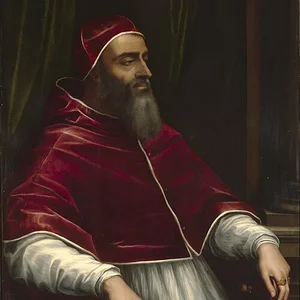
A solemn document issued by Pope Julius III in 1554 formally absolving England of the Henrician schism. Mary had it read before the assembled Parliament, sealing the kingdom's official return to Roman authority.
School Curriculum
Vocabulary & Tags
Key Vocabulary
Tags
Daily Life
Morning
Marie rose at dawn and attended morning Mass in her private chapel, a daily act of devotion inherited from her mother's strictly Catholic upbringing. She recited the Divine Office with her ladies-in-waiting before receiving her first advisers to dispatch affairs of state.
Afternoon
Afternoons were dedicated to royal audiences, reading diplomatic dispatches, and meetings of the Privy Council. Marie was a hardworking sovereign who personally read and annotated official documents, and was proficient in Latin, Spanish, French, and English.
Evening
Evening court gatherings revolved around formal banquets, chamber music, and sometimes theatrical performances. Marie, a music lover, played the virginal herself — a forerunner of the harpsichord. She retired early for a final prayer and the reading of Catholic devotional texts.
Food
The Tudor royal table offered lavish banquets: roasted meats (venison, poultry, pork), fish during Lent, spiced pastries, candied fruits, and wines imported from France and Spain. Marie scrupulously observed Catholic fast days and days of abstinence, imposing this practice on her entire court.
Clothing
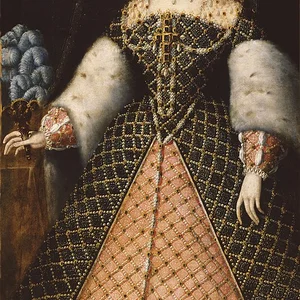
Marie wore Spanish-style gowns — a stiffened boned bodice, bell-shaped skirt, and long closed sleeves — in crimson velvet, purple, or black, richly embroidered with gold thread and pearls. She wore ruby and pearl necklaces, and favored the English gable hood or the French hood depending on the occasion.
Housing
Marie resided mainly at the Palace of Whitehall or St James's Palace in London, moving between royal residences according to the seasons and diplomatic needs. These red-brick Tudor palaces featured grand state rooms, richly decorated private chapels, and formal gardens.
Historical Timeline
Period Vocabulary
Visual Style
Style portrait Tudor des années 1550 inspiré de Hans Eworth : velours cramoisi et violet royal, broderies dorées, bijoux de perles, lumière de bougie sur un visage pâle et solennel portant les insignes de la royauté.
Sound Ambience
Ambiance sonore d'un palais Tudor des années 1550 : cloches appelant à la messe catholique, chant grégorien dans une chapelle de pierre, froissements de velours sur des dalles froides, crépitement d'une grande cheminée et notes douces de luth.
Liens externes & ressources
Références
Œuvres
Premier Statute of Repeal — Abrogation de la législation protestante d'Édouard VI
1553
Traité de mariage avec Philippe II d'Espagne
1554
Réconciliation avec Rome — Absolution parlementaire par le cardinal Pole
1554
Restauration des lois sur l'hérésie (Heresy Acts)
1554-1555
Modernisation de la marine royale anglaise
1557-1558