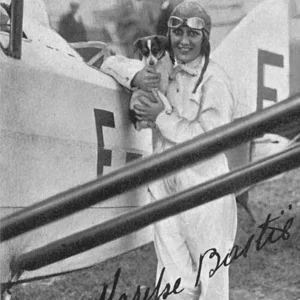

French aviator born in 1898, Maryse Bastié set numerous world records in the 1930s, including a solo crossing of the South Atlantic in 1936. A pioneer of feminism through action, she also served Free France during the Second World War.
Maryse Bastié(1898 — 1952)
Maryse Bastié
France
8 min read
Frequently asked questions
Key Facts
- 1928: sets a women's endurance record with 26h47 of solo flight
- 1930: breaks the women's world endurance record with 37h55 of flight
- 1931: women's distance record on the Paris–Moscow route
- 1936: solo crossing of the South Atlantic (Dakar–Natal) in 12h05
- 1940–1945: joins the Free French Forces, serving as a ferry pilot and test pilot
Works & Achievements
Bastié remained airborne for 37 hours, 55 minutes, and 5 seconds above Orly, breaking the women's world record. This feat earned her the Légion d'honneur and cemented her place among the world's greatest female aviators.
She set the women's world record for straight-line distance, covering several thousand kilometers in a single non-stop leg. These successive records made her the figurehead of French sport aviation.
Flying solo in her Caudron Simoun, she flew from Dakar (Senegal) to Natal (Brazil) in approximately 12 hours, becoming the first French woman to cross the South Atlantic solo and earning international acclaim.
Rejecting the armistice and collaboration, Bastié joined De Gaulle's cause and served as a ferry pilot transporting military aircraft. Her courage earned her the Croix de Guerre and several citations.
Throughout her career, Bastié campaigned for women's access to the piloting profession, trained many female aviators, and represented France at international air shows, becoming a role model for future generations.
Anecdotes
A factory worker in a shoe workshop and then a cashier, Maryse Bastié was anything but privileged when she discovered aviation. It was her first husband, Louis Bastié, himself a pilot, who introduced her to the joys of flying in 1925. To pay for her first flying hours, she had to save for months on her meager wages — yet she passed her license on the first attempt, astonishing her instructors.
In October 1930, Maryse Bastié stayed airborne above Orly for 37 hours, 55 minutes, and 5 seconds, breaking the women's world endurance record. She landed exhausted but triumphant, cheered by an enthusiastic crowd. This feat earned her the Légion d'honneur — an exceptionally rare distinction for a woman at the time — presented by the Minister of Air himself.
On December 30, 1936, Bastié took off from Dakar in her Caudron Simoun, bound for Natal in Brazil, alone above the South Atlantic. After roughly twelve hours of flying over open ocean — with no reliable radio or GPS, guided only by her charts and compass — she landed in tropical sunshine before a crowd of thousands of Brazilians who hailed her as a national heroine.
During the Second World War, Maryse Bastié rejected the armistice and joined General de Gaulle's Free France. While many women were confined to roles as nurses or auxiliaries, she continued to fly as a military aircraft ferry pilot, proving that her commitment went far beyond chasing records. She received the Croix de Guerre for her service.
On July 6, 1952, Maryse Bastié died in a military aircraft crash at an air show at Lyon-Bron: a passenger aboard a prototype that went down after engine failure, she was only 54 years old. All of France mourned; her name was subsequently given to streets, schools, and airfields, keeping alive the memory of a woman who had broken every boundary.
Primary Sources
“Mme Bastié broke the women's world endurance record yesterday above Orly, remaining airborne for 37 hours, 55 minutes, and 5 seconds. Upon landing, a large crowd cheered her.”
“I wasn't afraid. I had prepared every detail, calculated every hour of fuel. The sea was there, vast, but my Simoun and I were one.”
Official certification of the performance by Mme Marie-Louise Bastié, known as Maryse Bastié: solo crossing of the South Atlantic, Dakar–Natal (Brazil), distance approximately 3,100 km, flight duration 12 hours 5 minutes, on 30 December 1936.
Mme Marie-Louise Bastié, aviator, is appointed Chevalier de la Légion d'honneur for outstanding services rendered to French aviation and for certified world records.
“Takeoff 08:12. Calm seas up to the 20° meridian. Low clouds around 3,000 m. Fuel consumption in line with forecasts. Landing at Natal 20:17 local time.”
Key Places
Birthplace of Maryse Bastié, born on May 27, 1898 in this small wine-growing town in southwestern France. Nothing about this modest background hinted that she would become one of France's greatest female aviators.
The main Parisian airfield of the interwar period, where Bastié set her women's world endurance record in October 1930, circling above the field for nearly 38 hours before the eyes of journalists and the public.
The departure point of the historic South Atlantic crossing on December 30, 1936. Bastié took off from Ouakam aerodrome to the cheers of the French community in West Africa.
The Brazilian city where Bastié landed after her South Atlantic crossing, welcomed as a heroine by an enthusiastic crowd. This arrival point symbolized the conquest of the airspace between France and South America.
The site where Maryse Bastié met her death on July 6, 1952, during an air show. A passenger aboard a military aircraft that crashed after engine failure, she died along with two other people on board.
Typical Objects

Rigid brown leather headgear worn by all pilots of the era to protect against cold and wind in open cockpits. Bastié wore it in every official photograph — a symbol of her place in the world of aviation.

Wide-frame metal goggles with tinted lenses, essential for shielding eyes from wind and debris in open cockpits. They became the iconic accessory of women aviators in the 1930s.

A monoplane powered by a 180-horsepower Renault engine — fast and dependable — that Bastié flew on her historic South Atlantic crossing in 1936. The Simoun was the aircraft of choice for France's great interwar aerial adventures, also flown by Antoine de Saint-Exupéry.

A cockpit instrument that reads altitude by measuring atmospheric pressure, essential for navigating over open ocean with no visual landmarks. Holding the correct altitude during the Atlantic crossing was quite literally a matter of survival.

Detailed maps of air routes and coastlines, hand-annotated before each departure. Bastié planned her flights with meticulous precision, calculating every hour of fuel burn — because over the Atlantic, improvisation could be fatal.

A warm, waterproof one-piece worn over civilian clothes, indispensable in the unheated cockpits of the 1930s. It also gave women pilots a practical way to step outside the clothing conventions expected of them at the time.

A navigation instrument that orients the pilot by the cardinal points — the only reliable guide over the Atlantic in an era before radio navigation or GPS. Bastié mastered it with a precision that impressed the FAI's official observers.
School Curriculum
Vocabulary & Tags
Key Vocabulary
Daily Life
Morning
During her record preparations, Bastié rose at dawn to inspect her aircraft alongside the mechanics. She personally checked the fuel levels, the condition of the flight controls, and the cockpit instruments, trusting no one's eyes but her own. A hearty breakfast — bread, coffee, sometimes eggs — awaited her before every major flight.
Afternoon
Afternoons were devoted to training or, between records, to correspondence and meetings with journalists. Fame came with its demands: interview requests, official photographs, meetings with air force representatives or aircraft manufacturers. She also used these moments to read technical journals and keep up with the latest innovations.
Evening
In the evenings, after a long flight, Bastié carefully updated her logbook, noting weather conditions, technical incidents, and her impressions. She cherished simple dinners with family or fellow pilot friends, far from the social scene, and went to bed early to recover physically before the next day.
Food
A record-breaking aviatrix's diet was above all functional: before a major flight, she favored light but nourishing meals to avoid any discomfort at altitude. During her endurance flights, she brought sandwiches, chocolate, and Thermos bottles of coffee or hot broth. She strictly avoided alcohol, incompatible with the iron-clad alertness that flying demanded.
Clothing
On the ground, Bastié dressed simply, like most women of her modest means — plain dresses, practical suits. In the air, she pulled on a leather or canvas flight suit over her clothes, completed by a leather helmet and flying goggles. This androgynous outfit stood in sharp contrast to the feminine codes of the era and occasionally drew remarks that Bastié brushed off with a smile.
Housing
Bastié lived in a modest Parisian apartment, far from the luxury of the fashionable salons she sometimes frequented after her exploits. During periods of intensive training, she lodged near the airfields at Orly or Villacoublay to save time. Her home reflected her priorities: few precious furnishings, but maps, flight photographs, and trophies displayed with pride.
Historical Timeline
Period Vocabulary
Liens externes & ressources
Références
Œuvres
Record mondial d'endurance féminin
Octobre 1930
Record féminin de distance en ligne droite
1931
Traversée en solitaire de l'Atlantique Sud (Dakar–Natal)
30 décembre 1936
Engagement dans la France Libre
1940–1945
Promotion de l'aviation féminine
1930–1952