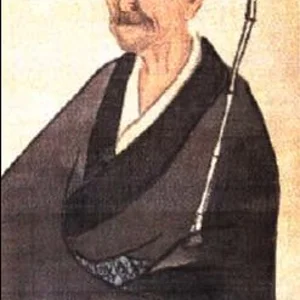

Matsuo Bashō (1644–1694) is the greatest master of haiku, the Japanese poetic form composed of three lines. After serving as a samurai, he devoted himself to poetry and travel across Japan. His masterwork, "The Narrow Road to the Deep North," blends prose and poetry.
Matsuo Bashō(1644 — 1694)
Matsuo Bashō
Japon
7 min read
Frequently asked questions
Famous Quotes
« The old pond — a frog jumps in, sound of water.»
« On a withered branch, a crow has settled — autumn evening.»
Key Facts
- Born in 1644 in Ueno, Iga Province (Japan), into a low-ranking samurai family
- Refined and codified haiku as a major poetic form from the 1680s onward
- Undertook long journeys on foot across Japan, which inspired his poetry collections
- Published "Oku no Hosomichi" (The Narrow Road to the Deep North) in 1689, a masterpiece of Japanese literature
- Died in 1694 in Osaka, leaving behind around 1,000 haiku that would go on to influence poetry worldwide
Works & Achievements
The undisputed masterpiece of Japanese literature, this travel journal in prose and haiku recounts Bashō's journey through northern Japan. It is considered one of the most translated and widely read texts in classical Japanese literature.
A poetry anthology from Bashō's school, bringing together his finest disciples. This collection defines the aesthetic principles of mature haiku: lightness, depth, and grounding in nature and the present moment.
Bashō's first major travel journal, marking his break from the ornate style of the era in favor of a more direct and personal voice, oriented toward meditation on death and beauty.
An iconic poem that revolutionized haiku by replacing classical literary references with pure sensory immediacy. This seventeen-syllable poem is now known throughout the world.
A journal of a journey to the Kashima Shrine to observe the autumn moon, blending Buddhist reflection with observations of nature in a style of striking simplicity.
Anecdotes
Bashō took his pen name from a banana tree (bashō in Japanese) that his disciples had planted in front of his hut in Edo. He was so fond of this delicate tree — a symbol of vulnerability and fleeting beauty — that he adopted it as his poetic name around 1681, abandoning his earlier pseudonyms.
His most famous haiku — 'An old silent pond / A frog jumps into the pond / Splash! Silence again' — was composed around 1686 during a gathering of poets. This poem revolutionized haiku by capturing a fleeting moment from ordinary nature, replacing classical Chinese references with a direct Japanese sensibility.
In 1689, Bashō set out on a journey of more than 2,400 kilometers on foot through the wild regions of northern Japan. Forty-five years old and in fragile health, he traveled with a single disciple, Sora, sleeping in rustic inns and composing poems before every remarkable landscape.
Bashō lived in such deliberate poverty that he sometimes had to accept food from his disciples to survive. Yet he turned down several offers of paid positions at court, preferring the freedom of the wandering poet to material security.
When he died in Osaka in 1694, Bashō was surrounded by many disciples who had come from across Japan. His final words are said to have been an unfinished haiku: 'Sick on a journey / My dreams wander / Over withered fields.' He left behind a poetic school that would transform Japanese literature.
Primary Sources
The sun and moon are eternal travelers. The years that pass are travelers too. Those who drift through life on a boat, or grow old leading a horse by the bridle, make their home in travel.
I set out resolved to die on the road — an autumn wind cuts me to the bone.
An old pond — / a frog jumps in, / sound of water.
In haiku poetry, what matters above all is makoto — sincerity. Without it, even the most skillful words ring hollow.
I set out to view the moon at Kashima. My companions were a Zen monk and a painter friend. We walked in the rain, soaked through — and it was perfect.
Key Places
Bashō's birthplace in 1644, born into a samurai family. The city today preserves a museum and a shrine dedicated to the poet.
The modest dwelling where Bashō lived from 1680 and composed some of his greatest haiku, including the famous frog poem. A memorial garden now marks the site.
A ruined medieval town visited during the northern journey of 1689; the contemplation of these ruins inspired one of Bashō's most powerful haiku on the fleeting nature of civilizations.
An archipelago of 260 wooded islands considered one of Japan's three most scenic views; Bashō was so overwhelmed with emotion that he said he could not write a single poem worthy of it.
Japan's largest lake, on whose shores Bashō retreated to the Genjū-an (Hut of Illusion) in 1690 to meditate and write away from the bustle of Edo.
Liens externes & ressources
Références
Œuvres
Oku no Hosomichi (La Sente étroite du Bout-du-Monde)
1689 (publié en 1702)
Sarumino (Le Manteau de pluie du singe)
1691
Nozarashi Kikō (Journal d'un squelette blanchi aux champs)
1684
Haïku de la grenouille (« Furuike ya... »)
1686
Kashima Kikō (Journal de Kashima)
1687