
Demigod and trickster hero of Māori and Polynesian mythology. Born prematurely and abandoned in the ocean by his mother Taranga, he accomplished extraordinary feats: fishing up the islands, slowing the sun, and stealing fire from the gods.
Maui-tikitiki-a-Taranga
Maui-tikitiki-a-Taranga
9 min read
Frequently asked questions
Key Facts
- Abandoned at birth in the ocean, wrapped in his mother Taranga's topknot — the origin of his name
- Fished up the landmass of New Zealand (Te Ika-a-Māui) using his magical fishhook
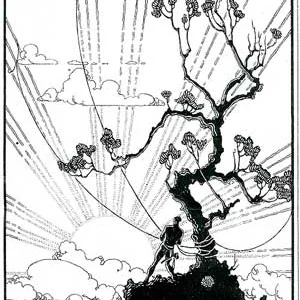
- Slowed the sun by snaring it with ropes to make the days longer
- Stole fire from the goddess Mahuika and gave it to humanity
- Died attempting to conquer immortality by entering the body of Hine-nui-te-pō, goddess of death
Works & Achievements
Maui's founding feat: fishing the habitable lands of Polynesia up from the ocean floor. This cosmogonic act explains the geological formation of the islands and establishes the bond between Polynesian peoples and their territories.
By lassoing the sun with ropes braided from ancestral hair, Maui lengthened the days, allowing humans to cook, farm, and work. This mythological feat explains the solar cycle and humanity's mastery over time.
Maui stole fire from the goddess Mahuika and transferred it into trees, from which humans have been able to draw it by friction ever since. This etiological myth explains the technique of fire-making by rubbing wood together, universal throughout Polynesia.
In several Polynesian traditions, Maui raised the vault of the sky that was crushing humanity, allowing people to stand upright and breathe. This cosmological act is recounted notably in Hawaiʻi and the Cook Islands.
In attempting to pass through Hine-nui-te-pō to win immortality for humankind, Maui failed and perished — permanently sealing humanity's mortal condition. This failure is the most profoundly tragic and philosophical act in the entire cycle.
Anecdotes
Maui was born prematurely, and his mother Taranga, believing he would not survive, wrapped him in a topknot of her hair and cast him into the sea. The child survived, raised by the spirits of the ocean, and grew to become the greatest of all Polynesian heroes — as his full name reminds us: "Maui-tikitiki-a-Taranga" means "Maui born of the topknot of Taranga."
To slow the sun and lengthen the days, Maui braided ropes from the hair of his grandmother Muri-ranga-whenua. He waited at the edge of the world where the sun rises each morning and, with his brothers, snared it in his bonds. Striking the sun with his ancestor's sacred jawbone, he forced it to cross the sky more slowly, allowing people to cook and work by daylight.
Maui fished up the islands of Polynesia using a magic fishhook carved from his ancestral grandmother's jawbone. According to Māori tradition, the North Island of New Zealand (Te Ika-a-Māui) is "the fish of Maui" and the South Island (Te Waka-a-Māui) is the canoe from which he fished. His jealous brothers cut up the fish before it could be properly consecrated, which is why the island has such a rugged, uneven landscape.
To obtain fire, Maui descended into the depths of the earth to the dwelling of Mahuika, goddess of fire and ancestor of all flames. After mischievously extinguishing her flames one by one, Mahuika grew furious and unleashed a great inferno. Maui transformed into an eagle to escape, and in this way fire was passed into the trees — ever since, humans have been able to draw flame by rubbing wood together.
Maui attempted to win immortality for humankind by passing through the body of Hine-nui-te-pō, goddess of death and night. He crept between her thighs while she slept, in the form of a worm, but a bird — the fantail (pīwakawaka), depending on the version — began to laugh and woke the goddess, who crushed Maui. His death sealed the mortal fate of all humanity.
Primary Sources
Ko Māui i ahu mai i raro, nāna nei i hī ake te motu nei, ā, ko tōna matau ko te kauae o tōna tīpuna, ko Murirangawhenua.
Maui was the last born child, and his mother Taranga, wrapping him in a topknot of her hair, cast him into the sea. He was not lost, but was found and cherished by an ancestor.
Ko Māui-tikitiki-a-Taranga tōna ingoa, nō reira i kīia ai ia ko Māui i ahu mai i ōna mātua, he uri nō ngā atua.
It was Maui who fished up this island from the depths of the sea, using the jawbone of his ancestor as a hook, and the canoe Te-waka-a-Maui as his craft.
Maui said to his brothers: 'Let us go and seek a rope by which to lasso the sun, so that he may be made to move slowly and give us time to do our work.'
Key Places
According to Māori mythology, the North Island is the 'fish of Maui,' hauled up from his brothers' canoe. Its rugged, mountainous terrain is explained by the rage of the fish, which was desecrated when the jealous brothers hastily began cutting it before the proper rituals were performed.
The South Island is identified as the canoe from which Maui fished up the North Island. This mythical place roots Māori cosmogony in the real geography of Aotearoa.
Hawaiki is the land of origin of the Polynesian peoples in their mythology — the place from which the great canoes set out and where the ancestors dwell. It was from Hawaiki that Maui embarked on many of his supernatural journeys to the ends of the world.
In Hawaiian tradition, Maui lifted the sky above Mauna Kea to free the people, who had been living hunched beneath a sky vault that hung too low. This sacred summit still carries the weight of Hawaiian mythological memory to this day.
A crossroads of Polynesian migrations, the Marquesas are one of the oldest cradles where the Maui cycle was transmitted and diversified before spreading outward to Hawaiʻi, New Zealand, and the Cook Islands.
New Zealand's geothermal heartland, this region of geysers and hot springs is associated with Mahuika, goddess of fire, and echoes the myth of Maui stealing fire. It remains a sacred site of Māori culture.
Typical Objects

Maui's fishhook, carved from the sacred jawbone of his ancestor Murirangawhenua, is his most iconic attribute. With it, he fished up the islands from the depths of the ocean — the founding cosmogonic feat of Polynesian mythology.

The outrigger canoe from which Maui fished up the islands is identified with the South Island of New Zealand. Mastery of canoe navigation was essential to Maui's exploits and to the broader Polynesian settlement of the Pacific.

Maui uses a club to strike the sun and force it to slow its journey across the sky. A ceremonial weapon and symbol of power in Māori culture, it represents the authority of heroes and chiefs.

To capture the sun, Maui braids ropes from the hair of his grandmother Muri-ranga-whenua. This material of human and ancestral origin grants them a supernatural power that an ordinary plant-fiber lasso would not possess.

A musical instrument associated with magical practices and seduction in Polynesian mythology, sometimes used by Maui to exercise his power of enchantment over gods and humans alike.

Māori demigods and heroes bear distinctive tā moko that encode their genealogy (whakapapa) and their deeds. Maui's tattoo would reflect his dual nature — part human, part divine.

The jawbone of his ancestor, obtained after visiting this dying elder who lived alone, is Maui's all-purpose tool: fishhook, ritual weapon, and source of magical power concentrating the strength of the ancestors.
School Curriculum
Vocabulary & Tags
Key Vocabulary
Tags
Daily Life
Morning
In mythological accounts, Maui rises before dawn to watch for the sun at the edge of the world. It is at daybreak that he sets his cosmic traps — magical ropes and fishhooks prepared in the silence of the night. Morning is the time of great deeds and cunning.
Afternoon
Midday belongs to voyages across the ocean: Maui crosses the Pacific waters in his ancestral canoe, guided by stars still visible on the horizon, by ocean currents, and by the flight of birds. He also descends into the underworld to confront gods and ancestors.
Evening
In the evening, Maui returns to the villages to receive the honors due for his exploits, to feast, and to listen to ritual songs (waiata). It is around the fire — which he himself stole from the gods — that the elders recite his great deeds, passing the hero's memory down to future generations.
Food
Like all Polynesian heroes, Maui lives on fish caught in the open sea, taro, sweet potato (kūmara), and tropical fruits such as coconut. He cooks with the fire he wrested from Mahuika, in stone ovens (hāngi), blending everyday food with offerings meant for the ancestors.
Clothing
In traditional depictions, Maui wears a woven loincloth made from plant fibers (ti kouka or harakeke), ornaments of bone or jade (pounamu), and bears sacred tattoos covering his face and body. These tā moko trace his divine genealogy and his exploits, immediately marking him as a demigod.
Housing
Maui moves between the world of humans (ao) and the divine realms: he stays in communal houses (whare) with posts carved with ancestral figures, but his true dwellings are the cosmic edges of existence — the rim of the world where the sun rises, the depths of the ocean, and the volcanic heart of the earth.
Historical Timeline
Period Vocabulary
Visual Style
Esthétique inspirée des arts traditionnels maori et polynésien : entrelacs de motifs tā moko, tons océaniques profonds et orangés volcaniques, héros démoniaque aux tatouages complexes sur fond d'horizon pacifique partagé entre jour et nuit.
Sound Ambience
L'environnement sonore de Maui mêle l'immensité de l'Océan Pacifique — vagues, vent, craquements de pirogue — aux sonorités rituelles de la Polynésie : flûtes nasales, chants ancestraux et feu crépitant sous les étoiles.
Liens externes & ressources
Références
Œuvres
Pêche des îles polynésiennes
Temps mythiques
Capture et ralentissement du soleil
Temps mythiques
Vol du feu à Mahuika
Temps mythiques
Soulèvement du ciel
Temps mythiques
Tentative d'immortalité (mort dans Hine-nui-te-pō)
Temps mythiques