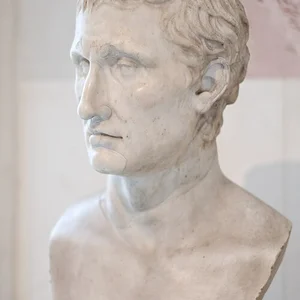

Menander (342–290 BC) was the greatest representative of Greek New Comedy. A prolific Athenian playwright, he wrote more than a hundred plays depicting everyday life and the social customs of his time.
Menander(340 av. J.-C. — 290 av. J.-C.)
Menander
Athènes
7 min read
Frequently asked questions
Famous Quotes
« Whom the gods love dies young.»
« Bad company corrupts good character.»
Key Facts
- Born around 342 BC in Athens
- Student of Theophrastus and influenced by Peripatetic philosophy
- Author of more than 100 comedies, of which only Dyskolos was rediscovered nearly complete in 1957
- Leading representative of New Comedy, the successor to the Old Comedy of Aristophanes
- Died around 290 BC, reportedly drowned in the port of Piraeus
Works & Achievements
The only complete surviving play by Menander, rediscovered on a papyrus in 1957. It features Knemon, a misanthropic old man who is forced by an accident to accept help from those around him — a reflection on solitude and life in society.
A comedy of domestic mix-ups in which an illegitimate child triggers a series of misunderstandings between a father and his son. Well preserved thanks to papyri, it perfectly illustrates the style of New Comedy, built around family conflicts.
One of the most admired plays of antiquity, dealing with the theme of marital forgiveness and the recognition of a child. It explores with great subtlety the moral contradictions of its male characters as they confront their own wrongdoings.
A soldier cuts off his girlfriend's hair in a fit of jealousy, setting off a comedy of family recognition. The play demonstrates the psychological complexity that Menander brought to his characters.
A comedy featuring a mercenary soldier and a young woman of Athenian origin, drawing on the theme of recovered identities so central to New Comedy. It reflects the historical backdrop of the Wars of the Diadochi.
Anecdotes
Menander and his rival Philemon competed every year for first prize at the Athenian comedy festivals. Paradoxically, Philemon often won, despite Menander's widely recognized superiority. One day, running into Philemon in the street, Menander reportedly said: 'Are you not ashamed, when you meet me, to have beaten me?' — an anecdote recorded by the grammarian Quintilian.
In 1957, a papyrus discovered in Egypt transformed our knowledge of ancient Greek literature: it contained the nearly complete text of the Dyskolos, the only full play by Menander known to this day. For centuries, his work had survived only in fragments quoted by later authors. The discovery felt like a true literary resurrection.
Menander reportedly declined an invitation from King Ptolemy I of Egypt to come and settle in Alexandria, preferring to stay in Athens with his companion Glycera. He is one of the few intellectuals of his era to have turned down royal patronage — a testament to his attachment to the ordinary Athenian life he portrayed so vividly on stage.
Menander died in 290 BCE in the port of Piraeus — not in battle or from illness, but by drowning during a morning swim. This unremarkable death, almost comic for an author of comedies, struck the Ancients deeply. The poet Diodorus dedicated a melancholy epitaph to him: 'The jealous sea has stolen Menander from us.'
Primary Sources
KNEMON: I wish all men were capable of being self-sufficient and had no need of one another. Then you would have no reason to bother me.
For a man who treats his own wife well does himself a service, and one who treats her badly does himself harm.
Such are women! When one of them has made up her mind about something, she is instantly convinced that she is right.
Whom the gods love dies young. / Habit is a second nature.
Polemon, in his jealousy, cut off Glycera's hair; but now his violent love turns back upon him as remorse.
Key Places
Carved into the southern slopes of the Acropolis, this 17,000-seat theatre was the main venue for Menander's performances during the Dionysia and Lenaia festivals. It was here that he won his eight official victories and competed against his rival Philemon.
The civic, commercial, and intellectual heart of Athens, the Agora was the real-world setting that Menander transposed onto the stage. His characters — merchants, soldiers returning from war, young middle-class men — were the very people one would encounter daily in this public square.
Athens' great cosmopolitan port, Piraeus provided Menander with a rich cast of colourful characters: sailors, courtesans, foreign merchants, and soldiers. It was also here that he met his death in 290 BC, drowning while swimming.
Founded around 297 BC by Ptolemy I, this institution gathered Menander's works into its collections. It is thanks to Alexandrian copies, recovered from the Egyptian sands in the form of papyri, that several of his plays have survived to the present day.
Typical Objects

Made from coated linen or lightweight wood, the theater mask allowed a small number of actors to play multiple roles. Menander codified fixed character types — the grumpy old man, the lovesick youth, the cunning slave — instantly recognizable to audiences through their distinctive masks.

Menander composed and revised his texts on papyrus scrolls imported from Egypt. These precious writing materials explain why only copies discovered in Egypt — preserved by the dry climate — have transmitted his works to us two millennia later.

The playwright used wooden tablets coated in wax to jot down drafts and dialogue sketches, which could be erased and reused. It was the everyday writing tool of every literate Athenian in the 4th century.

Each comic type wore a codified costume: young men wore white cloaks, slaves wore russet, and old men wore off-white. These visual conventions helped audiences immediately identify a character's social standing and personality.

Unlike tragedy, Menander's New Comedy used low-soled shoes, emphasizing how grounded his characters were in everyday reality — far removed from the mythological heroes of tragic drama.

Theatrical performances were timed using clepsydras during dramatic competitions. The running time of Menander's plays, designed for a single day's performance, was regulated this way at the Lenaia and Dionysia festivals.
School Curriculum
Vocabulary & Tags
Key Vocabulary
Daily Life
Morning
Menander rises at dawn in his house in the deme of Kephisia, north of Athens. He devotes the early hours of the day to writing, seated in his garden or library, scratching dialogues onto wax tablets. He regularly visits the Lyceum, where his teacher Theophrastus teaches, to discuss philosophy and observe human behavior.
Afternoon
In the afternoon, Menander makes his way down to the Agora and the Piraeus to observe his contemporaries — the direct source of his inspiration. He sometimes attends rehearsals of his own plays at the theater or at the premises of the choregoi who fund the productions. He also receives friends, including the governor Demetrius of Phalerum, for lively symposia.
Evening
In the evening, Menander attends banquets (symposia) at friends' homes or hosts them at his own with his companion Glycera. These gatherings, accompanied by wine diluted with water, are an occasion to recite verses, debate philosophy, and listen to musicians playing the lyre or aulos. He observes the gestures and words of his guests, which he will later transform into comic dialogue.
Food
Menander follows the typical Mediterranean diet of a wealthy Athenian: barley or wheat bread, olives, figs, goat cheese, vegetables, and fresh fish from the Piraeus. Meat — lamb or pork — is reserved for feast days and sacrificial occasions. Wine from Attica or the islands, always mixed with water, accompanies every meal.
Clothing
Like any Athenian citizen of comfortable means, Menander wears a chiton (a linen tunic) in white or saffron, covered by a himation (a draped cloak) when going out. At home, he works in a simple chiton. For theatrical performances or ceremonies, he dresses more formally, reflecting his social standing.
Housing
Menander lives in a house of classical Greek design organized around a central peristyle open to the sky, with rooms looking onto the interior courtyard: an andron (the men's hall used for banquets), a gynaeceum (the women's quarters), a library, and kitchens. The walls are coated in stucco and decorated with understated frescoes; the floors are laid with pebble mosaic or packed earth.
Historical Timeline
Period Vocabulary
Visual Style
Athènes hellénistique baignée de lumière méditerranéenne : architecture de marbre blanc, costumes aux drapés colorés, masques expressifs et décors peints du théâtre de Dionysos au pied de l'Acropole.
Sound Ambience
L'ambiance sonore du théâtre de Dionysos au IVe siècle av. J.-C. : foule athénienne, musique d'aulos et bruits quotidiens de la cité mêlés aux voix portées par les masques des acteurs.
Liens externes & ressources
Références
Œuvres
Dyscolos (Le Misanthrope)
317 av. J.-C.
Samia (La Femme de Samos)
vers 309 av. J.-C.
Epitrepontes (L'Arbitrage)
vers 304 av. J.-C.
Perikeiromene (La Tondue)
vers 314 av. J.-C.
Sikyonioi (Les Sikyoniens)
vers 300 av. J.-C.