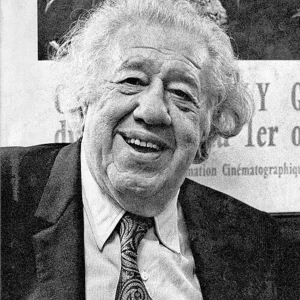

Michel Simon (1895-1975) is one of the greatest actors in French cinema, celebrated for his earthy, larger-than-life roles. Born in Geneva, he made his name in Paris on stage before moving to talking pictures, collaborating with Jean Renoir and Jean Vigo.
Michel Simon(1895 — 1975)
Michel Simon
Suisse
10 min read
Frequently asked questions
Key Facts
- Born on 9 April 1895 in Geneva, Switzerland
- Played Boudu in Jean Renoir's *Boudu Saved from Drowning* (1932), an iconic portrayal of the free-spirited vagrant
- Played Père Jules in Jean Vigo's *L'Atalante* (1934), a landmark of French cinema
- Received an honorary César and international recognition for a career spanning over 50 years
- Died on 30 May 1975 in Bry-sur-Marne
Works & Achievements
Michel Simon's first major talking-picture role, playing a naive office worker who falls for a scheming woman. This naturalistic film by Jean Renoir made a lasting mark on the history of French cinema with its unflinching portrait of society.
Michel Simon plays Boudu, an anarchic tramp taken in by a bourgeois bookseller whose domestic order he upends with wild, gleeful freedom. His uninhibited physical performance is considered one of the greatest in French cinema of the 1930s.
In this universally acclaimed masterpiece, Michel Simon plays Père Jules, an eccentric yet tender bargeman whose cabin cluttered with curiosities has become an iconic image in cinema history. The film regularly appears in rankings of the greatest films ever made.
A surrealist, farcical comedy in which Michel Simon plays a bourgeois botanist caught up in a whirlwind of misunderstandings alongside Michel Simon and Louis Jouvet. The film showcases Simon's ability to inhabit sophisticated comic registers with disarming ease.
A dark portrait of a solitary, marginalized man unjustly accused of murder and lynched by a neighborhood mob. Filmed just after the Liberation, the film resonates with themes of denunciation and collective responsibility that France had just lived through.
At 72, Michel Simon plays an elderly peasant with antisemitic views who unknowingly shelters a young Jewish boy entrusted to the countryside during the Occupation. This autobiographical film by Claude Berri, full of tenderness and ambiguity, gave Michel Simon his greatest late-career popular success.
Anecdotes
Michel Simon was famous for his menagerie of exotic animals: monkeys, parrots, reptiles, and countless other creatures filled his house in Noisy-le-Grand, nicknamed "Noah's Ark" by visitors. This eccentricity was well known throughout the Parisian arts scene of the 1930s and helped build the legend of an actor who defied all categories.
For the filming of *L'Atalante* in 1934, Jean Vigo cast Michel Simon as Père Jules, an eccentric bargeman living aboard a canal boat. Simon personally brought dozens of mismatched objects from his own home to decorate the character's cabin — tattoos, curiosities, stuffed animals — helping to create one of the most poetic atmospheres in the history of French cinema.
To portray Boudu, the anarchic tramp in Jean Renoir's *Boudu Saved from Drowning* (1932), Michel Simon spent several days observing the homeless men who slept under the bridges of the Seine. He studied their gestures, their gait, and their way of speaking in order to bring a striking social authenticity to the screen — long before the Stanislavski method had been formally introduced in Europe.
Born François Simon in Geneva in 1895, Michel Simon took his stage name in tribute to an actor he admired. His deep, gravelly voice, his distinctive nose, and his unpredictable temperament made him an incomparable figure of talking cinema: Jean Renoir claimed he was capable of inhabiting any character with total conviction, from criminals to bourgeois gentlemen to social outcasts.
At the age of 72, Michel Simon made a triumphant comeback with Claude Berri's *The Two of Us* (1967): he played an elderly antisemitic farmer who unknowingly takes in a Jewish child during the Occupation. This delicate and moving film brought him new recognition among younger audiences and earned him the broadest popular success of his late career.
Primary Sources
Michel Simon possessed that extraordinary ability to transform himself physically and morally into his character, while retaining a freedom of invention that forced the other actors to adapt to him. Directing Simon meant allowing something unpredictable — yet always right — to breathe.
Mr. Michel Simon, in the role of Legrand, delivers a performance of poignant truth. His expressive face, his distinctive diction and the restraint of his acting lend this ordinary character a human depth rarely achieved on screen.
Simon is Père Jules. There was no need to explain the character to him: he brought it with him — his objects, his gestures, his silences. There is something in him that is at once animal and tender, which is exactly what I was looking for.
I don't understand actors who try to please. What interests me is being truthful. If the character is ugly, you have to be ugly. If the character smells bad, the audience should almost smell it.
Key Places
Birthplace of Michel Simon, born François Simon on April 9, 1895. He spent his childhood and adolescence there before leaving Switzerland to try his luck in Paris, where he built his entire theatrical and film career.
A landmark of Parisian theatrical life run by Charles Dullin, this theatre on the place Charles-Dullin in Montmartre was a formative school of acting for Michel Simon during the 1920s. It was here that he honed his technique before establishing himself in cinema.
The shooting of Jean Vigo's *L'Atalante* (1934) took place largely on the Seine and the Canal de l'Ourcq, under difficult conditions in cold weather. These industrial yet poetic riverside landscapes gave the film its unforgettable atmosphere.
Major film studios in the Paris region and the main centre of French film production from the 1930s to the 1960s. Michel Simon shot numerous films there with Jean Renoir, Marcel Carné, and other leading directors of Poetic Realism.
A commune in the eastern suburbs of Paris where Michel Simon lived during his final years and where he died on May 30, 1975. His home, surrounded by exotic animals, had become a legendary spot in French artistic circles.
Typical Objects

With the advent of talking pictures (1929–1930), cameras were enclosed in soundproofed housings called 'blimps' to prevent their mechanical noise from being picked up by microphones. These bulky devices radically transformed shooting conditions in French studios.

The fixed or boom microphone positioned above the actors and hidden out of frame was the central instrument of talking pictures. For Michel Simon, whose deep, gravelly voice was a defining quality, the microphone amplified a uniquely expressive presence.

To portray Boudu in Jean Renoir's film (1932), Michel Simon wore torn, filthy clothing that visually constructed this iconic anarchist outsider. Stage costumes were designed by studio wardrobe departments to convey a character's social standing and psychological state.

In Jean Vigo's *L'Atalante* (1934), the barge serves as both setting and full-fledged character — a symbol of the working-class world of inland waterways and of wandering freedom. These working boats carrying goods along the Seine and its canals represented an authentic popular milieu that poetic realism sought to elevate.

Actors in 1930s cinema worked with makeup artists to transform their features for each role: foundation, false noses, hairpieces, accentuated wrinkles. Michel Simon, whose naturally expressive face was his trademark, used makeup sparingly so as not to undermine his spontaneity.

The large painted or lithographed posters that adorned cinema façades and Morris columns were works of popular art. The posters for Michel Simon's films helped forge the image of a larger-than-life, beloved actor across all of France.
School Curriculum
Vocabulary & Tags
Key Vocabulary
Daily Life
Morning
A film actor in the 1930s began his shooting days very early, sometimes before 7 in the morning, traveling to the studios in the Paris suburbs by tram or taxi. Makeup and costume preparation took an hour or two before the first takes, in an atmosphere of bustle involving technicians, script girls, and the director reviewing the day's scenes.
Afternoon
Filming continued throughout the afternoon in an alternation of takes, rehearsals, and waits caused by set changes or shifts in artificial lighting. Michel Simon, renowned for his improvisational instincts, might suggest variations to the director or invent spontaneous gestures that enriched the film. Exterior scenes, shot on the banks of the Seine or in the streets of Paris, depended on weather conditions.
Evening
As evening fell, actors and filmmakers gathered in the brasseries and cafés of the Parisian artistic world — La Coupole in Montparnasse, the bistros of Montmartre — to discuss projects, reviews, and cultural news. Michel Simon, both bohemian and solitary by nature, often headed home early to tend to his animals, to whom he was deeply devoted.
Food
The diet of Parisians in the 1930s and 1940s was rooted in tradition: fresh bread every day, cheeses, charcuterie, slow-cooked dishes in bistros. During the Occupation (1940–1944), severe rationing imposed coupons for bread, meat, and fats, drastically reducing daily meals. Michel Simon, a man who loved life's pleasures, had an appreciation for good food and French wines, symbols of a certain popular *art de vivre*.
Clothing
Men of the Parisian middle and artistic classes in the 1930s wore the three-piece suit, felt hat, and overcoat as everyday attire. On set, costume designers dressed actors according to their characters, sometimes in worn or working-class clothing, as was the case for Michel Simon's popular roles. Off set, Simon was known for his casual, relaxed style, with little regard for conventional elegance.
Housing
Michel Simon lived in several Parisian apartments with the ornate molded ceilings typical of Baron Haussmann's era, before settling in the suburbs — first in Noisy-le-Grand, then in Bry-sur-Marne — where his garden allowed him to house his menagerie. The popular Parisian dwellings of the interwar period, often cramped and poorly heated, stood in sharp contrast to the bourgeois apartments with their herringbone parquet floors that served as settings in Jean Renoir's films.