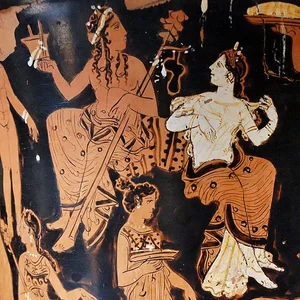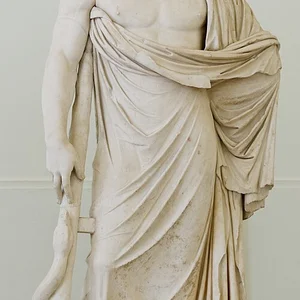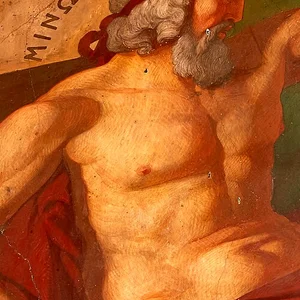

Legendary king of Crete, son of Zeus and Europa. He had the Labyrinth built to imprison the Minotaur, a monster born of the union between his wife Pasiphae and a divine bull. After his death, he became one of the judges of the Underworld.
Minos
Minos
9 min read
Frequently asked questions
Key Facts
- Son of Zeus and Europa, he rules Crete from the city of Knossos
- He commissions Daedalus to build the Labyrinth to imprison the Minotaur
- He imposes on Athens a tribute of seven young men and seven young women destined for the Minotaur
- Theseus manages to slay the Minotaur with the help of Ariadne's thread — Ariadne being Minos's own daughter
- After his death, Minos becomes a judge of souls in the Underworld, alongside Rhadamanthus and Aeacus
Works & Achievements
Minos was celebrated throughout Antiquity as the first great lawgiver; according to Plato, he received his laws from Zeus himself every nine years in a cave on Mount Ida, and his codes served as a model for Greek legislation.
An architectural masterpiece commissioned by Minos from the craftsman Daedalus, this underground maze served both as a prison for the Minotaur and as a symbol of Cretan ingenuity and creative power; the very word 'labyrinth' has entered every language in the world.
Minos established the first great maritime dominion in the Mediterranean: according to Thucydides, he was the first to control the Aegean Sea, drive out pirates, and impose his rule over the islands; the concept of 'thalassocracy' (empire of the seas) is directly tied to his reign.
In honor of his son who died in Athens, Minos instituted ritual games at Knossos combining athletic competitions and bull-leaping; these ceremonies are among the earliest mythological attestations of funeral games in the Greek tradition.
After his death, Minos was entrusted by the gods with the task of judging the souls of the dead in the realm of Hades; this posthumous role, described by Homer, Virgil, and Dante, makes him the archetype of the impartial judge and of eternal justice in Western culture.
Anecdotes
Minos was the son of Zeus and Europa, a Phoenician princess whom the god had abducted by transforming himself into a white bull. To prove his claim to the throne of Crete, he prayed to Poseidon to send a magnificent bull rising from the waves, promising to sacrifice it. The god granted his request, but Minos, dazzled by the animal's beauty, kept the bull for himself — a divine betrayal that would set off a terrible series of misfortunes for his family.
Furious at this betrayal, Poseidon struck Queen Pasiphae with an unnatural passion for the sacred bull. From this monstrous union was born Asterion, known as the Minotaur: half-man, half-bull. Minos, ashamed of this horror born within his own palace, called upon the genius of the craftsman Daedalus to design the Labyrinth, a vast underground maze of countless winding corridors, at the heart of which the monster was imprisoned forever.
To feed the Minotaur, Minos imposed a cruel tribute on Athens: every nine years, the city had to send seven young men and seven young women to be delivered to the monster. This tribute was the consequence of the mysterious death of Minos's son, Androgeos, who had been killed in Athens. It was only when the hero Theseus volunteered to join the tribute, guided by Ariadne — Minos's own daughter — that this terrible practice finally came to an end.
After the escape of Daedalus and Icarus, Minos swore to track down the ingenious craftsman. He traveled throughout the Mediterranean carrying a conch shell, promising a reward to anyone who could thread a string through it — a puzzle only Daedalus had the wit to solve. In Sicily, King Cocalus accepted the challenge, thereby revealing the craftsman's hiding place. But the daughters of Cocalus, who loved Daedalus, poured boiling water over Minos as he bathed, killing him in the very trap they had set to protect their friend.
After his death, Minos was chosen by the gods to serve as a judge of the Underworld, alongside his brother Rhadamanthus and Aeacus. In Homer's Odyssey, Odysseus glimpses him in the kingdom of the dead, holding a golden scepter and pronouncing his verdicts upon the souls pressing around him. Plato, in his dialogues, praises him as the wisest of all lawgivers, whose Cretan laws served as a model for the whole of Greece.
Primary Sources
I saw Minos, the glorious son of Zeus, seated, holding a golden scepter, pronouncing judgment upon the dead, who stood or sat around the king pleading their cases in the house of Hades with its wide gates.
Minos, king of the Cretans, lord of the seas, addressed the light-footed hero: "Theseus, if you are truly the son of the lord of the seas, prove it by diving into the waves and bringing back the ring I am casting in."
Minos ruled over Crete and a great many of the maritime nations. He married Pasiphae, daughter of Helios and Perse. From this union were born Catreus, Deucalion, Glaucus, Androgeus, Ariadne, Phaedra, and Xenodice. He ordered Daedalus to build the Labyrinth to confine the Minotaur within it.
Minos was the greatest lawgiver we know of; Zeus himself, his father, educated him in wisdom and judgment. Every nine years, Minos would go up to the cave of Zeus to receive his laws and bring them back to men.
Minos was the first to assemble a powerful fleet and to dominate the Aegean Sea. He drove out pirates, populated the islands with colonies, and established his laws throughout. His death came in Sicily, at the court of King Cocalus, whose daughters caused him to perish in a bath of boiling water.
Key Places
Capital of Minos's kingdom and site of the great labyrinthine palace with its thousands of rooms, whose frescoes depict dolphins, bulls, and sacred processions; the heart of Minoan civilization and the cradle of the myth.
An underground structure built by Daedalus on Minos's orders to imprison the Minotaur; a mythical space from which no one could escape unaided, and a universal archetype of entrapment and endless maze.
The city forced to pay tribute to Minos following the death of his son Androgeos; it was from here that the fourteen young men and women destined for the Minotaur were sent, and from here that Theseus set out to end the tribute.
The kingdom of the dead where Minos sits as supreme judge alongside Rhadamanthus and Aeacus; Homer, Virgil, and Dante each in turn cast him in this solemn role as guardian of justice in the afterlife.
The city of King Cocalus where Minos met his death, betrayed by the daughters of his host who were protecting Daedalus; this place marks the earthly end of the king of Crete and symbolizes the limits of power, even for the greatest rulers.
Typical Objects

The emblem of Minos's royal power, this golden scepter is attributed to him by Homer in the Odyssey, where he still holds it in the underworld to pass judgment on the dead.

A sacred symbol of Minoan Crete, the double axe adorned the sanctuaries of the Palace of Knossos and represented the king's divine and sacrificial authority; the word 'labyrinth' is thought to derive from 'labrys'.

A ritual vessel shaped like a bull's head, used for libations during Cretan religious ceremonies; it symbolizes the bull of Poseidon at the heart of the myth of Minos.

In his search for Daedalus, Minos used a pierced conch as a riddle, promising a reward to anyone who could thread a string through it — a trick that allowed him to track down the fugitive craftsman.

The central object of the myth, this ball of wool was given by Ariadne, daughter of Minos, to Theseus so he could find his way out of the Labyrinth after slaying the Minotaur.

A symbol of his role as judge in the Underworld, Minos rules on the fate of the souls of the dead according to their deeds in life, embodying immutable divine justice in the Greek tradition.
School Curriculum
Vocabulary & Tags
Key Vocabulary
Tags
Daily Life
Morning
Minos begins his day with religious rituals in the great sanctuary of the Palace of Knossos, offering libations of wine and oil to Poseidon and Zeus. Priestesses in flounced robes and priests assist him in these sacred ceremonies, invoking divine protection over the Cretan fleet and the island's prosperity.
Afternoon
In the afternoon, Minos presides over the great royal court, receiving ambassadors, delegates from tributary cities, and merchants from all corners of the Mediterranean. He also oversees the bull-leaping games in the palace's grand central courtyard — the famous bull-leaping rituals — which serve as both a religious rite and a political spectacle showcasing Minoan power.
Evening
In the evening, Minos hosts a banquet in the palace's red-columned hall, surrounded by his nobles and advisors. Bards sing the genealogies of the gods while dancers and musicians entertain the court. It is also at this hour that Minos, renowned for his wisdom as a lawgiver, settles the most serious disputes brought before him.
Food
Minos's royal table reflects the riches of Crete and the sea: fresh fish, octopus, and sea urchins, roasted lamb and kid seasoned with aromatic herbs, figs, pomegranates, and dried grapes, olives and olive oil. Cretan wine, thick and potent, is served in bull's-head rhytons or finely crafted golden cups.
Clothing
Minos wears the Minoan royal regalia: an elaborate belted loincloth with geometric patterns, and a long white linen robe trimmed with red and gold bands for ceremonial occasions. His headdress features a tall tiara adorned with peacock feathers and colored ribbons, a symbol of his divine authority. He wears broad bracelets and rings engraved with sacred symbols, and sandals decorated with thin sheets of gold.
Housing
The Palace of Knossos is a labyrinthine residence of more than a thousand rooms spread across several floors, its walls covered in vivid frescoes depicting leaping dolphins, athletic bull-leapers, and goddesses with raised arms. A sophisticated system of channels supplies running water and drainage. At its center, the grand courtyard paved with white limestone hosts ceremonies and bull-leaping games beneath the Cretan sky.
Historical Timeline
Period Vocabulary
Visual Style
Style inspiré des fresques minoennes de Cnossos et de la céramique grecque archaïque : formes dynamiques, couleurs franches, symbolisme taurin et marin omniprésent.
Sound Ambience
Ambiance mêlant la puissance marine et taurine de la Crète minoenne, l'écho sombre du Labyrinthe et la solennité froide du tribunal des Enfers.
Liens externes & ressources
Références
Œuvres
Le code de lois crétois
âge mythologique (vers -1600)
Le Labyrinthe de Cnossos
âge mythologique
La thalassocratie crétoise
vers -1700 à -1450
Les jeux funèbres d'Androgée
âge mythologique
Jugement des âmes aux Enfers
après la mort de Minos