 flip
flipBarley Grautr with Honey and Berries
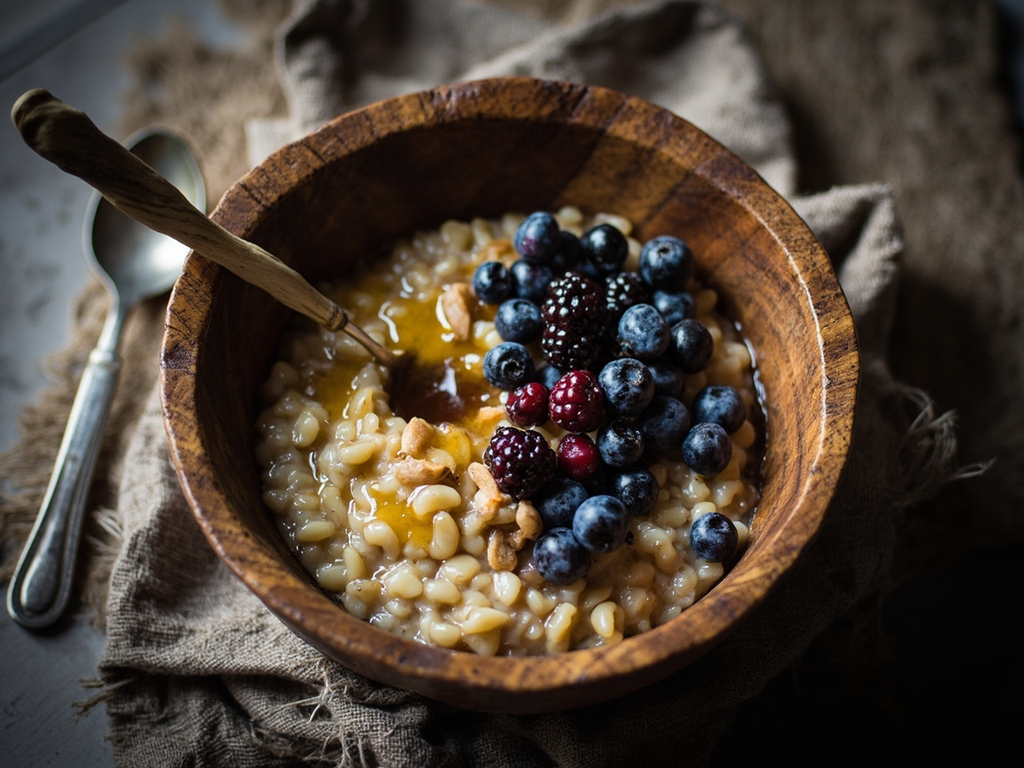
Barley Grautr with Honey and Berries
Why this dish? Before setting off to work or taking to the longhouse paths, the Northern men broke their fast with a thick barley porridge. Odin, god of both peasant farmers and kings, shared the humblest food: this grain that grew where wheat failed, sweetened with honey from the very hives that gave him mead.
A porridge of hulled barley cooked long in milk, sweetened with honey and brightened with wild Northern berries (bilberries, lingonberries). Comforting, warm, it sustains the body through a cold morning.
Listen, traveler. Before the raven takes flight, the wise man fills his belly, for none walks far with hollow entrails — thus I speak in my words. You throw the barley into the goats' milk, stir near the hearth until the grain softens, then pour the honey stolen from the bees and the blue berries picked under the birch. Eat warm: wisdom comes to him who is neither hungry nor cold.
- •Hulled barley — a full bowl (nourishing base)
- •Goat's or cow's milk — enough to cover (cooking liquid)
- •Honey — a good measure (sweetness)
- •Wild berries (bilberries, lingonberries) — a handful (tart fruitiness)
- •Salt — a pinch (seasoning)
Barley Grautr with Honey and Berries
A porridge of hulled barley cooked long in milk, sweetened with honey and brightened with wild Northern berries (bilberries, lingonberries). Comforting, warm, it sustains the body through a cold morning.
Why this dish? Before setting off to work or taking to the longhouse paths, the Northern men broke their fast with a thick barley porridge. Odin, god of both peasant farmers and kings, shared the humblest food: this grain that grew where wheat failed, sweetened with honey from the very hives that gave him mead.
Listen, traveler. Before the raven takes flight, the wise man fills his belly, for none walks far with hollow entrails — thus I speak in my words. You throw the barley into the goats' milk, stir near the hearth until the grain softens, then pour the honey stolen from the bees and the blue berries picked under the birch. Eat warm: wisdom comes to him who is neither hungry nor cold.
Ingredients (period version)
- Hulled barley — a full bowl (nourishing base)
- Goat's or cow's milk — enough to cover (cooking liquid)
- Honey — a good measure (sweetness)
- Wild berries (bilberries, lingonberries) — a handful (tart fruitiness)
- Salt — a pinch (seasoning)
Ingredients
- Hulled barley (or pearl barley) — 150 g (nourishing base)
- Whole milk — 600 ml (cooking liquid)
- Water — 200 ml (cooking liquid)
- Honey — 3 tbsp (sweetness)
- Bilberries and lingonberries (fresh or frozen) — 150 g (tart fruitiness)
- Salt — 1 pinch (seasoning)
Method
- Rinse the barley in cold water.
- Pour it into a saucepan with the milk, water, and a pinch of salt.
- Bring to a simmer and cook over low heat for 40 to 50 minutes, stirring often, until the grains are tender and the porridge creamy.
- Off the heat, stir in the honey.
- Serve warm, topped with berries (lightly heated separately if frozen).
How it was made : Barley was the staple grain of Viking-age Scandinavia, better suited to short summers than wheat. It was cooked as grautr (porridge) in iron cauldrons suspended over the central hearth of the longhouse. Honey and forest berries were the only sources of sugar, as cane sugar was unknown.
The contemporary twist : A spoonful of cold Icelandic skyr melting into the hot porridge gives you the hot-cold contrast that Northern farms already loved.
Odin · Charactorium