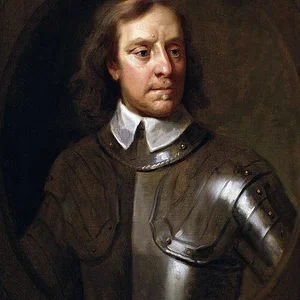

An English statesman and military leader, Oliver Cromwell led the Puritan revolution against Charles I. Commander of the Roundheads, he had the king executed in 1649 and ruled England as Lord Protector until his death in 1658.
Oliver Cromwell(1599 — 1658)
Oliver Cromwell
royaume d'Angleterre, Commonwealth d'Angleterre
9 min read
Frequently asked questions
Famous Quotes
« Put your trust in God, but keep your powder dry.»
« No man rises so high as he who knows not whither he is going.»
Key Facts
- 1642: Start of the English Civil War between Parliament and Charles I
- 1645: Decisive victory at Naseby with the New Model Army under his command
- 1649: Execution of Charles I — establishment of the Commonwealth (Republic)
- 1653: Cromwell dissolves Parliament and becomes Lord Protector of England
- 1658: Death of Cromwell; the monarchy would be restored in 1660 under Charles II
Works & Achievements
Cromwell was the chief architect of this professional, disciplined, and meritocratic army, recruited on the basis of ability rather than birth. It revolutionized English military practice and won every decisive battle of the Civil War.
The first written constitution in English history, drawn up under Cromwell's impetus. It established the Lord Protectorate and sought to balance power between the executive and Parliament.
A major piece of economic legislation requiring that goods imported into England be carried on English ships. It aimed to break the Dutch commercial monopoly and laid the foundations of British maritime power.
Cromwell led military campaigns that brought Ireland and Scotland under the authority of the English Commonwealth, laying the groundwork for the unification of the three kingdoms under English administration.
The collected writings and speeches of Cromwell, assembled in the nineteenth century by the historian Carlyle, provide an exceptional record of his political and religious thinking and his providential vision of history.
Under his Protectorate, Cromwell pursued a policy of relative religious toleration toward non-conformist Protestants and permitted the return of Jews to England, who had been expelled since 1290.
Anecdotes
Cromwell was known for his unflattering appearance and owned it completely. When a painter offered to flatter him in his portrait, he reportedly replied: 'I desire you would use all your skill to paint my picture truly like me, and not flatter me at all; but remark all these roughnesses, pimples, warts, and everything as you see me.' This gave rise to the famous English expression 'warts and all.'
During the trial of Charles I in January 1649, several judges hesitated to sign the death warrant. Cromwell reportedly seized the hand of one reluctant judge, Richard Ingoldsby, and forced him to sign, leaving an ink smudge on the historic document. Ingoldsby later used this very anecdote to obtain a pardon for himself after the Restoration.
Cromwell twice refused the crown of England when it was offered to him by Parliament in 1657. He preferred the title of Lord Protector, believing that accepting a monarchy would betray the principles of the revolution he had led. His refusal baffled both his allies and his enemies, who struggled to understand his vision of power.
Two years after his death in 1658, during the Monarchical Restoration, Cromwell's body was exhumed and subjected to a symbolic posthumous execution: his corpse was hanged at Tyburn, then beheaded, and his head displayed on a spike outside Parliament for twenty years. A macabre fate for the man who had himself ordered the beheading of a king.
Cromwell was an unremarkable horseman and a self-taught strategist who, at the age of 43, had never commanded troops. Yet within a few years, he created the New Model Army — England's first professional, disciplined fighting force — which won decisive victories such as Naseby in 1645. His ability to learn warfare on the job remains a source of astonishment for military historians.
Primary Sources
I am ready to serve not as a king, but as a servant of the Parliament and people of this nation, according to the laws and statutes of the land.
You are no longer a Parliament. I say you are no Parliament. You have sat too long here for any good you have been doing. Depart, I say, and let us have done with you!
Gentlemen, this is the victory of the Lord. The enemy has fled before us. Be humble before this divine mercy and attribute nothing to the flesh.
Let your faith be firm in God. We have not sought these things for ourselves, but the Providence of God has led us to them.
The government of the Commonwealth of England, Scotland and Ireland shall be vested in a single person together with Parliament.
Key Places
Cromwell's birthplace, where he was born on 25 April 1599. He spent his childhood and youth there before entering politics as a local Member of Parliament.
Site of the decisive battle of 14 June 1645, where Cromwell's New Model Army crushed the Royalist forces of Charles I. This victory marked an irreversible turning point in the Civil War.
The royal palace converted into Cromwell's official residence as Lord Protector. It was here that he governed England from 1653 until his death in 1658, and where he held his Councils of State.
The Irish town where Cromwell ordered the massacre of the Royalist garrison and part of the civilian population in 1649. This episode remains one of the most controversial and traumatic events in Irish history.
The site of King Charles I's trial in January 1649. Cromwell was one of the driving forces behind this unprecedented judgment of a sovereign by his own subjects.
Typical Objects

Cromwell wore a metal breastplate on the battlefield, typical of Parliamentary cavalry officers. It was this armour that earned him the nickname 'Ironsides', a name later extended to his elite cavalry troopers.

Cromwell was a devout Calvinist Protestant who constantly read and quoted Scripture. He interpreted every military victory as a sign of Divine Providence, and the Bible guided his political and military decisions.

The Great Seal of England was recast after the execution of the king, now bearing a map of England and Ireland with the motto 'In the first year of Freedom'. Cromwell used it to authenticate the official acts of the Republic.

As Lord General and later Lord Protector, Cromwell carried a ceremonial sword symbolising his military and civil authority. It was present at official ceremonies at Whitehall.

Like all Puritans of his time, Cromwell wore a broad-brimmed black hat, a symbol of religious austerity in contrast to the extravagant dress of the Royalists. His dark, plain attire embodied the values of the radical Protestant Reformation.

Cromwell wrote hundreds of hand-signed letters and orders addressed to his generals, governors, and Parliament. These documents are today among the essential primary sources for understanding his political and religious thought.
School Curriculum
Vocabulary & Tags
Key Vocabulary
Tags
Daily Life
Morning
Cromwell rose early and began his day with lengthy personal prayer and the reading of the Psalms. As a devout Puritan, he considered this morning communion with God essential before any action. During his military campaigns, he would gather his officers for collective prayer before dawn.
Afternoon
His afternoons were devoted to military or political affairs depending on the period: war councils, troop reviews, audiences with petitioners, or sessions of the Council of State at Whitehall. As Lord Protector, he received ambassadors and delegations in the state apartments, working directly with his secretaries and advisers.
Evening
Cromwell's evenings, contrary to the austere image often portrayed, could be lively: he enjoyed music, played bowls, and appreciated animated conversation with his family and officers. He retired relatively early, worn down by the fragile health that troubled him throughout his adult life.
Food
Cromwell's diet was that of a prosperous English gentleman of the 17th century: roasted meats, game, bread, cheeses, and barley ale. Puritans did not practice dietary asceticism, but they rejected the excess and waste of royal banquets. Cromwell drank in moderation but did not deny himself a good meal shared with his officers.
Clothing
Cromwell wore simple, practical clothing: a dark wool coat, a plain white linen collar without lace, and sturdy leather boots. On the battlefield, he wore his cavalry breastplate. He conspicuously refused the costly embroideries and ornaments worn by Royalist nobility, making his plain dress a deliberate political and religious statement.
Housing
Cromwell long lived in a country gentleman's house in Ely and then Huntingdon, before his military duties led him to live on campaign. Upon becoming Lord Protector, he moved into Whitehall Palace and Hampton Court — former royal palaces which he occupied without radically altering them, maintaining a relative austerity in their furnishings.
Historical Timeline
Period Vocabulary
Visual Style
Style visuel austère et réaliste inspiré de la peinture portrait anglaise du XVIIe siècle, avec une palette sombre puritaine, des scènes militaires dramatiques et une esthétique délibérément dépouillée de tout ornement.
Sound Ambience
Ambiance sonore mêlant le fracas des batailles de la guerre civile anglaise, la ferveur austère des réunions puritaines et la gravité des délibérations parlementaires du XVIIe siècle.
Liens externes & ressources
Références
Œuvres
Création de la New Model Army
1645
Instrument of Government
1653
Navigation Act (Acte de Navigation)
1651
Campagne d'Irlande et d'Écosse
1649-1651
Discours et lettres (recueillis par Thomas Carlyle)
1845
Réforme de l'Église et politique de tolérance
1653-1658