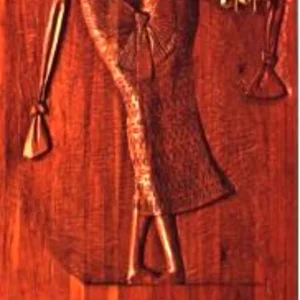

Oshun is an orisha (deity) of the Yoruba people of West Africa, venerated as the goddess of love, rivers, and fertility. Passed down through oral tradition, she embodies gentleness, beauty, and healing. Her cult, alive since pre-colonial times, spread to the Americas with the African diaspora.
Oshun
Oshun
7 min read
Frequently asked questions
Famous Quotes
« "Where sweet water flows, there is my home." (words attributed to Oshun by Yoruba tradition)»
« "Love is more powerful than war." (saying transmitted by the babalawo in the Ifá cult)»
Key Facts
- Oshun is one of the principal orishas of the Yoruba pantheon, a people established in present-day Nigeria since the first millennium CE
- Her name is linked to the Osun, a sacred river in Nigeria — the Osun-Osogbo sanctuary has been a UNESCO World Heritage Site since 2005
- The oral tradition (Ifá corpus) is the primary source of knowledge about Oshun — no pre-colonial written text documents her directly
- Through the transatlantic slave trade (16th–19th centuries), the cult of Oshun spread to the Caribbean and Latin America, giving rise to syncretic figures such as Oxum (Brazilian Candomblé) and La Caridad del Cobre (Cuba)
- Oshun is often depicted dressed in yellow or gold, holding a mirror and honey, symbols of beauty and abundance
Works & Achievements
Ensemble de textes divinatoires sacrés yorubas reconnus par l'UNESCO comme patrimoine immatériel de l'humanité. Ils constituent la principale source mythologique sur Oshun et ses attributs divins.
Grand rassemblement annuel de dizaines de milliers de fidèles à Osogbo. Ce festival vivant perpétue le culte d'Oshun à travers danses, offrandes et processions rituelles sur la rivière sacrée.
Les esclaves yorubas transportèrent le culte d'Oshun au Brésil où elle devint Oxum. Cette tradition syncrétique constitue un témoignage vivant de résistance culturelle face à l'esclavage.
Adaptation cubaine du culte yoruba où Oshun est vénérée sous le nom d'Ochún, associée à la Vierge de la Charité. Ce syncrétisme religieux est un pilier de l'identité culturelle cubaine.
Ensemble monumental de sculptures et d'autels dédiés à Oshun dans la forêt sacrée d'Osogbo. Ces œuvres d'art sacré constituent un patrimoine exceptionnel de la religion yoruba.
Anecdotes
According to Yoruba tradition, when the orishas (deities) were sent to Earth by Olodumare (the supreme god), Oshun was the only woman among them. The other orishas ignored her at first, but all their plans failed. Recognizing their mistake, they had to turn to her: without her wisdom and femininity, nothing could flourish.
Oshun is said to have saved humanity by taking the form of a peacock to fly up to heaven and beg Olodumare to end a devastating drought. Exhausted and scorched by the sun, she nonetheless reached her destination — which is why the peacock is one of her sacred animals and why its feathers adorn her altars.
The Osun River in Nigeria bears her name and is considered her earthly home. According to oral tradition, anyone who bathes in its waters with faith may receive healing and fertility. Each year, tens of thousands of devotees still gather on its banks for the Osun-Osogbo festival.
Oshun is often depicted holding a mirror, a symbol of her love of beauty and self-knowledge. Tradition holds that she was the first to teach humans the art of water divination (hydromancy), gazing into rivers to read the future.
Primary Sources
Oshun, the gentle, the beautiful, the mother of fish and rivers, was called upon by Olodumare to bring sweetness where there was only bitterness. She alone knows the path between the waters and the sky.
Yeye o, Yeye o — Mother of waters, you who dance with the current, you whose laughter heals the sick and whose tears make the harvests grow.
Oshun received from Olodumare the secret of fresh waters and knowledge of medicinal herbs. She taught women the art of healing and men the art of love.
We come each year to place our offerings in the sacred river. Our mothers and their mothers before them did the same. Oshun always answers those who call upon her with a pure heart.
Key Places
A sacred forest on the banks of the Osun River, considered the primary earthly dwelling of Oshun. Inscribed as a UNESCO World Heritage Site in 2005, it houses sculptures, altars, and temples dedicated to the goddess.
A river regarded as the physical manifestation of Oshun on Earth. Its waters are considered sacred and healing; pilgrims have journeyed to it every year for centuries.
A holy Yoruba city considered the cradle of humanity and the orishas according to Yoruba cosmology. It is the mythical birthplace of Oshun and the other deities.
A former center of the slave trade that became the world capital of Candomblé. Oxum (Oshun) is one of the most venerated orishas there, worshipped in terreiros (temples) founded in the 19th century.
A center of Cuban Santería where Oshun is venerated under the name Ochún, syncretized with Our Lady of Charity. Her cult has been practiced there since the 17th century.
Liens externes & ressources
Références
Œuvres
Corpus Ifá — Odus contenant les mythes d'Oshun
Tradition orale antérieure au Xe siècle, transcrite au XIXe-XXe siècle
Festival Osun-Osogbo (cérémonie annuelle)
Depuis au moins le XVe siècle, chaque mois d'août
Tradition du Candomblé brésilien (culte d'Oxum)
XVIIe-XIXe siècle, Bahia, Brésil
Santería cubaine (culte d'Ochún)
XVIIe-XVIIIe siècle, Cuba
Sculptures et autels du bois sacré d'Osogbo
XVe-XXe siècle (restaurés 1958-1994)