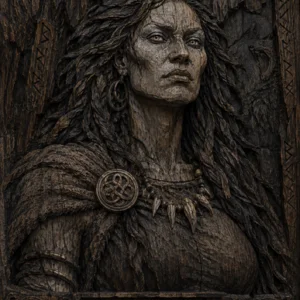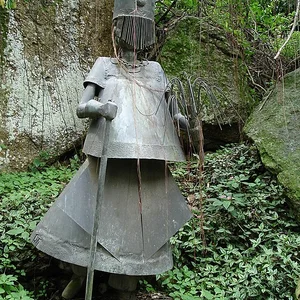

Oya is an orisha of the Yoruba tradition, deity of wind, storms, lightning, and transformation. Venerated by the Yoruba people of West Africa (present-day Nigeria, Benin, Togo), she is associated with the Niger River and the forces of change. Her figure crossed the Atlantic with the African diaspora, becoming integrated into the Candomblé and Santería traditions.
Oya
Oya
9 min read
Frequently asked questions
Famous Quotes
« "Where Oya passes, nothing stays in place." (saying attributed by the Yoruba oral tradition)»
Key Facts
- Oya is one of the principal orishas of the Yoruba pantheon, wife of Shango, orisha of thunder
- She is associated with the Niger River, called "Oya" in Yoruba, which is the source of her name
- Guardian of the realm of the dead (egun), she presides over transitions and passages between worlds
- Her veneration survived the transatlantic slave trade and became integrated into Brazilian Candomblé (under the name Iansã) and Cuban Santería
- In the Yoruba oral tradition, she is depicted wearing a skirt of nine colors, symbolizing her mastery over change
Works & Achievements
A collection of ritual chant-poems recited in her honor by Yoruba priestesses. These texts constitute the primary literary source on her divine nature and attributes.
A corpus of songs, dances, and rituals dedicated to Oya/Iansã, developed in Brazil by Yoruba enslaved communities. It represents the adaptation and survival of the tradition in the context of forced deportation.
A ritual celebration gathering devotees, priestesses, and initiates at Oya's principal shrine in Nigeria. It perpetuates pre-colonial rites and affirms Yoruba cultural identity.
The first major academic synthesis devoted to Oya, drawing on Yoruba, Brazilian, and Cuban sources. It helped bring this figure to Western audiences and lent legitimacy to Afro-religious studies.
The Nigerian Nobel laureate in literature weaves Yoruba orishas, including Oya, into his plays and poetry. His work contributes to the transmission of this mythology within contemporary world literature.
Anecdotes
Oya is one of the rare orishas with the power to cross the realm of the dead, Iku. According to Yoruba accounts, she is the only deity who does not fear death, which grants her particular authority during funeral ceremonies, where she guides souls into the afterlife.
Yoruba oral tradition tells that Oya stole the secrets of fire and lightning from her husband Shango, orisha of the storm, in order to master them herself. This story symbolizes her relationship to power and transformation: she does not submit to the forces of the world — she commands them.
In the Candomblé traditions of Brazil, where Oya is known as Iansã, devotees wave ritual fans called eruexim during ceremonies held in her honor. This gesture imitates the breath of wind she embodies, recalling the journey of Yoruba tradition to the Americas through the transatlantic slave trade.
Oya is associated with the number nine in Yoruba cosmology: she is said to have given birth to nine children, representing the nine mouths of the Niger River at its delta. This sacred number structures her rituals, her offerings, and her place within the pantheon.
In Cuban Santería tradition, Oya is syncretized with Saint Teresa of Ávila or Our Lady of Candelaria. This syncretism, born under Spanish colonization, allowed enslaved Africans to preserve their devotion to the orishas by concealing them behind Catholic figures.
Primary Sources
The odù (chapters) of the Ifá corpus contain numerous stories featuring Oya, particularly her ties to Shango and her role as psychopomp. Transmitted orally by babalawo (diviner-priests), this corpus has been recognized by UNESCO as an oral and intangible heritage of humanity.
Oriki are sung poems attesting to the attributes and deeds of a deity. Those dedicated to Oya describe her as 'she who wears nine buffalo skins', 'mistress of cemeteries', and 'mother of violent winds'. They are recited during annual festivals and rites of passage.
Samuel Johnson, a Yoruba pastor and historian, recorded in this foundational work the myths and legends of the Yoruba people, including narratives relating to the orishas. He mentions Oya as the deity of the Niger River and of storms, and as the wife of Shango.
Cuban ethnographer Lydia Cabrera documents Santería practices in Cuba, including the cult of Oyá (Oya). She collects the songs, offerings, and mythological narratives preserved by descendants of Yoruba enslaved people in the Caribbean, attesting to the continuity of the tradition.
The first academic monograph dedicated to Oya, this work compiles oral narratives gathered in Nigeria, Brazil, and Cuba, and analyzes the theological coherence of the figure across her multiple diasporic traditions.
Key Places
The Niger River is the embodiment of Oya in Yoruba cosmology; its very name means 'river of Oya' in Yoruba (Odo Oya). Its nine mouths at the delta correspond to the nine children of the goddess.
A sacred city in Yorubaland considered the main center of Oya worship. A great shrine is dedicated to her there, and annual festivals held in her honor draw devotees and priestesses from across the region.
The capital of Brazilian Candomblé, where the cult of Iansã (Oya) is especially vibrant. The city is home to some of the oldest and most important terreiros (houses of worship) in South America.
The historical heart of Cuban Santería, where Oyá is venerated in particular through her syncretism with Our Lady of Candelaria. Afro-Cuban communities have preserved her songs and rituals there since the 17th century.
A contemporary Yoruba metropolis where festivals dedicated to the orishas, including Oya, continue to be celebrated. The city is a hub of Yoruba cultural revival and exchange with the Afro-Atlantic diaspora.
Typical Objects

A ritual instrument waved by Oya's priestesses during Candomblé and Santería ceremonies to embody the breath of the wind. Its sweeping gestures replicate the movement of the storms the goddess commands.

An emblem of Oya's sacred dignity, used during Yoruba rituals. The horsehair symbolizes both nobility and the connection to the ancestors — Oya's domain of predilection.

A Yoruba ritual costume used during ancestor ceremonies (the Egungun cult), of which Oya is the divine protector. This mask allows ancestors to temporarily return among the living.

A sacred food associated with Oya in Afro-diasporic traditions. Purple — the color of the eggplant — is one of the goddess's emblematic colors, symbolizing transformation and transition.

Oya's symbolic weapon, emphasizing her warrior aspect. Unlike other female orishas, Oya is a formidable fighter who leads souls into battle and beyond death.

An initiatory necklace worn by devotees of Oya in Santería. Brown (cemetery, earth) and red (fire, transformation) are her distinctive sacred colors.

A sacred vessel holding Oya's emblems during Yoruba initiation rites. The sealed gourd represents the secret of the cosmos and the hidden powers held by the goddess of transformations.
School Curriculum
Vocabulary & Tags
Key Vocabulary
Tags
Daily Life
Morning
In Yoruba cosmology, Oya awakens with the breath of the dawn wind sweeping across the Niger River. The priestesses consecrated to her (the iyalorisha) begin their day with ritual ablutions and prayers recited facing east, where the wind is born. Incense and offerings of fruit are placed at the entrance to the sanctuary before sunrise.
Afternoon
The afternoon is a time for divination consultations and teachings passed on to novices. Oya governs transitions: in the myths, this is the hour when she moves between the world of the living and the world of the dead, accompanying departing souls. Funerary ceremonies are dedicated to her and are often held at midday in Yoruba communities.
Evening
The evening belongs to Oya and the spirits of the ancestors. Egungun ceremonies (the ancestor cult of which she is the protector) take place at dusk. The batá drums begin to sound, the masks emerge, and the faithful sing oriki chants to invoke her presence. In Brazilian terreiros, the trances of Iansã often occur as night falls.
Food
Oya's food offerings include purple eggplants, considered her sacred food, as well as palm wine and certain bean-based preparations. In Afro-Brazilian traditions, her ritual dishes (acarajé, vatapá) are prepared with particular attention to the brown and red colors associated with her.
Clothing
Oya adorns herself with robes of nine layered garments, symbolizing her nine children and the nine mouths of the Niger River. Her characteristic colors are brown, blood red, copper, and stormy purple. Her ritual garments are adorned with beads, cowrie shells, and iron threads symbolizing lightning. The priestesses who serve her wear her colors during ceremonies.
Housing
Oya's domain is the threshold: she dwells at the borders between spaces — at cemetery gates, along riverbanks, at the crossroads of winds. In Yoruba towns, her sanctuary is often situated at the edge of a forest or near a body of water. In Brazilian terreiros and Cuban ilés, she is given a space outside the main building, in close connection with the natural elements.
Historical Timeline
Period Vocabulary
Visual Style
Esthétique de l'art sacré yoruba et afro-brésilien : robes tourbillonnantes aux neuf couches marron-cuivre et violet orageux, couronnes de fer, foudre et eaux du Niger dans un style expressif et puissant.
Sound Ambience
Ambiance de tempête sacrée : vent puissant, tonnerre lointain, rivière en crue, tambours batá et voix rituelles yoruba entremêlés dans une cérémonie nocturne en l'honneur d'Oya.
Liens externes & ressources
Références
Œuvres
Corpus des oriki d'Oya (chants de louange)
Tradition orale multiséculaire
Liturgie Candomblé d'Iansã (Bahia, Brésil)
XVIIe-XXe siècle
Fête annuelle d'Oya à Ìrá Àwọ̀rọ̀
Tradition annuelle, Nigeria
Judith Gleason, 'Oya : In Praise of an African Goddess'
1987
Wole Soyinka, références aux orishas dans son œuvre (dont 'La Danse de la forêt', 1960)
1960