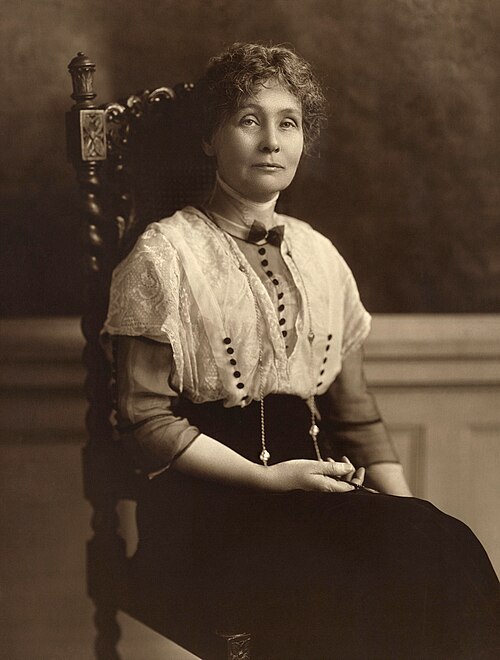
Pankhurst (Emmeline)
Emmeline Pankhurst
8 min read
British activist and founder of the Women's Social and Political Union (WSPU) in 1903, Emmeline Pankhurst led the English suffragist movement using radical methods. Her struggle led to British women gaining the right to vote in 1918.
Frequently asked questions
Famous Quotes
« I would rather be a rebel than a slave. »
« We are here, not because we are law-breakers; we are here in our efforts to become law-makers. »
Key Facts
- 1858: Born in Manchester
- 1903: Founded the Women's Social and Political Union (WSPU)
- 1913: Repeated arrests and hunger strikes in prison
- 1918: British women over the age of 30 gain the right to vote
- 1928: Died in London, a few weeks before universal women's suffrage was achieved
Works & Achievements
A suffragist organization founded with her daughter Christabel, open to women only and adopting the motto 'Deeds not Words'. It became the driving force of the radical movement for women's voting rights in Britain.
An autobiography dictated to Rheta Childe Dorr, published in the United Kingdom and the United States. A primary historical document, it traces the suffragist struggle from the inside and served as a propaganda tool for the cause.
The WSPU's weekly newspaper, edited by Christabel from Paris. Emmeline Pankhurst oversaw its editorial direction and used the paper to coordinate militant actions on a national scale.
Pankhurst undertook several transatlantic lecture tours to raise funds for the WSPU and bring the women's suffrage debate to an international audience, meeting Theodore Roosevelt and other major political figures.
With the support of the Lloyd George government, Pankhurst organised campaigns to encourage women to work in munitions factories, directly contributing to the political argument that legitimised women's right to vote in 1918.
Anecdotes
Emmeline Pankhurst was born on 14 July 1858 in Manchester into a militant family: her father took his children to visit exhibitions about slavery from a very young age. Her mother read suffragist newspapers aloud in the evenings. This early activist upbringing forged her conviction that injustice is never inevitable.
In 1905, Christabel Pankhurst and Annie Kenney interrupted a Liberal Party meeting in Manchester by publicly asking whether the party would support women's suffrage. Expelled and arrested, they refused to pay the fine and chose prison instead. Emmeline hailed this bold act as the true beginning of their militant strategy: “Deeds, not words.”
Arrested more than twelve times between 1908 and 1914, Emmeline Pankhurst repeatedly went on hunger strike in prison. The Asquith government passed the “Cat and Mouse Act” in 1913: suffragettes who had grown too weak were released, then re-arrested as soon as they had recovered. Pankhurst saw it as worldwide publicity for her cause and declared: “You cannot imprison an idea.”
In June 1913, activist Emily Wilding Davison threw herself under King George V’s horse at the Epsom Derby and died from her injuries. Her coffin was escorted through London by thousands of suffragettes dressed in white. Emmeline Pankhurst herself, facing imminent arrest, could not attend the procession but sent a wreath in the WSPU’s colours: purple, white and green.
When the First World War broke out in August 1914, Emmeline Pankhurst suspended all militant action and called on women to support the war effort. She organized parades to recruit soldiers and distributed white feathers — a symbol of cowardice — to men in civilian clothes. This reversal shocked some activists but allowed her to secure, in 1918, the law granting voting rights to women over the age of 30.
Primary Sources
We have taken this action, because as women we realise that the condition of our sex is so deplorable that it is our duty even to break the law in order to call attention to the reasons why we do so.
We are here, not because we are law-breakers; we are here in our efforts to become law-makers.
The WSPU is a women's organisation only. Its object is to secure votes for women on the same terms as men. Its motto is 'Deeds not Words'.
We are not here to plead for mercy; we are here because we have broken the law in the performance of what we believe to be a public duty.
The argument of the broken pane of glass is the most valuable argument in modern politics.
Key Places
Emmeline Goulden was born on 14 July 1858 in this industrial city in northern England, into a family with a tradition of radical politics. It was in Manchester that she founded the WSPU in 1903 at her own home at 62 Nelson Street.
Emmeline Pankhurst was imprisoned here on several occasions between 1908 and 1914. She carried out hunger strikes and refused any preferential treatment, turning her imprisonment into a tool for bringing her cause to international attention.
The site of numerous suffragist demonstrations, where hundreds of activists repeatedly attempted to deliver petitions to Parliament and were violently turned back by police, most notably during “Black Friday” in November 1910.
A meeting hall close to Parliament where the WSPU held its “Parliaments of Women” at the opening of each legislative session. Pankhurst delivered several pivotal speeches here before dispatching delegations to the House of Commons.
Emmeline Pankhurst lived in several London neighbourhoods throughout her activist years. She died on 14 June 1928 in London, just weeks before Parliament passed equal voting rights for women.