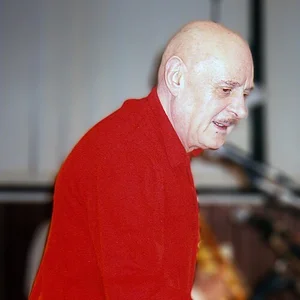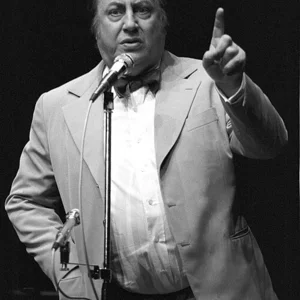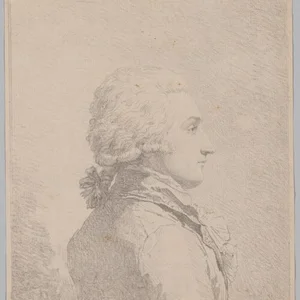

Pierre Desproges (1939-1988) was a French comedian, columnist, and writer. A master of black and absurdist humor, he left his mark on the French stage and radio with his cutting wit and erudition. He died of cancer at the age of 48.
Pierre Desproges(1939 — 1988)
Pierre Desproges
France
6 min read
Frequently asked questions
Famous Quotes
« You can laugh at anything, but not with just anyone.»
« Astonishing, isn't it?»
« Let us live happily while we await death.»
Key Facts
- Born on 9 May 1939 in Pantin, died on 18 April 1988 in Paris.
- Rose to fame in 1975 on Jacques Martin's television show “Le Petit Rapporteur.”
- From 1982 to 1983, he delivered the famous “closing arguments” on the radio show Le Tribunal des flagrants délires on France Inter.
- Created his solo shows at the Théâtre Fontaine and the Théâtre Grévin (1984, 1986).
- Published several collections, including “Les Réquisitoires du Tribunal des flagrants délires” and “Chroniques de la haine ordinaire.”
Works & Achievements
Jacques Martin's satirical show where he revealed himself to the public with his absurd fake interviews.
Cult show on France Inter where he played the role of the prosecutor; his closing arguments became legendary set pieces.
His first major one-man show, which established his dark humor and literary style on stage.
A series of radio columns on France Inter, later published as a book, a masterpiece of biting irony.
A posthumous collection of assorted writings that reveals the richness of his prose.
The published versions of his shows, extending the success of his one-man shows onto bookshelves.
A parody of an etiquette manual, a ferocious and hilarious satire of social conventions.
His second major solo show, confirming his status as a master of literary comedy.
Anecdotes
In 1975, Pierre Desproges joined the team of *Le Petit Rapporteur*, Jacques Martin's satirical show. He made a name for himself with a fake interview of the writer Françoise Sagan, in which he strung together absurd, unsettling questions, revealing the deadpan humour that would become his trademark.
From 1982 to 1983, Desproges hosted the segment *Le Tribunal des flagrants délires* on France Inter. Every day, playing a mock prosecutor, he would deliver a “case for the prosecution” against a famous guest. His most celebrated indictment targeted **Jean-Marie Le Pen**, which he opened with the provocative line: “Can we laugh about everything? Can we laugh with everyone?”
His most famous saying, “You can laugh about anything, but not with just anyone,” sums up his conception of dark humour. He developed it especially around taboo subjects such as death, illness or the tragedies of History, which he tackled with rare erudition and precision of language.
Stricken with lung cancer, Desproges kept performing and writing until the very end, joking about his own death. He would say ironically, “Astonishing, isn't it?”, a phrase that punctuated his *Chroniques de la haine ordinaire*. He died on **18 April 1988**, at just 48 years old.
A great lover of fine food and good wines, Desproges also cultivated his taste for classical French. He peppered his texts with rare words and polished literary turns of phrase — a striking contrast with the crudeness of some of his remarks — which gave his comedy a scholarly, refined dimension.
Primary Sources
Can we laugh at everything? Can we laugh with everyone? To the first question I will answer yes without hesitation... Can we laugh with everyone? That's difficult.
Astonishing, isn't it?
The more I know people, the more I love my dog.
You can laugh at everything, but not with just anyone.
Key Places
Town in the north-eastern suburbs of Paris where Pierre Desproges was born on 9 May 1939.
Village in the Limousin region where Desproges spent part of his childhood and to which he remained attached; he is buried there.
Headquarters of Radio France where he recorded “Le Tribunal des flagrants délires” and “Les Chroniques de la haine ordinaire”.
Parisian venue where he triumphed with his one-man shows in the 1980s.
Capital city where most of his career as a columnist, writer and stage performer took place; he died there on 18 April 1988.
Typical Objects

The central tool of his radio segments on France Inter, where his voice and phrasing carried all the comedy. Radio was his favorite arena.

The costume he donned at the “Tribunal des flagrants délires” to parody the justice system. The judicial trappings provided the setting for his satirical indictments.

The working instrument of the writer-columnist, on which he chiseled his carefully crafted texts. Writing always came before the stage.

A heavy smoker, the cigarette was part of his stage silhouette. The lung cancer that killed him was linked to tobacco.
📷 Domaine public · Wikimedia Commons ↗
The scholar's companion, from which he drew rare and classical vocabulary to build his comic effects. His mastery of language was what set him apart.

A lover of fine food and wine, he celebrated the pleasures of the table in his writing. Good wine was part of his openly proclaimed art of living.
School Curriculum
Vocabulary & Tags
Key Vocabulary
Daily Life
Morning
A meticulous writer, Desproges devoted his mornings to writing, chiseling his texts word by word on the typewriter. He tirelessly reworked his columns and indictments to fine-tune every effect.
Afternoon
The afternoon might be taken up with radio recordings at the Maison de la Radio or with preparing his shows. He read a great deal, cultivating his erudition and his collection of rare words.
Evening
Touring evenings were dedicated to the stage, where he performed his one-man shows in the theaters of Paris and the provinces. After the show, he liked to gather with those close to him around a fine meal.
Food
A discerning gourmet and lover of French gastronomy, he appreciated refined cuisine and great wines. The pleasure of the table held an important place in his art of living.
Clothing
On stage as in daily life, he readily sported a sober and elegant style, suit and tie. At the “Tribunal des flagrants délires,” he donned the robe and cap of a prosecutor.
Housing
He divided his life between Paris, the heart of his professional activity, and the Limousin, the region of his childhood to which he remained deeply attached. Châlus, in Haute-Vienne, was his family anchor.
Historical Timeline
Period Vocabulary
Liens externes & ressources
Références
Œuvres
Le Petit Rapporteur
1975-1976
Le Tribunal des flagrants délires
1980-1983
Vivons heureux en attendant la mort
1983
Les Chroniques de la haine ordinaire
1986
Fonds de tiroir
1990
Textes de scène
1988
Manuel de savoir-vivre à l'usage des rustres et des malpolis
1981