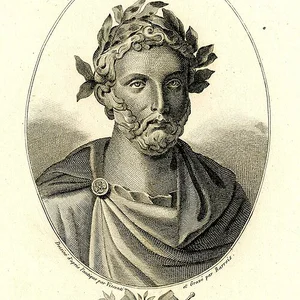

A Latin comic playwright of the 3rd–2nd century BC, Plautus is the leading figure of Roman comedy. He adapted Greek New Comedy for Roman audiences, creating characters that became archetypes: the cunning slave, the miser, the braggart soldier.
Plautus(249 av. J.-C. — 183 av. J.-C.)
Plautus
Rome antique
9 min read
Frequently asked questions
Famous Quotes
« Lupus est homo homini, non homo. (A man is a wolf to another man, not a man.) — Asinaria, II, 4»
Key Facts
- Born around 254 BC in Sarsina, Umbria
- Died around 184 BC in Rome
- He is said to have written around 130 comedies, of which 21 have survived in full
- His major works include Amphitryon, Aulularia, Miles Gloriosus, and Menaechmi
- His comedies inspired Molière (The Miser, Amphitryon) and Shakespeare (The Comedy of Errors)
Works & Achievements
A comedy featuring Pyrgopolinices, a vain and dim-witted soldier convinced of his own irresistible charm. This play created the universal archetype of the 'miles gloriosus', later echoed by Shakespeare (Falstaff), Molière, and modern comedies alike.
A comedy centered on Euclio, a miserly old man obsessed with a pot of gold inherited from his ancestors. A direct inspiration for Molière's 'The Miser', it remains one of the most widely studied plays in secondary education.
A comedy of errors built on the confusion between twin brothers separated at birth. This play was the primary source for Shakespeare's 'The Comedy of Errors' and showcases Plautus's genius for absurd, farcical situations.
A masterpiece by Plautus featuring the slave Pseudolus, a true genius of trickery who outwits every obstacle to help his young master. The play was adapted into a Broadway musical in 1962 under the title 'A Funny Thing Happened on the Way to the Forum'.
A mythological comedy blending gods and mortals in which Jupiter disguises himself as Amphitryon to seduce Alcmena. Plautus's only comedy on a mythological subject, it was later adapted by Molière, Dryden, Kleist, and many others.
A more serious comedy than most, praised by the ancients for its moral worth, depicting a slave's unwavering loyalty to his master held captive in war. Cicero considered it one of the finest plays in the Latin repertoire.
Anecdotes
According to Aulus Gellius, Plautus squandered the money he had earned as an actor in a series of disastrous business ventures. Ruined, he found himself working in a mill to survive, and it was there that he allegedly wrote his first plays, selling them to theater managers for a few sesterces.
Plautus came from humble origins, probably born in Sarsina in Umbria, and his nickname 'Plautus' meant 'flat-footed' in Latin — a rather unflattering reference to his appearance. Despite these modest beginnings, he became the most popular playwright in Rome, with his plays still being performed decades after his death.
Cicero reports that Plautus was so popular that several apocryphal works were attributed to him after his death. Grammarians such as Varro had to conduct a thorough investigation to distinguish the twenty-one authentic plays from the many imitations circulating under his name.
In his play 'Asinaria' (The Comedy of Asses), Plautus depicts a father competing with his own son for the affections of a courtesan — a bold comic device that showcases his freedom of tone. This kind of bawdy, satirical humor was especially popular during the religious festivals at which his comedies were performed.
Plautus drew inspiration from the Greek comedies of Menander, Diphilus, and Philemon, but he did not simply translate them — he freely adapted them, adding Latin wordplay, references to Roman daily life, and the musical rhythm distinctive to Roman theater known as 'fabula palliata'. Shakespeare himself drew on Plautus's 'Menaechmi' when writing 'The Comedy of Errors'.
Primary Sources
«Nunc ego sum miser: quia hic compressit filiam meam vi in tenebris — id dolet. Nam istuc honeste non potest fieri nisi aut nox aut vinum aut adulescentia in culpa est.»
«Pyrgopolynices: How many men did you kill today? — Artotrogus: Seven thousand two hundred in Cilicia, a hundred in Cryphio, thirty Sardinians, sixty Macedonians.»
«This is the best birthday I've ever had — I'm making the most of it with good food and fine plans. I'm laying on a feast here at my mistress's place, the one my master is mad about.»
«It is said that Plautus wrote the Saturio, the Addictus, and a third unnamed play while working in a mill, having lost his fortune and hired himself out as a manual laborer.»
«Our Plautus is so praised by scholars that his works are held to contain much that is witty and well suited to human life.»
Key Places
The presumed birthplace of Plautus, a small Umbrian town in the Apennines that was absorbed into the Roman Republic in the 3rd century BC. A modern statue there commemorates the playwright, and the town still hosts an ancient theater festival in his honor.
The earliest theatrical performances in Rome took place in the Forum, in front of temporary wooden stands. Plautus made his debut in this popular setting, amid merchants and citizens who gathered to celebrate religious festivals.
A versatile entertainment venue that also hosted theatrical performances during the Ludi Romani. Plautus is said to have presented several of his plays here before audiences of thousands, drawn from all walks of life.
Rome's main seaport, Ostia was the arrival point for the merchants, slaves, and Greek travelers who populate Plautus's comedies. The cosmopolitan atmosphere of this harbor fueled his imagination for the adventurers and traders who fill his plays.
Typical Objects

Roman actors wore painted masks of clay or lacquered wood, differentiated by color and expression according to character types. Plautus exploited these visual conventions so that the audience could immediately recognize the cunning slave, the miser, or the parasite before a single word was spoken.

Plautus's plays were 'musical comedies' in which large portions were sung or recited against a backdrop of tibia (double flute) music. The tibicen musician was present on stage throughout the performance, underscoring the comic moments.

Plautus's comedies belong to the genre of 'fabula palliata' — actors wore the Greek cloak (pallium) to signal that the action takes place in Greece. This costume allowed writers to tackle freer subject matter, as Roman censorship was less strict regarding foreign customs.

Money is the central dramatic engine of Plautus's comedies: the theft, trickery, and manipulation of a bag of coins drives nearly all of his plots. In the Aulularia, the pot filled with gold is the object around which the entire play revolves.

Plautus composed his texts on wax tablets, the standard writing medium of ancient Rome. These tablets were then copied onto papyrus to be distributed to the actors of traveling troupes.

Roman theatrical performances took place outdoors during the day, but nighttime scenes used oil lanterns as stage props. Plautus frequently incorporates them into his plots of nocturnal disguises and mistaken identities.
School Curriculum
Vocabulary & Tags
Key Vocabulary
Tags
Daily Life
Morning
Plautus rose at dawn like most Romans, making the most of the cool morning hours to work. He composed his texts on wax tablets in the dim light of his domus, refining dialogues and Latin wordplay. Mornings were also devoted to meetings with theater company directors (domini gregis) who commissioned his new plays.
Afternoon
In the afternoon, Plautus would head to rehearsals at a temporary theater or a public portico. He supervised the actors — free men or freedmen who specialized in performance — directing their timing and gestures. He might also attend other playwrights' productions to draw inspiration or observe how Roman audiences reacted.
Evening
In the evening, like any Roman of modest means, Plautus ate his main meal (cena), consisting of spelt porridge (puls), vegetables, cheese, and occasionally a little meat. During festivals (ludi), he might be invited to the homes of aristocratic patrons, drinking wine mixed with water and reciting passages from his plays to entertain the guests.
Food
Plautus's diet was typically Roman and unpretentious: grain porridge (puls aut polenta), bread, olives, vegetables, and legumes. Wine, always diluted with water, was consumed daily. Meat was rare and reserved for religious festivals, when sacrificial animals were slaughtered and distributed to the people.
Clothing
Plautus wore the simple woolen tunic (tunica), the basic garment of every Roman citizen, cinched at the waist with a leather belt. In cool weather, he added a woolen cloak (lacerna or paenula). As a Roman citizen of humble origins, he did not wear the white toga, which was reserved for official occasions.
Housing
Plautus most likely lived in an insula — a multi-story Roman apartment building — in one of Rome's working-class neighborhoods, far from the aristocratic residences on the Palatine Hill. These lodgings were often cramped, noisy, and poorly ventilated, a stark contrast to the spacious domus that Plautus described in his comedies.
Historical Timeline
Period Vocabulary
Visual Style
Scènes de comédie romaine du IIe siècle av. J.-C. dans un style inspiré des fresques pompéiennes, avec des couleurs chaudes ocre et terracotta, représentant les personnages-types du théâtre plautinien.
Sound Ambience
L'atmosphère sonore d'une représentation plautinienne au IIe siècle av. J.-C. : une foule romaine bruyante et participative, la flûte tibia omniprésente, et les acteurs projetant leur voix dans un théâtre en plein air.
Liens externes & ressources
Références
Œuvres
Miles Gloriosus (Le Soldat fanfaron)
vers 205 av. J.-C.
Aulularia (La Marmite)
vers 200 av. J.-C.
Menaechmi (Les Ménechmes)
vers 210 av. J.-C.
Pseudolus
191 av. J.-C.
Amphitryon
vers 190 av. J.-C.
Captivi (Les Captifs)
vers 195 av. J.-C.
See also
Related Characters
Catiline
107 av. J.-C. — 61 av. J.-C.
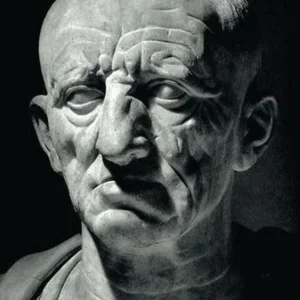
Cato the Elder
233 av. J.-C. — 148 av. J.-C.
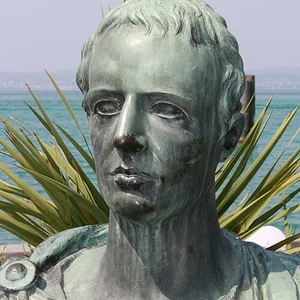
Catullus
83 av. J.-C. — 53 av. J.-C.
Claudius
9 av. J.-C. — 54
Cornelia
190 av. J.-C. — 100 av. J.-C.
Horace
64 av. J.-C. — 7 av. J.-C.