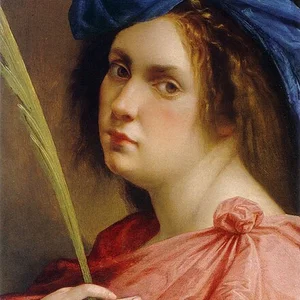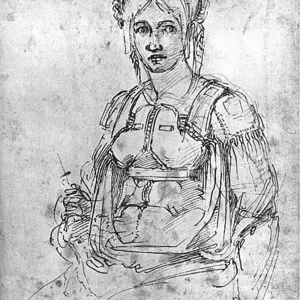

A Bolognese sculptor of the Renaissance (c. 1490–1530), Properzia de' Rossi is considered the first professional female sculptor in Europe. She is celebrated for her marble bas-reliefs and miniature sculptures carved on apricot pits.
Properzia de' Rossi(1490 — 1530)
Properzia de' Rossi
États pontificaux, seigneurie de Bologne
8 min read
Frequently asked questions
Key Facts
- Born around 1490 in Bologna, she trained in a vibrant artistic and cultural environment
- She created miniature sculptures on apricot pits, demonstrating exceptional technical mastery
- Around 1525, she received an official commission for the Basilica of San Petronio in Bologna — a rare honor for a woman
- Giorgio Vasari dedicated an entry to her in his 'Lives of the Artists' (1550), acknowledging her extraordinary talent
- She died around 1530, leaving behind a body of sculpted work that foreshadowed the recognition of women artists across Europe
Works & Achievements
Extraordinary miniature works carved on fruit pits, depicting dozens of figures with microscopic precision. They earned Properzia renown throughout Italy and granted her access to Bolognese aristocratic circles.
A narrative bas-relief carved for the main portal of San Petronio, depicting the biblical scene in which Potiphar's wife attempts to seduce Joseph. It is her best-preserved masterwork, and according to Vasari, carries an autobiographical dimension connected to unrequited love.
Free-standing sculptures commissioned to flank the main portal of the Basilica of San Petronio. These angels demonstrate Properzia's technical mastery of large-scale marble carving.
Several marble busts have been attributed to her by art historians, though the attributions remain debated. These works would illustrate her activity as a portraitist in the service of the Bolognese aristocracy.
Anecdotes
Properzia de' Rossi created miniature works of astonishing precision by carving entire religious scenes onto simple apricot pits. These tiny masterpieces — sometimes depicting the Passion of Christ with dozens of figures — circulated throughout Italy and earned her an extraordinary reputation even before she ever touched marble.
The painter and biographer Giorgio Vasari included her in his famous 'Lives of the Artists' (1550), dedicated to the greatest artists of the Renaissance. This was a remarkably rare honor for a woman: Vasari describes her as beautiful, an accomplished musician, and a gifted sculptor, noting that nature had bestowed upon her 'all graces at once.'
In 1524, Properzia received an official commission for the Basilica of San Petronio in Bologna, one of the most important artistic projects in Italy. She carved two marble angels and a bas-relief depicting Joseph and Potiphar's wife — a scene that some historians interpret as an expression of her own heartbreak over a young nobleman who did not return her feelings.
Her career was marked by conflicts with other artists who were jealous of her success. She was even brought to court for throwing stones at a canon who had refused her a commission. These tensions reflect the obstacles women artists faced in trying to establish themselves in an exclusively male-dominated field.
Properzia died around 1530, most likely a victim of the great plague epidemic that swept through Bologna that year. She was barely forty years old. According to Vasari, she died in poverty, her commissions having dwindled due to the scheming of her male rivals — a tragic end for the woman now regarded as the first professional female sculptor in Europe.
Primary Sources
Properzia de' Rossi, cittadina bolognese, giovane non solamente nelle cose della casa come l'altre donne, ma in infinite scienze ancora [...] intagliò in un nocciolo di pesco la passione di Cristo con tanto numero di figure, che, oltra la minutezza e la diligenza, vi si conosce una bella maniera.
A Properzia de' Rossi scultrice per intagliare dui angeli di marmo per la porta magna della chiesa [...] ducati venti.
Denuncia presentata contro Properzia de' Rossi per aver gettato pietre contro il canonico [...] della Basilica di San Petronio.
La scultura della porta magna fu affidata anche alla Properzia, nonostante le opposizioni di alcuni maestri, per la qualità riconosciuta del suo lavoro sul nobile marmo.
Key Places
Properzia's birthplace and the setting of her entire career. A vibrant university and artistic hub, Bologna provided both her training and her most important commissions.
A major artistic undertaking where Properzia sculpted two marble angels and the bas-relief 'Joseph and Potiphar's Wife' (1524–1526). This is her most significant work and the only one attributed to her with certainty.
The seat of municipal power in Bologna, where decisions about major artistic commissions were made. Properzia had to argue her case here to secure and retain her official mandates.
The source of the white marble used by sculptors of the Italian Renaissance. Although Properzia likely never visited in person, Carrara marble was the prized material she worked with for her major sculptures.
Typical Objects

Properzia's most emblematic medium, on which she engraved biblical scenes with astonishing precision. These miniature works circulated as precious curiosities in aristocratic collections across Italy.

Fundamental tools of the Renaissance sculptor, used to rough out and refine marble. Properzia wielded them with rare precision, having trained from childhood to work at a very small scale.

Essential for striking the chisels when working marble, it allowed Properzia to carve the bas-reliefs commissioned for San Petronio. Her mastery of this heavy tool — traditionally the domain of men — impressed her contemporaries.

The noble material of Renaissance sculpture, often imported from the quarries of Carrara in Tuscany. Properzia worked in marble for her official commissions, moving from miniature carvings on apricot stones to large architectural compositions.

A preparatory wax maquette that sculptors made before attacking the stone. Properzia likely used bozzetti to plan her narrative bas-reliefs before transposing them into marble.

According to Vasari, Properzia was an accomplished musician. The lute or viol were part of daily life for cultivated women of the Italian Renaissance, and musical practice rounded out her image as a universally gifted woman.
School Curriculum
Vocabulary & Tags
Key Vocabulary
Tags
Daily Life
Morning
Properzia rose at dawn, when natural light was ideal for precision work. She began her day with a short prayer, then put on her work clothes — a simple linen dress protected by a leather apron — before heading to her studio where blocks of marble and tools awaited her.
Afternoon
The afternoons were devoted to the heaviest work: rough-cutting marble with a hammer and rondel chisel for large commissions such as the bas-reliefs for San Petronio. She sometimes supervised assistants for the more strenuous tasks, while reserving the most delicate finishing work for herself alone, particularly faces and hands.
Evening
In the evenings, by candlelight, Properzia dedicated herself to her miniature works on apricot pits, which required extreme concentration in silence. According to Vasari, she also played the lute and sang, sometimes receiving learned friends or patrons who came to admire her latest creations.
Food
Bolognese Renaissance cuisine was built around fresh pasta, legumes, seasonal vegetables, and local cured meats. As a prosperous craftswoman, Properzia had access to Bologna's varied markets: meats, freshwater fish, cheeses, and the white bread reserved for the urban middle classes.
Clothing
Properzia wore a wool or linen dress in a subdued color — brown, ochre, or grey — cinched at the waist with a leather belt, typical of Italian Renaissance craftswomen. For receptions at noble patrons' homes, she dressed in a more elaborate gown with detachable sleeves, following the Bolognese fashion of the early sixteenth century.
Housing
She likely lived and worked in a house-workshop in Bologna, in the artisan quarters near the city center. Her home included a living room, a bedroom, and above all a large north-facing studio for consistent light, with shelves for her carved pits and blocks of marble stacked near the windows.
Historical Timeline
Period Vocabulary
Visual Style
Style Renaissance italienne — lumière chaude, marbre blanc, drapés en ocre et terre cuite — évoquant la Bologne des papes et des grandes commandes artistiques du début du XVIe siècle.
Sound Ambience
L'atelier de sculpture bolonais de Properzia, rythmé par les coups de marteau sur le ciseau, les cloches de San Petronio et les rumeurs de la ville Renaissance.
Liens externes & ressources
Références
Œuvres
Scènes de la Passion du Christ sur noyaux d'abricot
vers 1510-1520
Joseph et la femme de Putiphar (bas-relief en marbre)
1524-1526
Buste de portrait (attribution incertaine)
vers 1520