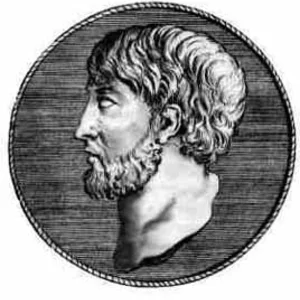

Protagoras of Abdera (c. 489 – c. 419 BC) was one of the earliest and most celebrated Greek Sophists. He is best known for his relativist thesis: "Man is the measure of all things."
Protagoras(489 av. J.-C. — 419 av. J.-C.)
Protagoras
8 min read
Frequently asked questions
Famous Quotes
« Man is the measure of all things: of the things that are, that they are; of the things that are not, that they are not.»
« Concerning the gods, I am unable to know either that they exist or that they do not exist, or what form they take.»
Key Facts
- Born around 489 BC in Abdera, Thrace — the same city that would later produce Democritus.
- He was one of the first thinkers to charge fees for teaching rhetoric and argumentation.
- A friend and adviser to Pericles, he drafted the laws for the Panhellenic colony of Thurii around 444 BC.
- Charged with impiety in Athens, his books were burned in the agora, most likely around 415 BC.
- He died around 419 BC — tradition holds that he drowned in a shipwreck while fleeing Athens.
Works & Achievements
A treatise in which Protagoras declares his agnosticism regarding the existence of the gods. This work led to his being charged with impiety in Athens; copies were burned, making it one of the earliest known cases of philosophical censorship in history.
The central work of his thought, which opened with the famous dictum 'Man is the measure of all things.' In it he developed his relativism: truth is subjective and depends on each individual.
A treatise in which Protagoras challenged the theses of the Eleatic philosophers (Parmenides, Zeno) on the existence of a single, unchanging being. He argued instead for a pluralistic and dynamic view of reality.
A collection of paired contradictory arguments on ethical, political, and legal questions. This work served as the foundational textbook of Sophist teaching and trained generations of orators and jurists.
A treatise in which Protagoras argued that civic virtue could be taught, contrary to the position held by Socrates. This thesis lies at the heart of Plato's eponymous dialogue.
Anecdotes
Protagoras was the first Greek thinker to charge fees for teaching. He demanded high payment from his students, which deeply shocked his contemporaries, who were accustomed to knowledge being passed on freely. This practice would come to define the sophist as a paid instructor.
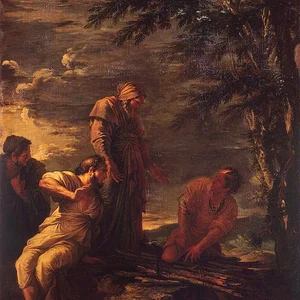
According to Diogenes Laërtius, Protagoras began life as a wood-carrier before being noticed by Democritus of Abdera, who was so impressed by the clever way he bundled his faggots that he decided to educate him. This chance encounter is said to have changed the course of his life.
Protagoras was put on trial in Athens for impiety after writing in his treatise On the Gods: 'Concerning the gods, I cannot know whether they exist or not.' His books were reportedly burned in the agora, and he himself was forced to flee the city.
Plato records that Protagoras was among the first to analyze the Greek language by distinguishing grammatical genders and modes of speech. He is said to have classified sentences into questions, answers, prayers, and commands — a remarkably early contribution to linguistics.
According to Heraclides of Pontus, Protagoras perished at sea while fleeing Athens, when his ship was wrecked. He was around 70 years old at the time and was one of the most celebrated and best-paid thinkers of his era.
Primary Sources
"Man is the measure of all things, of things that are that they are, and of things that are not that they are not." This is how Plato quotes and extensively discusses Protagoras's central thesis.
Plato portrays Protagoras presenting his famous myth of Prometheus and Epimetheus to justify the teaching of political virtue. Protagoras argues that virtue can be taught and that every citizen can attain it.
"Protagoras was the first to maintain that there are two sides to every question, opposed to each other." Diogenes Laërtius also credits him with inventing argumentative maieutics and the practice of adversarial debate.
"Concerning the gods, I have no means of knowing whether they exist or do not exist, nor what form they might have. Many things prevent such knowledge: the obscurity of the subject and the shortness of human life."
This anonymous 5th-century text illustrates Protagoras's method of presenting two opposing arguments on every moral or political question, demonstrating that each thesis can be both defended and refuted.
Key Places
Protagoras's hometown, a Greek city in Thrace renowned for producing two great thinkers: Protagoras and Democritus. It was here that he received his earliest intellectual formation.
The intellectual and political center of the Greek world, Athens was the main stage of Protagoras's career. He taught there, associated with Pericles, and was ultimately charged with impiety before fleeing the city.
A pan-Hellenic colony founded in 444 BCE on the coast of what is now Calabria, Italy. Pericles entrusted Protagoras with drafting its laws — a commission that stands as a testament to his political standing.
At the great pan-Hellenic Games at Olympia, Protagoras is said to have publicly read aloud his treatise On the Gods, causing both astonishment and admiration among delegations from cities across the Greek world.
The public square where sophists and philosophers debated, taught, and clashed over ideas. It was on the Agora that Protagoras's books were reportedly burned on the orders of the Athenian authorities.
Liens externes & ressources
Références
Œuvres
Sur les dieux (Peri theôn)
v. 450 av. J.-C.
La Vérité ou Les Discours renversants (Alêtheia)
v. 445 av. J.-C.
Sur l'être (Peri tou ontos)
v. 440 av. J.-C.
Antilogies (Discours opposés)
v. 445 av. J.-C.
Sur la vertu (Peri aretês)
v. 440 av. J.-C.