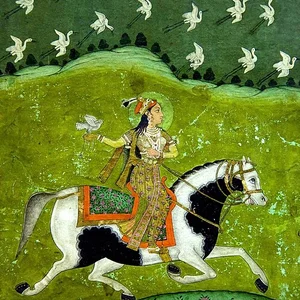

Razia Sultana was the first and only woman to rule the Delhi Sultanate (1236–1240). Daughter of Sultan Iltutmish, she governed unveiled and on horseback, defying the conventions of her time. A revolt by Turkish nobles led to her downfall and death in 1240.
Razia Sultana(1205 — 1240)
Jalâlat-ud-Dîn Razziyâ
Sultanat de Delhi
8 min read
Frequently asked questions
Key Facts
- Around 1205: birth of Razia, daughter of Sultan Iltutmish
- 1236: enthroned as Sultana of Delhi, appointed by her father against tradition
- 1236–1240: effective reign — she governed unveiled, rode on horseback, and personally led armies
- 1240: overthrown by a coalition of Turkish nobles (the Forty), captured and killed
Works & Achievements
Razia ruled the Delhi Sultanate for four years, governing one of the most powerful states in Asia. She stands as the first and only example of a woman who exercised sovereign power in the medieval history of the Indian subcontinent.
Razia encouraged exchanges between Muslim, Hindu, and Buddhist communities within the sultanate. She supported madrasas (Quranic schools) and libraries in Delhi, continuing the policy of her father Iltutmish.
Razia attempted to reduce the power of the Forty (Chahalgani), an oligarchy of Turkish nobles who controlled the provinces. She appointed non-Turkish freedmen to key positions to counter their monopoly — a visionary policy that ultimately hastened her downfall.
Razia had coins struck bearing her titles and name, asserting her sovereign legitimacy in keeping with Islamic tradition. These coins now serve as valuable archaeological evidence of her reign.
Razia personally led several military expeditions to suppress revolts by provincial governors. Her direct presence on the battlefield — rare for a medieval ruler — speaks to her active military engagement.
Anecdotes
At her investiture in 1236, Razia Sultana made a public appearance unveiled at the great mosque of Delhi, before thousands of astonished subjects. This deliberate gesture signaled her refusal to comply with the conventions imposed on women of the court: she intended to rule with her face uncovered, as a sovereign in her own right.
Her father, Sultan Iltutmish, had officially designated Razia as heir to the throne, passing over his sons whom he deemed unfit. He reportedly declared before his nobles: 'My sons are given over to pleasure; only Razia is worthy to succeed me.' This unprecedented decision in the history of the Delhi Sultanate provoked immediate opposition among the powerful Turkish emirs.
Razia rode on horseback or elephant during military expeditions, dressed in male attire with her face uncovered. She commanded her troops in person, breaking with the tradition that confined women to the zananas (women's quarters). This behavior, admired by the common people, deeply scandalized the Turkish nobles, who saw it as a violation of the natural order.
The appointment of Jamaluddin Yaqut, an Abyssinian freedman, to the position of chief equerry (amir-i-akhur) was one of the acts that hastened Razia's downfall. The Turkish emirs, jealous of their monopoly on power, denounced this promotion as an insult to their rank. In 1240, a coalition of rebel governors overthrew Razia in a decisive battle near Kaithal.
After her capture, Razia was compelled to marry the rebel governor Altunia, whom she had defeated just weeks earlier. Attempting to reclaim Delhi alongside her new husband, she was defeated one final time. She died in October 1240 under murky circumstances — some sources speak of assassination, others of death in battle — near Kaithal, bringing an end to the only female reign in the history of the Delhi Sultanate.
Primary Sources
"Razia Sultana was a great sovereign, endowed with sound judgment, just, a benefactress of the poor, possessed of all the qualities required to govern; but she was not born of the right sex, and for that reason, in the eyes of men, all her worth counted for nothing."
"Sultan Iltutmish had recognized in Razia a capacity for governance superior to that of his sons, and had ordered that her name be mentioned in the khutba and struck upon the coinage."
"Never in the kingdoms of Islam had a woman occupied the throne or led armies into battle; Razia was the first, and she inspired wonder among scholars and princes alike."
The coins struck during her reign bear the Arabic legend: "Pillar of women, queen of the age, Sultana Razia, daughter of Iltutmish."
Key Places
Capital of the sultanate and seat of Razia's throne. She resided there in the royal palace and held court in the great audience hall (diwan-i-am), where she received nobles, ambassadors, and merchants.
The first great mosque built in the sultanate, and the place where Razia appeared publicly unveiled at her investiture. The Friday prayer (khutba) was recited in her name there, formally marking her sovereignty.
A strategic stronghold in Punjab whose governor, Altunia, revolted against Razia in 1238. It was during the siege of this fortress that Razia was captured, marking the beginning of her downfall.
The town where Razia and her husband Altunia were decisively defeated by the forces of Bahram Shah in October 1240. Razia met her death there, and a tomb is traditionally attributed to her in this region.
The second city of the sultanate and a major commercial and military crossroads of Punjab. Lahore was a key strategic prize that Razia had to defend against revolts by Turkish governors and growing Mongol pressure.
Liens externes & ressources
Références
Œuvres
Règne sur le sultanat de Delhi (1236-1240)
1236-1240
Politique d'ouverture religieuse et mécénat
1236-1240
Réforme de la cour et affaiblissement du Chahalgani
1236-1238
Frappe monétaire en son propre nom
1236-1240
Campagnes militaires au Pendjab et au Rajasthan
1237-1238