 flip
flipRoast Capon with Cameline Sauce, the Roast of King Noble's Court
Roast Capon with Cameline Sauce, the Roast of King Noble's Court
Why this dish? Renart is constantly summoned—or invites himself—to the court of King Noble the lion. The grand roast accompanied by cameline sauce, brown and fragrant, is the prestige dish of seigneurial banquets: exactly what the fox covets at the king's table before playing a nasty trick.
A capon roasted on a spit, napped with cameline: a cold brown-red sauce with cinnamon, ginger, and toasted bread, thinned with verjuice. The spiced opulence of great medieval tables, where the abundance of costly spices signaled the host's rank.
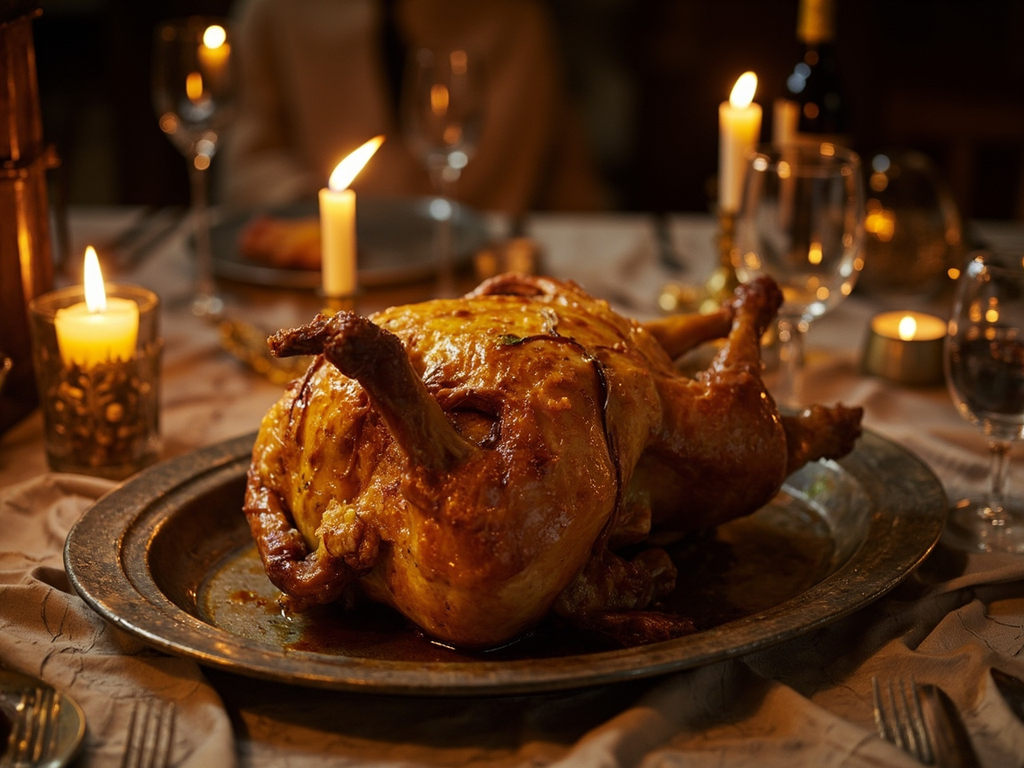
My lords, make way, for here comes the roast served before Noble the king! A fine capon turned on the spit until the skin crackles and browns, and over it my cameline sauce, brown as a monk's robe, where cinnamon and ginger sing. Dip your slice of bread in this sauce, lord, and taste: while you lick your lips, I, Renart, bow low—and already eye the next dish. He who dines at court must have an eye as sharp as his tooth.
- •Capon — a fine one (prestige meat)
- •Cinnamon — generous (master spice of cameline)
- •Ginger — a little (warm spice)
- •Grains of paradise (melegueta pepper) — a pinch (medieval heat (not American))
- •Clove — a few (fragrance)
- •Toasted bread — several slices (sauce thickener)
- •Verjuice — a cupful (acidity)
Roast Capon with Cameline Sauce, the Roast of King Noble's Court
A capon roasted on a spit, napped with cameline: a cold brown-red sauce with cinnamon, ginger, and toasted bread, thinned with verjuice. The spiced opulence of great medieval tables, where the abundance of costly spices signaled the host's rank.
Why this dish? Renart is constantly summoned—or invites himself—to the court of King Noble the lion. The grand roast accompanied by cameline sauce, brown and fragrant, is the prestige dish of seigneurial banquets: exactly what the fox covets at the king's table before playing a nasty trick.
My lords, make way, for here comes the roast served before Noble the king! A fine capon turned on the spit until the skin crackles and browns, and over it my cameline sauce, brown as a monk's robe, where cinnamon and ginger sing. Dip your slice of bread in this sauce, lord, and taste: while you lick your lips, I, Renart, bow low—and already eye the next dish. He who dines at court must have an eye as sharp as his tooth.
Ingredients (period version)
- Capon — a fine one (prestige meat)
- Cinnamon — generous (master spice of cameline)
- Ginger — a little (warm spice)
- Grains of paradise (melegueta pepper) — a pinch (medieval heat (not American))
- Clove — a few (fragrance)
- Toasted bread — several slices (sauce thickener)
- Verjuice — a cupful (acidity)
Ingredients
- Capon or large free-range chicken — 2.5 kg (prestige meat)
- Ground cinnamon — 1½ teaspoons (master spice)
- Ground ginger — ½ teaspoon (warm spice)
- Grains of paradise (or a twist of pepper) — 1 pinch (heat)
- Cloves — 3, ground (fragrance)
- Rustic bread, toasted — 3 slices (thickener)
- Verjuice (or sweet wine vinegar) — 120 ml (acidity)
- Salt — to taste (seasoning)
Method
- Salt the capon, truss it, and roast at 180°C for about 1½ hours (or on a spit), basting with its juices, until the skin is golden and crisp.
- For the cameline: toast the bread, soak it in a little warm verjuice, and mash.
- Mix the soaked bread with cinnamon, ginger, cloves, grains of paradise, and the remaining verjuice; adjust with a little water to obtain a coating consistency.
- Strain the sauce through a sieve or blend until smooth and uniform; salt. Cameline is served cold or warm, never cooked.
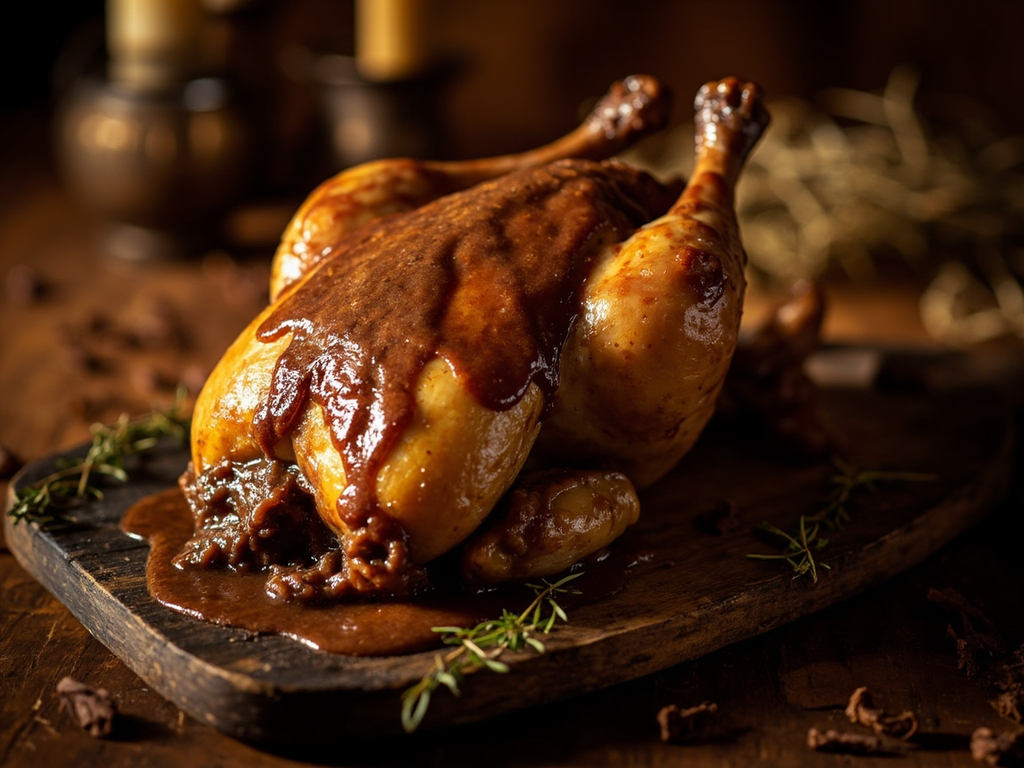
- Carve the capon and present it napped with a cordon of cameline, with the rest of the sauce in a gravy boat.
How it was made : Cameline (from its 'camel' color) is one of the best-documented sauces of the Middle Ages, appearing in Le Viandier. Served cold, thickened with bread rather than flour, it accompanied roasted meats and fish at noble tables, where a host was judged by his abundance of Eastern spices.
The contemporary twist : Present the capon on a dark wooden board, with a glossy cameline cordon and shards of toasted bread: a 'court roast' for a festive table, carved before the guests as before King Noble.
Sources : Le Viandier de Taillevent (compilation c. 1300), cameline sauce · Le Ménagier de Paris (c. 1393), variants of cameline
Renart · Charactorium