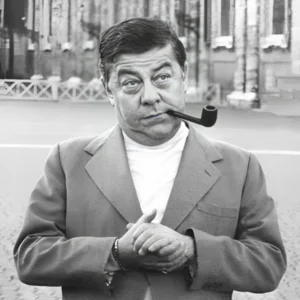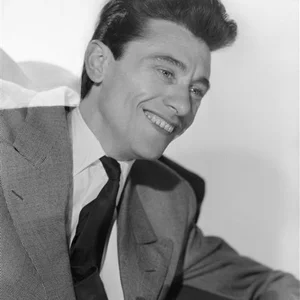

Robert Lamoureux (1920-2011) was a French comedian, actor, playwright and stage director. Famous for his comic monologues, notably “La Chasse au canard” (“The Duck Hunt”), he also found success in boulevard theatre and in cinema with the “7th Company” film series.
Robert Lamoureux(1920 — 2011)
Robert Lamoureux
France
5 min read
Frequently asked questions
Key Facts
- Born on 4 January 1920 in Saint-Mandé and died on 29 October 2011 in Boulogne-Billancourt
- Made famous in the late 1940s by his comic monologues, including “La Chasse au canard” (“The Duck Hunt”)
- Author of many successful boulevard theatre plays from the 1950s onwards
- Directed and starred in the film trilogy “La 7e Compagnie” (“The 7th Company”, 1973-1977), a huge popular success
Works & Achievements
Iconic sketch that brought him to wide public attention and became his signature routine.
Popular 1950s family comedy that cemented his fame in cinema.
Boulevard play written and performed by Lamoureux, showcasing his talent as a playwright.
War comedy that he wrote and directed, a huge success and the starting point of a saga.
Second installment of the adventures of the 1940 soldiers, confirming its popular triumph.
Third film in the series, closing the trilogy that became a classic of French comedy.
Anecdotes
Robert Lamoureux became an overnight star thanks to his monologue “The Duck Hunt,” created on the cabaret stage in the late 1940s. This sketch, in which a hunter recounts a hunting trip that turns to disaster, remained so popular that he performed it throughout his entire career.
During the Second World War, the young Robert Lamoureux was conscripted for the Compulsory Labour Service (STO) in Germany. This harsh wartime experience marked an entire generation of French people born around 1920.
In 1973, Lamoureux wrote and directed “Now Where Did the 7th Company Get To?,” a comedy about French soldiers lost during the rout of 1940. The film was a huge popular success and gave rise to a whole series, becoming a classic of French comedy.
A one-man band of the entertainment world, Robert Lamoureux did not merely act: he wrote his own monologues, penned boulevard plays such as “This Brunette Here,” and staged his own shows, combining the roles of author, actor, and director.
A keen horseman, Lamoureux was an accomplished rider who long practised and taught dressage, to the point of publishing works on the equestrian art — a passion far from the spotlight that he cultivated with great seriousness.
Primary Sources
In a comic crescendo, the hunter recounts how his duck-hunting trip goes off the rails: the sketch rests entirely on the rhythm of the spoken narrative and the misunderstandings.
The story follows three French soldiers, Chaudard, Pithivier and Tassin, stranded behind German lines during the debacle of June 1940.
A popular family chronicle of 1950s France in which Lamoureux plays a young man from the Parisian middle class.
Key Places
Town bordering Paris where Robert Lamoureux was born in 1920.
Capital of music hall and theatre where Lamoureux triumphed with his monologues and plays after the war.
Country where the young Lamoureux was sent under the Compulsory Work Service (Service du travail obligatoire) during the war.
Town in the Hauts-de-Seine département where Robert Lamoureux died in 2011.
Typical Objects

The central prop of his monologue “The Duck Hunt,” which made him famous. In it, the weapon becomes a comic device more than a hunting tool.

The monologuist's instrument, which captures the voice and the silences of the comedian facing the audience. Post-war music hall rests on this direct bond with the crowd.

A 1940 French military outfit worn by the characters of his famous film saga. The costume embodies the ordinary soldier caught up in the debacle.

An object of his passion for dressage, which he practiced seriously off the set. Lamoureux even published works on the art of horsemanship.

The playwright's working notebook, in which he wrote the comedies intended for Parisian theaters. Writing was at the heart of his craft.

A tool of the director he became for the “7th Company” series. It marks his shift from the stage to filmmaking.
School Curriculum
Vocabulary & Tags
Key Vocabulary
Daily Life
Morning
A man of the stage, Lamoureux often lived to the rhythm of performance: mornings were spent writing his monologues and plays, polishing a text, or answering his mail. A horse-riding enthusiast, he also allowed himself rides on horseback when his schedule permitted.
Afternoon
The afternoon was devoted to rehearsals, staging trials or, from the 1970s on, film shoots. He directed his actors, worked out the gags, and checked the comic timing so essential to his art.
Evening
The evening was the highlight: a performance at the cabaret or the theatre before a Parisian audience. There the monologuist tested his effects, listened to the laughter, and adjusted his delivery from one night to the next.
Food
His table was that of a Parisian in the France of the Trente Glorieuses: bistro cooking, slow-simmered dishes and good food, in a country rediscovering abundance after the deprivations of the war and rationing.
Clothing
On stage he cultivated the elegance of the music hall: suit and tie, the monologuist's impeccable bearing. Off stage he wore the classic suit of the 1950s–1970s showman, and riding attire during his equestrian pursuits.
Housing
Lamoureux lived in the Paris region, between Paris and its residential suburbs, in the comfort of the postwar artistic world. His passion for horses also drew him closer to the countryside and its riding centres.
Historical Timeline
Period Vocabulary
Liens externes & ressources
Références
Œuvres
La Chasse au canard (monologue)
fin des années 1940
La Brune que voilà
1957
Mais où est donc passée la 7e compagnie ?
1973
On a retrouvé la 7e compagnie
1975