
Bishop of Bourges in the 7th century (c. 624–647), Sulpicius the Pious was renowned for his charity toward the poor and his defense of the oppressed. His cult gave its name to the famous Parisian church.
Saint Sulpice
Saint Sulpice
7 min read
Frequently asked questions
Key Facts
- Elected Bishop of Bourges around 624 AD
- Died around 647; venerated as a saint immediately after his death
- His feast day is celebrated on January 17 in the Catholic calendar
- The church of Saint-Sulpice in Paris (17th c.) is dedicated to him, as is the Parisian metro station (line 4)
Works & Achievements
Sulpicius took part in the decrees aimed at combating simony and improving the formation of the clergy. His signature appears among those of the bishops who pledged to implement these reforms in their respective dioceses.
Sulpicius established a structured system of relief for the poor, going so far as to sell the church's precious ornaments to fund his distributions. This action is regarded as exemplary throughout the entire Merovingian hagiographic tradition.
In the tradition of the great Merovingian bishops such as Saint Eligius and Saint Desiderius, Sulpicius regularly interceded with judges and lords to protect the vulnerable. This practice of episcopal intercession was one of the major social functions of bishops of the era.
A hagiographic biography was composed shortly after his death, establishing the canon of his sainthood. This text, the primary source of our knowledge of Sulpicius, ensured the transmission of his memory and justified his liturgical feast on January 17.
Through the spread of his cult, the name of Sulpicius became attached to a Parisian parish as early as the Middle Ages, giving rise to one of the most famous religious monuments in Paris — a place of memory that endures to this day.
Anecdotes
Sulpitius the Pious is said to have sold the precious ornaments of his church to feed the poor during a great famine that struck Berry. According to his hagiographic biography, he personally distributed bread to the destitute who crowded at the gates of the bishopric of Bourges, refusing to let anyone leave empty-handed.
Hagiographic tradition tells that Sulpitius repeatedly interceded with powerful Frankish lords to secure the release of unjustly condemned prisoners. His reputation for justice and gentleness was such that even the most powerful nobles of Neustria were reluctant to refuse his requests.
According to his Vita, Sulpitius performed several healing miracles, including that of a blind child whose sight he restored by making the sign of the cross over his eyes. This account, typical of Merovingian hagiography, reflects the spiritual prestige his contemporaries attributed to him.
Sulpitius took part in the Council of Clichy in 626–627, an important synod that brought together the bishops of the Frankish kingdom to reform ecclesiastical discipline and combat simony. His attendance at this council is one of the few documented historical attestations of his episcopate.
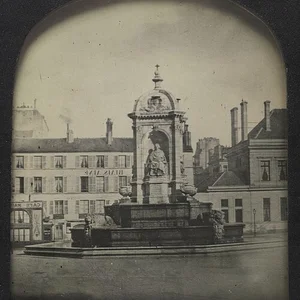
It was in his honor that a Parisian parish was placed under his patronage in the Middle Ages, giving rise to what would become one of the largest and most celebrated churches in the capital: the church of Saint-Sulpice, whose definitive construction did not begin until 1646.
Primary Sources
Sulpicius autem pontificatum adeptus, mox pauperum curam gerere coepit, ita ut non solum propria distribueret, sed et ecclesiae ornamenta venderet ad inopum subsidia procuranda.
Sulpicius episcopus ecclesiae Bituricae interfuit et subscripsit decretis synodi de disciplina clericorum et de simoniae prohibitione.
XVI Kalendas Februarii, Bituricis civitate, natale sancti Sulpicii episcopi et confessoris, qui multa miracula in vita et post obitum patrauit.
Tempore Dagoberti regis, multi episcopi in Gallia floruerunt, inter quos Sulpicius Bituricensis episcopus caritate et humilitate praecipuus habebatur.
Key Places
Former capital of the Bituriges, it became a major episcopal seat in Gaul. Sulpicius served as bishop here for nearly twenty-three years, transforming the city into a center of Christian charity recognized throughout the Frankish kingdom.
A Merovingian royal residence near Paris where the Council of 626–627 was held. Sulpicius's presence at this synod is one of the few historically documented certainties of his episcopate.
A grand Parisian church dedicated to the Bishop of Bourges, whose parish dates back to the Middle Ages and whose current building began construction in 1646. This site keeps the memory of Sulpicius alive in the French capital to this day.
The heir to the episcopal see that Sulpicius occupied in the 7th century, the current Gothic cathedral (13th century) stands on the site of the religious buildings known to the Merovingian bishop.
Typical Objects

A pastoral staff in the shape of a crozier, the principal attribute of the Merovingian bishop. Sulpicius carried it during processions and when blessing the faithful, symbolizing his role as a shepherd guiding his spiritual flock.

An illuminated manuscript containing the four Gospels, the quintessential sacred object of the Merovingian bishop. Sulpicius read and commented on the Scriptures at synods and for the instruction of his parish clergy.

A gold ring adorned with an engraved stone, symbolizing the bishop's spiritual marriage to his Church. It also served as a seal to authenticate official documents issued by the bishopric of Bourges.

A small vial containing consecrated oil for the sacraments of baptism, confirmation, and the anointing of the sick. Bishop Sulpicius personally visited the dying in his diocese to bring them this spiritual comfort.

A simple leather purse in which Sulpicius kept coins set aside to be distributed to the poor. His reputation for exceptional generosity rested on this daily practice of direct and personal charity.

Common writing surfaces in the Merovingian era, used for the administrative correspondence of the bishopric. Sulpicius used them to draft his letters to fellow bishops and to representatives of royal authority.
School Curriculum
Vocabulary & Tags
Key Vocabulary
Daily Life
Morning
Bishop Sulpicius began his day before dawn, joining the clergy of his cathedral to sing the office of Matins, then Lauds at sunrise. He would then celebrate the daily Mass in the episcopal basilica of Bourges, surrounded by his chapter of priests and deacons.
Afternoon
The afternoon was devoted to administering the diocese: receiving priests who had come from the countryside to report on their parishes, arbitrating disputes among the faithful, and above all granting audiences to the poor and marginalized who sought his help. Sulpicius also dedicated time to instructing the catechumens preparing for baptism.
Evening
In the evening, Sulpicius joined his clergy for Vespers and Compline, then withdrew for the reading of Scripture and the Church Fathers. According to his biography, he slept little and devoted part of the night to personal prayer — an ascetic practice common among the saintly bishops of the Merovingian era.
Food
Bishop Sulpicius kept a deliberately frugal table: vegetables, bread, and fish on ordinary days, with rare additions of meat on liturgical feast days. His biographers emphasize that he fasted frequently and declined the banquets of the kingdom's great lords, preferring to share meals with the poor.
Clothing
In daily life, Sulpicius wore a simple woolen tunic covered by a cope when traveling. For liturgical ceremonies, he put on the pontifical vestments: a linen alb, chasuble, stole, and pallium, along with the miter and episcopal sandals befitting his dignity.
Housing
The bishop resided in the episcopal *palatium* adjoining the cathedral of Bourges, a complex of stone buildings comprising his private chamber, a reception hall, and the administrative rooms of the bishopric. According to hagiographic tradition, Sulpicius converted part of this residence into a hospice to shelter the sick and pilgrims passing through.
Historical Timeline
Period Vocabulary
Liens externes & ressources
Références
Œuvres
Participation au Concile de Clichy
626-627
Organisation de la charité épiscopale à Bourges
vers 624-647
Défense des opprimés face au pouvoir séculier
vers 624-647
Vita Sancti Sulpicii
VIIe-VIIIe siècle
Patronage de l'église Saint-Sulpice de Paris
Moyen Âge – 1646