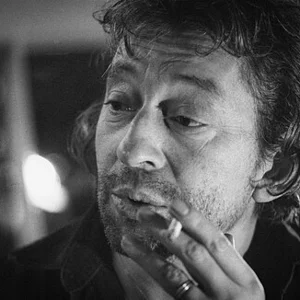

French singer-songwriter, film director, and painter (1928–1991), a towering figure of French popular music. A provocateur and poet, he left his mark on popular culture with works blending humor, eroticism, and artistic boldness.
Serge Gainsbourg(1928 — 1991)
Serge Gainsbourg
France
8 min read
Frequently asked questions
Famous Quotes
« The superfluous — a most necessary thing.»
« I am a monstrously superficial being.»
Key Facts
- Born on April 2, 1928 in Paris under the name Lucien Ginsburg
- Composed 'La Javanaise' in 1963, one of his first major songs
- Recorded 'Je t'aime… moi non plus' with Jane Birkin in 1969, a song censored by the Vatican
- Directed the films 'Je vous salue Marie' (1976) and 'Equateur' (1983)
- Died on March 2, 1991 in Paris, leaving behind an immense and controversial body of work
Works & Achievements
A seven-part concept album with orchestral arrangements by Jean-Claude Vannier, considered Gainsbourg's masterpiece. It blends rock, jazz, and strings in a poetic-erotic narrative that influenced generations of musicians around the world.
A duet with Jane Birkin banned by the Vatican and numerous radio stations for its eroticism, yet it reached number one in the United Kingdom. It became one of the most internationally recognized French songs ever recorded.
An album recorded in Jamaica offering a reggae reimagining of *La Marseillaise*. A national scandal and a phenomenal commercial success, it stands as a pioneering example of intercultural musical fusion in French popular song.
A concept album telling the story of a journalist obsessed with a hairdresser named Marilou. Recognized as one of the high points of French narrative songwriting, it has a dark, cinematic rock texture.
Gainsbourg's first major popular hit, a melancholy homage to poet Jacques Prévert. The song reveals his identity as a poet as much as a provocateur and roots him firmly in the French tradition of literary songwriting.
A film he directed and starred in alongside his own daughter Charlotte Gainsbourg, in an intimate register. An atypical work that speaks to his cinematic ambitions beyond the world of song.
Anecdotes
During the German Occupation, the young Lucien Ginsburg — future Serge Gainsbourg — was forced to wear the yellow star at the age of twelve. His father, a cabaret pianist born in Ukraine, hid his family in the Bordeaux countryside to keep them safe from police raids. This traumatic experience left a deep mark on Gainsbourg, who developed a complex relationship with his Jewish identity throughout his life.
In January 1984, invited onto the television program “7 sur 7” opposite journalist Anne Sinclair, Gainsbourg pulled out a 500-franc note and burned it live on camera. His aim was to protest against a tax rate exceeding 70% in France. The gesture caused a scandal, but perfectly illustrated his taste for calculated provocation.
In 1979, Gainsbourg recorded “Aux armes et cætera” in Jamaica — a reggae version of *La Marseillaise* backed by musicians Sly Dunbar and Robbie Shakespeare, close associates of Bob Marley. The release triggered a national uproar: war veterans considered the subversion of the national anthem an insult, and paratroopers attempted to storm the stage at his concert in Strasbourg. Gainsbourg held his ground and completed the tour.
The song “Je t'aime… moi non plus” was first recorded in 1967 with Brigitte Bardot, whose voice was highly explicit. At the actress's request — concerned for her reputation — the track was never released commercially. Gainsbourg re-recorded it in 1969 with Jane Birkin: banned by numerous radio stations and condemned by the Vatican, the record nonetheless reached number one on the charts in the United Kingdom.
Gainsbourg had begun his career as a painter at the École des Beaux-Arts before turning to songwriting in the mid-1950s, having failed to achieve commercial success. He nonetheless continued to paint throughout his life, producing expressionist canvases. His house at 5 bis rue de Verneuil in Paris — covered after his death with thousands of pieces of graffiti and drawings left by admirers from around the world — has become an informal monument of Parisian culture.
Primary Sources
Cover of La Marseillaise set to a reggae riddim recorded in Jamaica: “Arise, children of the Fatherland / The day of glory has arrived” — a demonstration that the national anthem can lend itself to any musical form.
“I am a character from novels, not a character from reality.” In it, Gainsbourg draws a distinction between “Gainsbourg” the poet and “Gainsbarre,” his provocative media alter ego.
A Rolls-Royce drive, a collision with a young English cyclist named Melody Nelson: a poetic-erotic tale in seven scenes with orchestral arrangements by Jean-Claude Vannier.
“La Marseillaise belongs to me as much as to them. I am French, I was born in Paris, and I have the right to do whatever I want with the national anthem.”
“Oh! how I wish you would remember / The happy days when we were friends” — a melancholic tribute to the poet Jacques Prévert, and Gainsbourg’s first major critical success.
Key Places
The house where Gainsbourg lived from 1969 until his death in 1991. Its outer walls have since been covered with thousands of graffiti, drawings, and messages left by fans from around the world, turning the façade into a collective work of art.
Gainsbourg has been buried here since March 6, 1991. His grave is regularly adorned with flowers, packs of Gitanes cigarettes, photos, and handwritten notes left by visitors — a living continuation of his cult following.
The neighborhood where Lucien Ginsburg was born on April 2, 1928, in a Paris shaped by immigration and the artistic life of the cabarets. His father played piano in the bars of Pigalle and Montmartre.
In 1979, Gainsbourg traveled here to record "Aux armes et cætera" with reggae musicians Sly Dunbar and Robbie Shakespeare, giving the album its Jamaican authenticity and international reach.
Gainsbourg studied painting here in the 1940s and 1950s before turning to songwriting. This artistic training profoundly shaped his sense of visual, poetic, and theatrical composition.
Typical Objects

Gainsbourg was an inveterate smoker of unfiltered Gitanes, and his cigarette had become an inseparable visual hallmark of his silhouette. He chain-smoked several packs a day, in complete defiance of all medical warnings.

Son of a Ukrainian cabaret pianist, Gainsbourg was trained on the piano from childhood. He composed the bulk of his work at the piano, an instrument he considered his fundamental working tool even at the height of his fame.

Alcohol was an integral part of the persona of “Gainsbarre,” his media alter ego. He was frequently seen with a drink during television appearances, and those close to him attested that his daily consumption was considerable.

Gainsbourg recorded his compositions on tape and worked with arrangers using sound demos as a foundation. The studio tool was at the heart of a rigorous creative process concealed beneath his nonchalant exterior.

Before becoming a singer, Gainsbourg developed his artistic sensibility at the École des Beaux-Arts in Paris. He continued painting expressionist canvases throughout his life, filling the walls of his home on Rue de Verneuil.

Gainsbourg was above all a wordsmith: he drafted his lyrics by hand, playing on assonance, wordplay, and literary references. His handwritten notebooks bear witness to meticulous craftsmanship lurking beneath the surface of provocation.
School Curriculum
Vocabulary & Tags
Key Vocabulary
Daily Life
Morning
Gainsbourg generally woke very late, often in the early afternoon, after nights of work and outings. He would have a strong coffee with his first Gitane in the semi-darkness of his house on the rue de Verneuil, whose shutters were often kept closed.
Afternoon
His afternoons were devoted to composition: he would sit at the piano or the tape recorder, working on his lyrics in notebooks before submitting them to his arrangers. He also received journalists, collaborators, and artists for whom he was writing songs.
Evening
His evenings began late, in the bars and restaurants of Saint-Germain-des-Prés or at friends' homes. He enjoyed lively dinners, wine-fuelled philosophical discussions, and late nights out. His nocturnal television appearances, often unpredictable, had become events in their own right.
Food
Gainsbourg ate irregularly, often at restaurants, with a preference for classic French cuisine. He drank heavily — whisky, Ricard, wine — and tobacco frequently killed his appetite, much to his doctors' dismay.
Clothing
Gainsbourg cultivated a deliberately rumpled style: shirt half-open, relaxed jacket, a few days' stubble, and a leather perfecto. His outfits signalled an ostentatious rejection of conventional bourgeois elegance while constructing an iconic and instantly recognisable image.
Housing
Since 1969, he had lived in a townhouse in the 7th arrondissement of Paris on the rue de Verneuil, decorated in a baroque and highly personal style: canvases from his own paintings, eclectic objects, dim lighting. The interior reflected an avowed creative disorder that contrasted with the hidden rigour of his work as a songwriter.