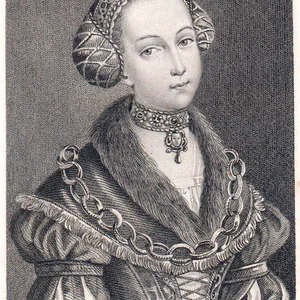

A Pomeranian noblewoman born around 1590, Sidonie von Borcke was accused of witchcraft and sentenced to death. Beheaded in 1620 in Stettin, her trial illustrates the violence of persecutions against women in the early modern period.
Sidonie von Borcke
Sidonie von Borcke
Allemagne
7 min read
Frequently asked questions
Key Facts
- Born around 1590 into a Pomeranian noble family
- Accused of witchcraft and making a pact with the devil
- Tried and sentenced to death by the ducal authorities of Pomerania
- Beheaded in Stettin (Szczecin) in 1620
- Her story inspired a novel and an opera in the 19th century (Carl Loewe, 1827)
Works & Achievements
The judicial documents recording the charges, interrogations, and sentence handed down against Sidonie von Borcke. These archives are the primary historical source on her case and illustrate the legal mechanisms of 17th-century witchcraft trials.
A Gothic novel inspired by Sidonie's fate, fraudulently presented as an authentic 17th-century chronicle. This work brought Sidonie von Borcke to the attention of readers across Europe and raised questions about the boundary between history and fiction.
An English translation of Meinhold's novel published by Jane Francesca Wilde (mother of Oscar Wilde), which brought Sidonie's story to English-speaking audiences. It reinforced the romantic and tragic image of this Pomeranian noblewoman accused of witchcraft.
Records from the Lutheran convent of Marienfließ documenting Sidonie's stays and conflicts there. These documents are a valuable primary source for understanding the living conditions of noblewomen forcibly placed in Protestant religious institutions.
Anecdotes
Born into an illustrious Pomeranian noble family, Sidonie von Borcke grew up in privileged circumstances but soon faced serious financial difficulties. Known for her haughty temperament and frequent conflicts with those around her, she was placed against her will in the Lutheran convent of Marienfließ, where her quarrels with the nuns fed her reputation as a dangerous woman.
The witchcraft accusations leveled against Sidonie rested on a widespread belief: she was blamed for the infertility and premature deaths of the Dukes of Pomerania, thereby condemning the House of Griffin to extinction. In a society where dynastic death was inconceivable without a supernatural cause, a solitary and defiant woman became the perfect scapegoat.
Her trial in Stettin in 1620 reflects the judicial machinery of the witch hunts: confessions extracted under torture, testimony from vengeful neighbors, accusations of casting spells and making a pact with the devil. Despite her noble rank, Sidonie received no protection and was sentenced to beheading followed by burning at the stake.
On September 28, 1620, Sidonie von Borcke was publicly executed in Stettin. Her execution came barely two years after the outbreak of the Thirty Years' War, against a backdrop of extreme religious and political tension across Europe. Her death stands as a tragic illustration of how political crises amplify persecution against women deemed 'troublesome.'
In the nineteenth century, the writer Wilhelm Meinhold transformed Sidonie's fate into a successful Gothic novel, 'Sidonia die Zauberin' (1838), presenting a fabricated text as an authentic seventeenth-century chronicle. This literary hoax was initially accepted as genuine by historians, revealing how the figure of the witch continues to fascinate and unsettle later generations.
Primary Sources
The depositions recorded during the interrogations report alleged bewitchments against members of the ducal house of Pomerania, and supposed pacts with evil spirits attributed to the accused.
The convent registers repeatedly mention conflicts between Sidonie von Borcke and the sisters of the convent, noting her behavior deemed seditious and her repeated refusals to submit to religious discipline.
Several ducal letters refer to the legal and patrimonial disputes of the von Borcke family, bearing witness to Sidonie's social marginalization well before her trial.
The pastoral account describes Sidonie's final moments, recounting her composure during the reading of the sentence and her brief statement before being led to the scaffold.
Key Places
Capital of the Duchy of Pomerania and the region's main judicial center, Stettin was the site of Sidonie von Borcke's trial and execution on September 28, 1620. The city stands as a symbol of the institutional brutality of witch hunts.
A Lutheran convent in Pomerania where Sidonie was forced to reside for many years. Her repeated conflicts with the nuns there fueled the damaging reputation that weighed heavily against her at trial.
The von Borcke family owned several lordships throughout Pomerania. It was in this declining noble milieu that Sidonie grew up, shaped by inheritance disputes that foreshadowed her future isolation.
Residence of the Pomeranian dukes of the House of Griffins, this castle was the seat of the power that Sidonie was accused of plotting against through witchcraft. The extinction of the ducal line was retrospectively attributed to her sorcery.
Typical Objects

A central object of Protestant piety in the 17th century, the Bible was present in every Lutheran convent. Sidonie, a resident at Marienfließ, was required to attend the daily services organized around the reading of Scripture.

Noblewomen in northern Germany in the early 17th century wore dark gowns with white lace collars, reflecting Lutheran austerity. Sidonie's clothing marked her rank while setting her apart from the convent's nuns.

Handwritten interrogation transcripts were the central document in criminal proceedings of the era. In Sidonie's case, these pages recorded the confessions obtained under duress that sealed her conviction.

Legally permitted in criminal proceedings of the early modern period, these instruments were used to 'extract the truth' from the accused. They were most likely used against Sidonie to force a confession of witchcraft.

The city of Stettin (now Szczecin) was the administrative and judicial center of Pomerania. Its court, whose official acts bore its seal, pronounced the death sentence against Sidonie.

Kept by the administrators of Lutheran convents, these registers recorded daily life, conflicts, and breaches of discipline. The entries relating to Sidonie bear witness to her isolation and rebellious character.
School Curriculum
Vocabulary & Tags
Key Vocabulary
Tags
Daily Life
Morning
At the Marienfließ convent, Sidonie was required to rise before dawn for Matins, sung in German according to Lutheran liturgy. She breakfasted simply on grain porridge and black bread in the common refectory, under the wary eyes of the sisters.
Afternoon
Afternoons were devoted to the manual work required in Protestant convents: sewing, embroidery, or help with household chores. For Sidonie, a noblewoman by birth forced into this communal life, these occupations represented a constant humiliation and a source of frequent conflict.
Evening
In the evening, after a frugal meal, the residents took part in a collective Bible reading led by the pastor or the prioress. Sidonie, described as resistant to discipline, reportedly often refused or disrupted these services, reinforcing her reputation as a 'possessed' woman in the eyes of the community.
Food
The diet at the Lutheran convent in Pomerania was simple and Nordic: rye bread, oat porridge, dried fish, cabbage, turnips, and apples in winter. The Pomeranian nobility also ate game and wheat beer at festive meals.
Clothing
Lutheran noblewomen wore long dark woolen gowns — black or slate gray — accented with a stiff white lace collar. A white linen coif covered the hair; modest dress was a mark of Protestant piety, even for women of rank.
Housing
The Lutheran convents of 17th-century Pomerania, repurposed from their medieval origins, were cold stone buildings with narrow cells furnished with a wooden bed, a chest, and a prayer kneeler. Sidonie, coming from the nobility, likely occupied a slightly better-appointed room than the ordinary nuns.
Historical Timeline
Period Vocabulary
Visual Style
Esthétique luthérienne austère du nord de l'Allemagne au début du XVIIe siècle, portraits sombres à la manière des maîtres flamands et germaniques, lumière froide et contrastée typique des pays baltes.
Sound Ambience
Une atmosphère sonore austère et froide mêlant le silence des couvents luthériens de Poméranie, le bruissement des procédures judiciaires et la rumeur d'une foule assistant à une exécution publique au cœur du XVIIe siècle.
Liens externes & ressources
Références
Œuvres
Actes du procès en sorcellerie de Stettin
1620
Sidonia die Zauberin (roman de Wilhelm Meinhold)
1838
Sidonia the Sorceress (traduction anglaise par Lady Wilde)
1849
Chroniques conventuelles de Marienfließ
1600-1619