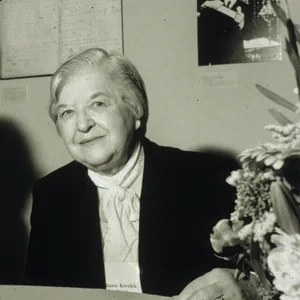

American chemist (1923-2014), Stephanie Kwolek invented Kevlar in 1965, a synthetic fiber five times stronger than steel. Her discovery revolutionized protective equipment and earned her numerous scientific distinctions.
Stephanie Kwolek(1923 — 2014)
Stephanie Kwolek
États-Unis, Pologne
8 min read
Frequently asked questions
Key Facts
- Born July 31, 1923, in New Kensington, Pennsylvania
- Joined DuPont laboratories in 1946 as a research chemist
- Invented Kevlar in 1965 while working on new lightweight fibers for the automotive industry
- Inducted into the National Inventors Hall of Fame in 1995
- Died June 18, 2014, in Wilmington, Delaware
Works & Achievements
Kwolek's landmark achievement: the synthesis of an aramid fiber five times stronger than steel at equal weight. This discovery revolutionized personal protective equipment, the aerospace industry, and numerous industrial fields.
The first patent describing the liquid-crystal solution that led to Kevlar. It stands as the founding document of the high-performance aramid fiber family and remains one of the most cited inventions in polymer literature.
A major publication co-authored by Kwolek detailing the mechanisms behind Kevlar fiber formation. It laid the theoretical groundwork for understanding lyotropic liquid-crystal polymers, opening the door to an entire generation of high-performance materials.
Over the course of her career, Kwolek filed more than seventeen patents in the fields of synthetic polymers and high-performance fibers, covering spinning processes, liquid-crystal solutions, and aromatic polyamides.
Kwolek took an active role in this national program aimed at encouraging young women to pursue careers in science and technology, leading lectures and workshops at numerous American high schools.
Anecdotes
In 1964, Stephanie Kwolek was working on synthesizing new polymers intended to lighten car tires. While filtering her experimental solution, she noticed something unusual: the liquid was cloudy and milky, whereas polymer solutions are normally clear. Unlike standard protocols, which called for discarding this type of solution, she insisted on spinning it. The technician at first refused, fearing damage to the machines, but Kwolek convinced him to try. The resulting filaments proved to be five times stronger than steel: Kevlar had just been discovered.
Stephanie Kwolek had originally planned to study medicine. To fund her education, she joined DuPont in 1946 as a chemist, expecting to stay only a few months. Captivated by polymer research, she never left. Her 'temporary career' ultimately lasted forty years and led to one of the most important discoveries of the twentieth century.
When Kwolek first submitted her results to her superiors, no one truly believed them. The solution she had obtained displayed such unusual optical properties — a birefringence visible to the naked eye — that her colleagues suspected a handling error. She had to repeat the experiments multiple times and have her results independently verified by the spectroscopy laboratory before DuPont took her discovery seriously.
Although Kwolek was the originator of Kevlar, the patent filed in 1965 belonged to DuPont, in keeping with the practices of the time. She never received royalties on the millions of bulletproof vests manufactured thanks to her invention. When asked about this, she replied that she found her reward in knowing that her discovery had saved thousands of lives — a satisfaction she considered priceless.
In 1994, at the age of 71, Stephanie Kwolek was inducted into the National Inventors Hall of Fame, joining figures such as Thomas Edison and Alexander Graham Bell. She became one of the very few women to receive that honor at the time, and continued until the end of her life to encourage young girls to pursue scientific careers, participating in educational programs and corresponding personally with high school students.
Primary Sources
Aromatic polyamide dopes having unique optical anisotropic properties are disclosed. The dopes are solutions of wholly aromatic polyamides in appropriate solvents. Filaments, fibers, films and other shaped articles having high tensile strength and high modulus may be prepared from these dopes.
I knew the solution was different from anything I had seen before. Instead of being clear and viscous, it was cloudy. The spinning technician didn't want to spin it because he thought it would plug up the spinneret. I had to convince him to try it anyway.
The spinning of these lyotropic liquid crystalline polyamide solutions by conventional wet or dry jet-wet spinning methods yields fibers with remarkable tensile properties, surpassing those of glass fibers and approaching those of steel wire at equivalent weight.
Science is not reserved for those born with a special instinct. It is open to anyone who observes carefully, questions persistently, and refuses to abandon what their eyes show them — even when others say it is impossible.
Key Places
Industrial town where Stephanie Kwolek was born in 1923, into a family of Polish immigrants. Her father, who died young, passed on to her a love of nature and careful observation — a curiosity that shaped her entire scientific career.
Institution (now part of Carnegie Mellon University) where Kwolek earned her chemistry degree in 1946. It was there that she developed her passion for research into synthetic materials.
Kwolek's workplace for forty years and the site of her discovery of Kevlar in 1965. DuPont's polymer research laboratory was at the time one of the most advanced in the world in that field.
The place where Kwolek was officially inducted in 1994, joining the pantheon of America's greatest inventors. She stands today as one of the most iconic female figures in industrial chemistry.
In 1996, Kwolek received the National Medal of Technology here from President Bill Clinton, a national recognition of forty years of research into synthetic materials.
Typical Objects

A laboratory tool pierced with tiny orifices used to extrude a polymer solution into filaments. It was through this device that Kwolek spun her cloudy solution, producing the first Kevlar fibers.

An optical instrument that detects the birefringence of liquids — the property of bending light in two directions. This instrument revealed to Kwolek that her polymer solution was liquid-crystalline, a phenomenon then unknown for that type of material.

An instrument that measures the viscosity of polymer solutions. Kwolek used it daily to characterize her experiments, and was intrigued by the unusually low viscosity of the solution that would become Kevlar.

The cloudy, milky solution of poly-paraphenylene terephthalamide in concentrated sulfuric acid that Kwolek refused to discard in 1964–1965. That simple beaker held the substance from which the first bulletproof vests would be made.

The most iconic application of Kwolek's discovery. The first models deployed in the 1970s weighed far less than earlier metal body armor while offering superior protection against projectiles.

DuPont researchers recorded every experiment in numbered, dated notebooks that held legal standing for patent filings. Kwolek's notebook documents the precise steps leading to the discovery of Kevlar.
School Curriculum
Vocabulary & Tags
Key Vocabulary
Tags
Daily Life
Morning
In the 1960s, Kwolek would arrive early at DuPont's Wilmington laboratory, often before most of her male colleagues. She would begin the day by reviewing her notes from the previous day and preparing her polymer solutions — a delicate operation requiring precise measurement of reagents in aggressive solvents such as concentrated sulfuric acid.
Afternoon
The afternoon was devoted to spinning experiments and measurements of the mechanical properties of the resulting fibers. Kwolek worked in close collaboration with laboratory technicians, discussing unusual results and adjusting temperature and concentration parameters in an environment that was still overwhelmingly male.
Evening
Back home in Wilmington, Kwolek enjoyed gardening and sewing — activities she described as a way of “switching sensory registers” after a day spent surrounded by solvent fumes. She regularly read specialized scientific journals and maintained a rich correspondence with other polymer researchers.
Food
The American diet in the 1960s was marked by the rise of processed foods and ready-made meals. Kwolek, of Polish descent, appreciated home cooking and the family recipes passed down by her mother. Meals in the DuPont cafeteria, common among researchers, were an opportunity for informal exchanges between colleagues.
Clothing
In the laboratory, Kwolek was required to wear a white lab coat, safety goggles, and solvent-resistant gloves — safety rules were strict at DuPont. Outside the laboratory, 1960s fashion dictated that women wear fitted dresses or suits, although female researchers gradually adopted more practical attire.
Housing
Kwolek lived in Wilmington, Delaware, close to the DuPont site, for most of her career and into retirement. The city, dominated by the chemical industry, offered a modest but lively setting animated by an active scientific community. She lived alone for most of her life, devoting her free time to sewing and gardening.
Historical Timeline
Period Vocabulary
Liens externes & ressources
Références
Œuvres
Découverte et synthèse du Kevlar (poly-paraphénylène téréphtalamide, PPTA)
1965
Brevet US 3,671,542 — 'Optically anisotropic aromatic polyamide dopes'
1965 (déposé), 1972 (accordé)
Article scientifique 'Preparation of Polymers with High Moduli from Stiff Chain Aromatic Polyamides'
1977
Plus de 17 brevets déposés chez DuPont
1946–1986
Engagement dans le programme éducatif 'Expanding Your Horizons'
années 1990–2000